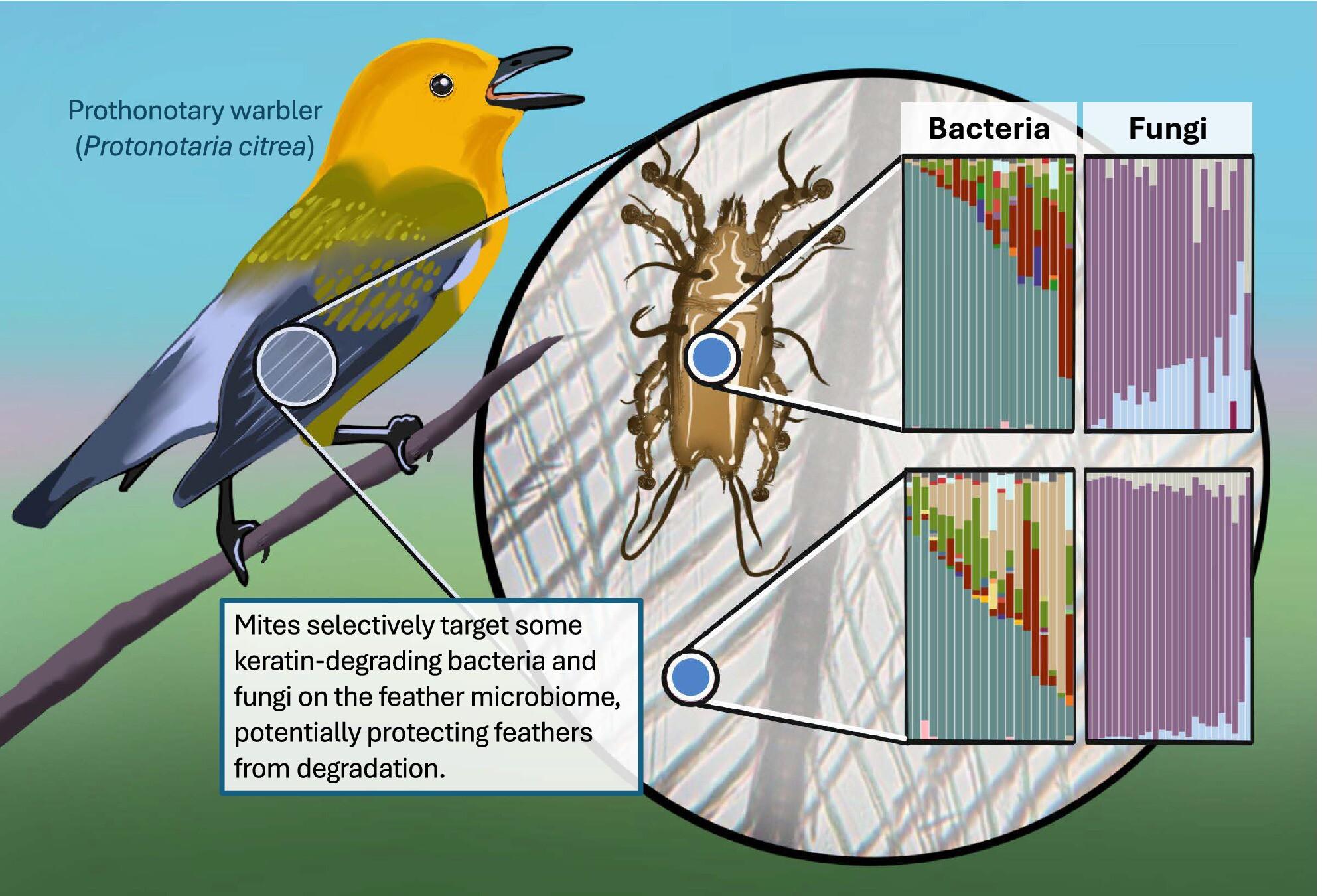
{"title":"Feather mites selectively feed on specific bacteria and fungi on feathers with potential benefits to hosts","authors":"Alice Risely","doi":"10.1111/1365-2656.70021","DOIUrl":null,"url":null,"abstract":"<p><b>Invited Research Highlight:</b> Matthews, A. E., Trevelline, B. K., Wijeratne, A. J., & Boves, T. J. (2024). Picky eaters: Selective microbial diet of avian ectosymbionts. <i>Journal of Animal Ecology</i>. Trophic interactions such as herbivory and predation are crucial regulators of ecological communities, yet few examples exist for these processes within host-associated microbiomes. In a recent study, Matthews et al. (2024) looked for evidence of selective microbial predation of bacteria and fungi by microscopic mites on the feathers of wild Prothonotary warblers (<i>Protonotaria citrea</i>). The authors quantified the bacterial and fungal diet of commensal feather mites and compared this with the composition of microbial communities living directly on the feather. They found that, despite a large variety of microbes to choose from, mites strongly preferred to eat a small number of bacterial and fungal genera. Some of these selectively enriched taxa are known keratin-degraders, suggesting that mites may protect feathers by selectively consuming harmful microbes. This study presents a rare example of a trophic interaction within the microscopic ecosystem of the feather that may act as an important force shaping microbial communities in ways that benefit the host, providing an overlooked mechanism by which symbioses between birds and mites could evolve.</p>","PeriodicalId":14934,"journal":{"name":"Journal of Animal Ecology","volume":"94 4","pages":"482-484"},"PeriodicalIF":3.7000,"publicationDate":"2025-02-25","publicationTypes":"Journal Article","fieldsOfStudy":null,"isOpenAccess":false,"openAccessPdf":"","citationCount":"0","resultStr":null,"platform":"Semanticscholar","paperid":null,"PeriodicalName":"Journal of Animal Ecology","FirstCategoryId":"93","ListUrlMain":"https://besjournals.onlinelibrary.wiley.com/doi/10.1111/1365-2656.70021","RegionNum":1,"RegionCategory":"环境科学与生态学","ArticlePicture":[],"TitleCN":null,"AbstractTextCN":null,"PMCID":null,"EPubDate":"","PubModel":"","JCR":"Q1","JCRName":"ECOLOGY","Score":null,"Total":0}
引用次数: 0
Abstract
Invited Research Highlight: Matthews, A. E., Trevelline, B. K., Wijeratne, A. J., & Boves, T. J. (2024). Picky eaters: Selective microbial diet of avian ectosymbionts. Journal of Animal Ecology. Trophic interactions such as herbivory and predation are crucial regulators of ecological communities, yet few examples exist for these processes within host-associated microbiomes. In a recent study, Matthews et al. (2024) looked for evidence of selective microbial predation of bacteria and fungi by microscopic mites on the feathers of wild Prothonotary warblers (Protonotaria citrea). The authors quantified the bacterial and fungal diet of commensal feather mites and compared this with the composition of microbial communities living directly on the feather. They found that, despite a large variety of microbes to choose from, mites strongly preferred to eat a small number of bacterial and fungal genera. Some of these selectively enriched taxa are known keratin-degraders, suggesting that mites may protect feathers by selectively consuming harmful microbes. This study presents a rare example of a trophic interaction within the microscopic ecosystem of the feather that may act as an important force shaping microbial communities in ways that benefit the host, providing an overlooked mechanism by which symbioses between birds and mites could evolve.
期刊介绍:
Journal of Animal Ecology publishes the best original research on all aspects of animal ecology, ranging from the molecular to the ecosystem level. These may be field, laboratory and theoretical studies utilising terrestrial, freshwater or marine systems.





 京公网安备 11010802042870号
京ICP备2023020795号-1
京公网安备 11010802042870号
京ICP备2023020795号-1

 分享
分享
 求助内容:
求助内容: 应助结果提醒方式:
 扫码关注我们
