Features of Structured, One-to-One Videoconference Interventions That Actively Engage People in the Management of Their Chronic Conditions: Scoping Review.
Yu-Ting Chen, Michelle Lehman, Toni Van Denend, Jacqueline Kish, Yue Wu, Katharine Preissner, Matthew Plow, Tanya L Packer
{"title":"Features of Structured, One-to-One Videoconference Interventions That Actively Engage People in the Management of Their Chronic Conditions: Scoping Review.","authors":"Yu-Ting Chen, Michelle Lehman, Toni Van Denend, Jacqueline Kish, Yue Wu, Katharine Preissner, Matthew Plow, Tanya L Packer","doi":"10.2196/58543","DOIUrl":null,"url":null,"abstract":"<p><strong>Background: </strong>A dramatic increase in the use of videoconferencing occurred as a response to the COVID-19 pandemic, including delivery of chronic disease management programs. With this increase, clients' openness to and confidence in receiving any type of telehealth care has dramatically improved. However, the rapidity of the response was accomplished with little time to learn from existing knowledge and research.</p><p><strong>Objective: </strong>The purpose of this scoping review was to identify features, barriers, and facilitators of synchronous videoconference interventions that actively engage clients in the management of chronic conditions.</p><p><strong>Methods: </strong>Using scoping review methodology, MEDLINE, CINAHL, and 6 other databases were searched from 2003 onward. The included studies reported on structured, one-on-one, synchronous videoconferencing interventions that actively engaged adults in the management of their chronic conditions at home. Studies reporting assessment or routine care were excluded. Extracted text data were analyzed using thematic analysis and published taxonomies.</p><p><strong>Results: </strong>The 33 included articles reported on 25 distinct programs. Most programs targeted people with neurological conditions (10/25, 40%) or cancer (7/25, 28%). Analysis using the Taxonomy of Every Day Self-Management Strategies and the Behavior Change Technique Taxonomy version 1 identified common program content and behavior change strategies. However, distinct differences were evident based on whether program objectives were to improve physical activity or function (7/25, 28%) or mental health (7/25, 28%). Incorporating healthy behaviors was addressed in all programs designed to improve physical activity or function, whereas only 14% (1/7) of the programs targeting mental health covered content about healthy lifestyles. Managing emotional distress and social interaction were commonly discussed in programs with objectives of improving mental health (6/25, 24% and 4/25, 16%, respectively) but not in programs aiming at physical function (2/25, 8% and 0%, respectively). In total, 13 types of behavior change strategies were identified in the 25 programs. The top 3 types of strategies applied in programs intent on improving physical activity or function were feedback and monitoring, goals and planning, and social support, in contrast to shaping knowledge, regulation, and identity in programs with the goal of improving mental health. The findings suggest that chronic condition interventions continue to neglect evidence that exercise and strong relationships improve both physical and mental health. Videoconference interventions were seen as feasible and acceptable to clients. Challenges were mostly technology related: clients' comfort, technology literacy, access to hardware and the internet, and technical breakdowns and issues. Only 15% (5/33) of the studies explicitly described compliance with health information or privacy protection regulations.</p><p><strong>Conclusions: </strong>Videoconferencing is a feasible and acceptable delivery format to engage clients in managing their conditions at home. Future program development could reduce siloed approaches by adding less used content and behavior change strategies. Addressing client privacy and technology issues should be priorities.</p>","PeriodicalId":16337,"journal":{"name":"Journal of Medical Internet Research","volume":"27 ","pages":"e58543"},"PeriodicalIF":6.0000,"publicationDate":"2025-02-26","publicationTypes":"Journal Article","fieldsOfStudy":null,"isOpenAccess":false,"openAccessPdf":"https://www.ncbi.nlm.nih.gov/pmc/articles/PMC11904366/pdf/","citationCount":"0","resultStr":null,"platform":"Semanticscholar","paperid":null,"PeriodicalName":"Journal of Medical Internet Research","FirstCategoryId":"3","ListUrlMain":"https://doi.org/10.2196/58543","RegionNum":2,"RegionCategory":"医学","ArticlePicture":[],"TitleCN":null,"AbstractTextCN":null,"PMCID":null,"EPubDate":"","PubModel":"","JCR":"Q1","JCRName":"HEALTH CARE SCIENCES & SERVICES","Score":null,"Total":0}
引用次数: 0
Abstract
Background: A dramatic increase in the use of videoconferencing occurred as a response to the COVID-19 pandemic, including delivery of chronic disease management programs. With this increase, clients' openness to and confidence in receiving any type of telehealth care has dramatically improved. However, the rapidity of the response was accomplished with little time to learn from existing knowledge and research.
Objective: The purpose of this scoping review was to identify features, barriers, and facilitators of synchronous videoconference interventions that actively engage clients in the management of chronic conditions.
Methods: Using scoping review methodology, MEDLINE, CINAHL, and 6 other databases were searched from 2003 onward. The included studies reported on structured, one-on-one, synchronous videoconferencing interventions that actively engaged adults in the management of their chronic conditions at home. Studies reporting assessment or routine care were excluded. Extracted text data were analyzed using thematic analysis and published taxonomies.
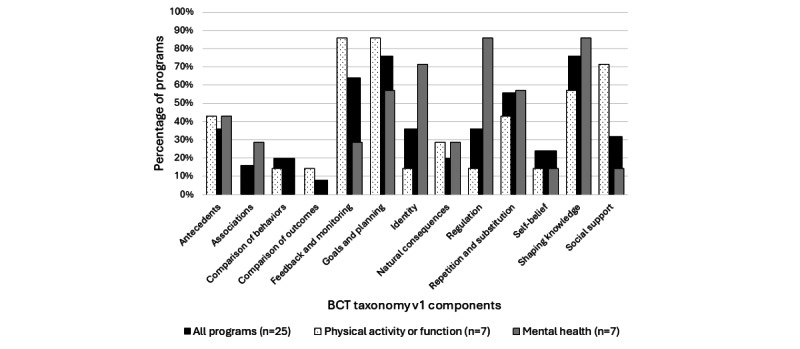
Results: The 33 included articles reported on 25 distinct programs. Most programs targeted people with neurological conditions (10/25, 40%) or cancer (7/25, 28%). Analysis using the Taxonomy of Every Day Self-Management Strategies and the Behavior Change Technique Taxonomy version 1 identified common program content and behavior change strategies. However, distinct differences were evident based on whether program objectives were to improve physical activity or function (7/25, 28%) or mental health (7/25, 28%). Incorporating healthy behaviors was addressed in all programs designed to improve physical activity or function, whereas only 14% (1/7) of the programs targeting mental health covered content about healthy lifestyles. Managing emotional distress and social interaction were commonly discussed in programs with objectives of improving mental health (6/25, 24% and 4/25, 16%, respectively) but not in programs aiming at physical function (2/25, 8% and 0%, respectively). In total, 13 types of behavior change strategies were identified in the 25 programs. The top 3 types of strategies applied in programs intent on improving physical activity or function were feedback and monitoring, goals and planning, and social support, in contrast to shaping knowledge, regulation, and identity in programs with the goal of improving mental health. The findings suggest that chronic condition interventions continue to neglect evidence that exercise and strong relationships improve both physical and mental health. Videoconference interventions were seen as feasible and acceptable to clients. Challenges were mostly technology related: clients' comfort, technology literacy, access to hardware and the internet, and technical breakdowns and issues. Only 15% (5/33) of the studies explicitly described compliance with health information or privacy protection regulations.
Conclusions: Videoconferencing is a feasible and acceptable delivery format to engage clients in managing their conditions at home. Future program development could reduce siloed approaches by adding less used content and behavior change strategies. Addressing client privacy and technology issues should be priorities.
期刊介绍:
The Journal of Medical Internet Research (JMIR) is a highly respected publication in the field of health informatics and health services. With a founding date in 1999, JMIR has been a pioneer in the field for over two decades.
As a leader in the industry, the journal focuses on digital health, data science, health informatics, and emerging technologies for health, medicine, and biomedical research. It is recognized as a top publication in these disciplines, ranking in the first quartile (Q1) by Impact Factor.
Notably, JMIR holds the prestigious position of being ranked #1 on Google Scholar within the "Medical Informatics" discipline.





 京公网安备 11010802042870号
京ICP备2023020795号-1
京公网安备 11010802042870号
京ICP备2023020795号-1

 分享
分享

 求助内容:
求助内容: 应助结果提醒方式:
 扫码关注我们
