Jisoo Kang, Cheolhyoung Park, Hanoul Yun, Chulhee Choi, Wonhyo Seo
{"title":"Engineered Exosomes Carrying Super-Repressor IκB Reduced Biliary Atresia-Induced Liver Fibrosis in Minipig and Mouse Models.","authors":"Jisoo Kang, Cheolhyoung Park, Hanoul Yun, Chulhee Choi, Wonhyo Seo","doi":"10.3390/pharmaceutics17020264","DOIUrl":null,"url":null,"abstract":"<p><p><b>Background and Aim:</b> Biliary atresia is a rare, progressive disease that affects the bile ducts in newborns. Persistent bile duct obstruction induces various pathological conditions, including jaundice, inflammation, and liver fibrosis; however, the exact pathogenesis of biliary atresia is not yet fully understood. Nuclear factor-κB (NF-κB) is widely acknowledged as a key regulator in the pathogenesis of hepatitis and liver fibrosis, and extensive research has been conducted to develop strategies to effectively inhibit its activity to mitigate liver damage. Exosome-based therapeutic platforms offer targeted NF-κB inhibition with low immunogenicity and enhanced liver-specific delivery. This study aimed to evaluate the therapeutic efficacy of Exo-SrIκB in treating cholestatic liver fibrosis using experimental animal models. <b>Methods:</b> Exo-SrIκB (an exosome-based therapy containing the super-repressor IκB protein) using EXPLOR technology (Exosome engineering for Protein Loading via Optically Reversible protein-protein interactions) to encapsulate the super repressor IκB (SrIκB) within exosomes. The therapeutic efficacy of Exo-SrIκB was assessed in minipig and mouse models with experimentally induced cholestatic liver disease. <b>Results:</b> Administration of Exo-SrIκB significantly attenuated liver fibrosis progression in both animal models by inhibiting NF-κB nuclear translocation and reducing the expression of fibrotic markers. Treated animals exhibited reduced collagen deposition, lower α-SMA levels, and improved hepatic function compared to untreated controls. <b>Conclusion:</b> Exo-SrIκB effectively suppressed NF-κB signaling and alleviated liver fibrosis in experimental cholestatic liver disease models, suggesting that exosome-based therapeutics may offer a targeted and biocompatible application to managing liver fibrosis and other chronic liver diseases.</p>","PeriodicalId":19894,"journal":{"name":"Pharmaceutics","volume":"17 2","pages":""},"PeriodicalIF":5.5000,"publicationDate":"2025-02-17","publicationTypes":"Journal Article","fieldsOfStudy":null,"isOpenAccess":false,"openAccessPdf":"https://www.ncbi.nlm.nih.gov/pmc/articles/PMC11859306/pdf/","citationCount":"0","resultStr":null,"platform":"Semanticscholar","paperid":null,"PeriodicalName":"Pharmaceutics","FirstCategoryId":"3","ListUrlMain":"https://doi.org/10.3390/pharmaceutics17020264","RegionNum":3,"RegionCategory":"医学","ArticlePicture":[],"TitleCN":null,"AbstractTextCN":null,"PMCID":null,"EPubDate":"","PubModel":"","JCR":"Q1","JCRName":"PHARMACOLOGY & PHARMACY","Score":null,"Total":0}
引用次数: 0
Abstract
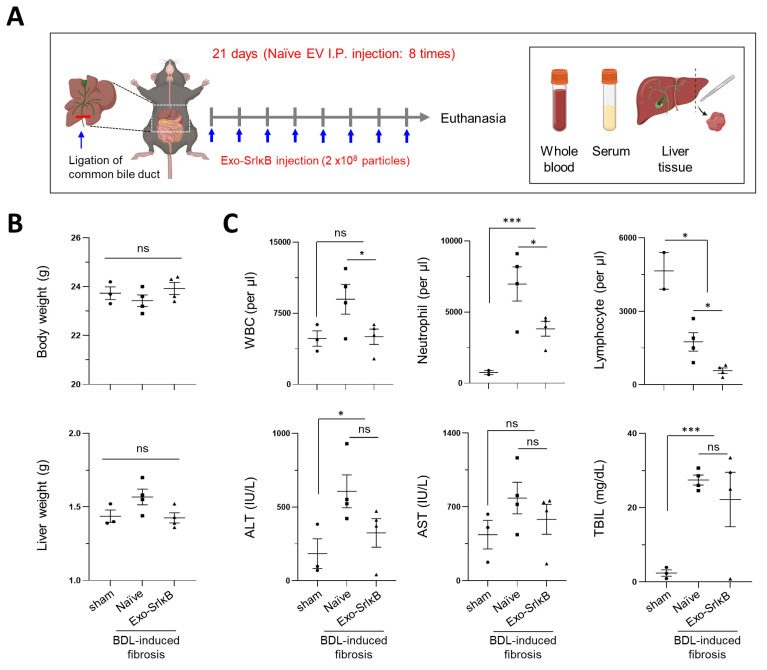
Background and Aim: Biliary atresia is a rare, progressive disease that affects the bile ducts in newborns. Persistent bile duct obstruction induces various pathological conditions, including jaundice, inflammation, and liver fibrosis; however, the exact pathogenesis of biliary atresia is not yet fully understood. Nuclear factor-κB (NF-κB) is widely acknowledged as a key regulator in the pathogenesis of hepatitis and liver fibrosis, and extensive research has been conducted to develop strategies to effectively inhibit its activity to mitigate liver damage. Exosome-based therapeutic platforms offer targeted NF-κB inhibition with low immunogenicity and enhanced liver-specific delivery. This study aimed to evaluate the therapeutic efficacy of Exo-SrIκB in treating cholestatic liver fibrosis using experimental animal models. Methods: Exo-SrIκB (an exosome-based therapy containing the super-repressor IκB protein) using EXPLOR technology (Exosome engineering for Protein Loading via Optically Reversible protein-protein interactions) to encapsulate the super repressor IκB (SrIκB) within exosomes. The therapeutic efficacy of Exo-SrIκB was assessed in minipig and mouse models with experimentally induced cholestatic liver disease. Results: Administration of Exo-SrIκB significantly attenuated liver fibrosis progression in both animal models by inhibiting NF-κB nuclear translocation and reducing the expression of fibrotic markers. Treated animals exhibited reduced collagen deposition, lower α-SMA levels, and improved hepatic function compared to untreated controls. Conclusion: Exo-SrIκB effectively suppressed NF-κB signaling and alleviated liver fibrosis in experimental cholestatic liver disease models, suggesting that exosome-based therapeutics may offer a targeted and biocompatible application to managing liver fibrosis and other chronic liver diseases.
背景与目的:胆道闭锁是一种罕见的影响新生儿胆管的进行性疾病。持续的胆管梗阻引起各种病理状况,包括黄疸、炎症和肝纤维化;然而,胆道闭锁的确切发病机制尚不完全清楚。核因子-κB (Nuclear factor-κB, NF-κB)被广泛认为是肝炎和肝纤维化发病机制的关键调节因子,目前已开展大量研究以制定有效抑制其活性以减轻肝损伤的策略。基于外泌体的治疗平台具有低免疫原性和增强肝脏特异性递送的靶向NF-κB抑制作用。本研究旨在通过实验动物模型评价exo - sri - κ b治疗胆汁淤积性肝纤维化的疗效。方法:exo - sri - κ b(一种包含超抑制因子i - κ b蛋白的基于外泌体的疗法)使用EXPLOR技术(Exosome engineering for protein Loading via optical Reversible protein-protein interactions)将超抑制因子i - κ b (sri - κ b)包封在外泌体内。exo - sri - κ b对实验性胆汁淤积性肝病小猪和小鼠模型的治疗效果进行了评价。结果:在两种动物模型中,exo - sri -κB通过抑制NF-κB核易位和降低纤维化标志物的表达,显著减轻肝纤维化进展。与未治疗的对照组相比,治疗动物表现出胶原沉积减少,α-SMA水平降低,肝功能改善。结论:exo - sri -κB有效抑制NF-κB信号通路,减轻实验性胆汁淤淤性肝病模型的肝纤维化,提示基于外泌体的治疗方法可能在治疗肝纤维化和其他慢性肝病方面具有靶向性和生物相容性。
PharmaceuticsPharmacology, Toxicology and Pharmaceutics-Pharmaceutical Science
CiteScore
7.90
自引率
11.10%
发文量
2379
审稿时长
16.41 days
期刊介绍:
Pharmaceutics (ISSN 1999-4923) is an open access journal which provides an advanced forum for the science and technology of pharmaceutics and biopharmaceutics. It publishes reviews, regular research papers, communications, and short notes. Covered topics include pharmacokinetics, toxicokinetics, pharmacodynamics, pharmacogenetics and pharmacogenomics, and pharmaceutical formulation. Our aim is to encourage scientists to publish their experimental and theoretical details in as much detail as possible. There is no restriction on the length of the papers. The full experimental details must be provided so that the results can be reproduced.






 京公网安备 11010802042870号
京ICP备2023020795号-1
京公网安备 11010802042870号
京ICP备2023020795号-1

 分享
分享
 求助内容:
求助内容: 应助结果提醒方式:
 扫码关注我们
