Dietary Plant-Based Mixture Improves Feed Efficiency, Gross Profit, Physiological Performance, Gene Expression and Gut Health of Nile Tilapia (Oreochromis niloticus).
Abdel-Fattah M El-Sayed, Mahougnon Simeon Fagnon, Amira M Hamdan, Thibaut Chabrillat, Sylvain Kerros, Salma M S Zeid
{"title":"Dietary Plant-Based Mixture Improves Feed Efficiency, Gross Profit, Physiological Performance, Gene Expression and Gut Health of Nile Tilapia (<i>Oreochromis niloticus</i>).","authors":"Abdel-Fattah M El-Sayed, Mahougnon Simeon Fagnon, Amira M Hamdan, Thibaut Chabrillat, Sylvain Kerros, Salma M S Zeid","doi":"10.3390/biology14020186","DOIUrl":null,"url":null,"abstract":"<p><p>The goal of this study was to evaluate the effect of the supplemental plant-based blend Phyto AquaNity (PAN) on growth, profitability and health status of Nile tilapia (<i>O. niloticus</i>) cultured in hapas. Juvenile fish of average weight 73 g were stocked in 2-m<sup>3</sup> hapas in triplicates at a density of 20 fish m<sup>-3</sup> (40 fish hapa<sup>-1</sup>). Four extruded diets were formulated following isonitrogenous (30% CP), isoenergetic (17 MJ kg<sup>-1</sup>) standards, with incorporation levels of 0, 0.25, 0.50, or 1.00 g of PAN kg<sup>-1</sup> diet. Fish were fed the experimental diets at a daily rate of 2-3% of their body weight (BW) over 80 days. From this study, results showed that growth performance and tissue composition were not significantly impacted by these treatments. Feed intake exhibited a significant reduction while feed efficiency was improved in the groups fed 0.5 g kg<sup>-1</sup>. Diets supplemented with PAN were also more profitable than the control diet, with 0.5 g kg<sup>-1</sup> indicating the highest return (9.24% increase). Digestive enzyme activity and hepatic enzyme activity were significantly improved with an increase in the level of PAN up to 0.50 g kg<sup>-1</sup>. In addition, immune parameters (lysozyme activity, alternative complement and phagocytic cells) and antioxidant enzymes (superoxide dismutase, glutathione peroxidase and catalase) were significantly enhanced with increasing PAN level up to 0.5 g kg<sup>-1</sup> (<i>p</i> < 0.05). Gene expression of cytokines was also upregulated in fish fed with PAN at levels of up to 0.5 g kg<sup>-1</sup> (<i>p</i> < 0.05). Moreover, the results showed that higher levels of PAN promoted the growth of beneficial bacteria while reducing the load of pathogenic bacteria. Additionally, intestinal fold length and goblet cell count were significantly increased in the group fed PAN up to 0.5 g kg<sup>-1</sup>. A quadratic regression analyses performed on feed efficiency, profitability, hepatic enzyme activity and gut microbial load revealed that 0.60-0.65 g kg<sup>-1</sup> of feed were the optimal dosages. Regarding immunological and antioxidant responses, the optimal dosages ranged between 0.75 and 0.85 g kg<sup>-1</sup>. Overall, about 0.60-0.85 g PAN kg<sup>-1</sup> feed is suggested for optimum performance, profitability, gut health and overall health status of Nile tilapia, depending on the target objective for which this product is added.</p>","PeriodicalId":48624,"journal":{"name":"Biology-Basel","volume":"14 2","pages":""},"PeriodicalIF":3.5000,"publicationDate":"2025-02-11","publicationTypes":"Journal Article","fieldsOfStudy":null,"isOpenAccess":false,"openAccessPdf":"https://www.ncbi.nlm.nih.gov/pmc/articles/PMC11852027/pdf/","citationCount":"0","resultStr":null,"platform":"Semanticscholar","paperid":null,"PeriodicalName":"Biology-Basel","FirstCategoryId":"99","ListUrlMain":"https://doi.org/10.3390/biology14020186","RegionNum":3,"RegionCategory":"生物学","ArticlePicture":[],"TitleCN":null,"AbstractTextCN":null,"PMCID":null,"EPubDate":"","PubModel":"","JCR":"Q1","JCRName":"BIOLOGY","Score":null,"Total":0}
引用次数: 0
Abstract
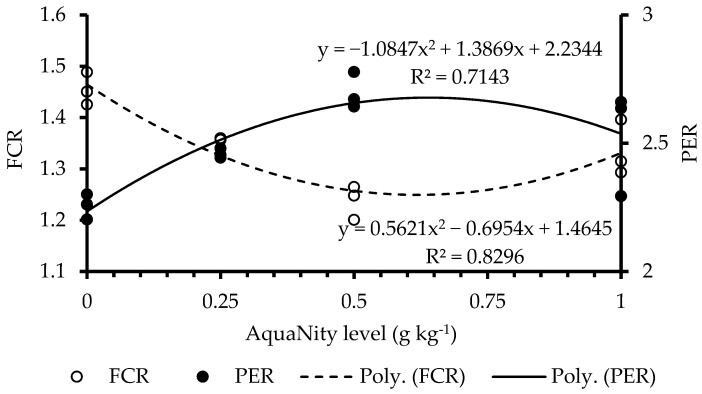
The goal of this study was to evaluate the effect of the supplemental plant-based blend Phyto AquaNity (PAN) on growth, profitability and health status of Nile tilapia (O. niloticus) cultured in hapas. Juvenile fish of average weight 73 g were stocked in 2-m3 hapas in triplicates at a density of 20 fish m-3 (40 fish hapa-1). Four extruded diets were formulated following isonitrogenous (30% CP), isoenergetic (17 MJ kg-1) standards, with incorporation levels of 0, 0.25, 0.50, or 1.00 g of PAN kg-1 diet. Fish were fed the experimental diets at a daily rate of 2-3% of their body weight (BW) over 80 days. From this study, results showed that growth performance and tissue composition were not significantly impacted by these treatments. Feed intake exhibited a significant reduction while feed efficiency was improved in the groups fed 0.5 g kg-1. Diets supplemented with PAN were also more profitable than the control diet, with 0.5 g kg-1 indicating the highest return (9.24% increase). Digestive enzyme activity and hepatic enzyme activity were significantly improved with an increase in the level of PAN up to 0.50 g kg-1. In addition, immune parameters (lysozyme activity, alternative complement and phagocytic cells) and antioxidant enzymes (superoxide dismutase, glutathione peroxidase and catalase) were significantly enhanced with increasing PAN level up to 0.5 g kg-1 (p < 0.05). Gene expression of cytokines was also upregulated in fish fed with PAN at levels of up to 0.5 g kg-1 (p < 0.05). Moreover, the results showed that higher levels of PAN promoted the growth of beneficial bacteria while reducing the load of pathogenic bacteria. Additionally, intestinal fold length and goblet cell count were significantly increased in the group fed PAN up to 0.5 g kg-1. A quadratic regression analyses performed on feed efficiency, profitability, hepatic enzyme activity and gut microbial load revealed that 0.60-0.65 g kg-1 of feed were the optimal dosages. Regarding immunological and antioxidant responses, the optimal dosages ranged between 0.75 and 0.85 g kg-1. Overall, about 0.60-0.85 g PAN kg-1 feed is suggested for optimum performance, profitability, gut health and overall health status of Nile tilapia, depending on the target objective for which this product is added.
本研究的目的是评估添加植物基混合植物水(PAN)对尼罗罗非鱼(O. niloticus)生长、盈利能力和健康状况的影响。平均体重73 g的幼鱼以20条鱼/ m-3(40条鱼/ a-1)的密度分3次放养,每组2-m3。按等氮(30% CP)、等能(17 MJ kg-1)标准配制4种挤压饲粮,分别添加0、0.25、0.50和1.00 g PAN kg-1饲粮。在80天内,按体重的2-3%饲喂试验饲料。本研究结果表明,这些处理对生长性能和组织组成没有显著影响。饲喂0.5 g kg-1组采食量显著降低,饲料效率显著提高。饲粮中添加PAN的收益也高于对照组,以0.5 g kg-1回报最高(提高9.24%)。随着PAN添加量的增加,消化酶活性和肝酶活性显著提高,添加量可达0.50 g kg-1。此外,随着PAN水平的升高(0.5 g kg-1),免疫指标(溶菌酶活性、替代补体和吞噬细胞)和抗氧化酶(超氧化物歧化酶、谷胱甘肽过氧化物酶和过氧化氢酶)均显著升高(p < 0.05)。在饲料中添加0.5 g kg-1时,细胞因子的基因表达也上调(p < 0.05)。此外,高水平的PAN促进了有益菌的生长,同时减少了致病菌的负荷。此外,饲粮添加至0.5 g kg-1时,肠道折叠长度和杯状细胞数量显著增加。对饲料效率、盈利能力、肝酶活性和肠道微生物负荷进行二次回归分析,结果表明0.60 ~ 0.65 g kg-1为最佳饲料添加量。关于免疫和抗氧化反应,最佳剂量范围为0.75至0.85 g kg-1。总体而言,根据添加该产品的目标目标,建议约0.60-0.85 g PAN kg-1饲料可获得尼罗罗非鱼的最佳性能、盈利能力、肠道健康和整体健康状况。
期刊介绍:
Biology (ISSN 2079-7737) is an international, peer-reviewed, quick-refereeing open access journal of Biological Science published by MDPI online. It publishes reviews, research papers and communications in all areas of biology and at the interface of related disciplines. Our aim is to encourage scientists to publish their experimental and theoretical results in as much detail as possible. There is no restriction on the length of the papers. The full experimental details must be provided so that the results can be reproduced. Electronic files regarding the full details of the experimental procedure, if unable to be published in a normal way, can be deposited as supplementary material.






 京公网安备 11010802042870号
京ICP备2023020795号-1
京公网安备 11010802042870号
京ICP备2023020795号-1

 分享
分享
 求助内容:
求助内容: 应助结果提醒方式:
 扫码关注我们
