John Chamberlain, Stuart D Dowall, Jack Smith, Geoff Pearson, Victoria Graham, John Raynes, Roger Hewson
{"title":"Attenuation of Chikungunya Virus by a Single Amino Acid Substitution in the nsP1 Component of a Non-Structural Polyprotein.","authors":"John Chamberlain, Stuart D Dowall, Jack Smith, Geoff Pearson, Victoria Graham, John Raynes, Roger Hewson","doi":"10.3390/v17020281","DOIUrl":null,"url":null,"abstract":"<p><p>Chikungunya virus (CHIKV) is a mosquito-transmitted alphavirus that, since its re-emergence in 2004, has become recognised as a major public health concern throughout many tropical and sub-tropical regions of the world. Amongst the insights gained from studies on other alphaviruses, several key determinants of virulence have been identified, including one present at the P3 position in the nsP1/nsP2 cleavage domain of the S.A.AR86 Sindbis (SINV) strain. This strain is associated with neurovirulence in adult mice; however, when a threonine-to-isoleucine substitution is engineered at this P3 position, an attenuated phenotype results. A reverse genetics system was developed to evaluate the phenotype that resulted from the substitution of alanine, present at the P3 position in the wild-type CHIKV clone, with valine. The A533V-mutant CHIKV induced milder disease symptoms in the C57BL/6 mouse model than the wild-type virus, in terms of severity of inflammation, length of viraemic period, and histological changes. Furthermore, the induction of type I IFN occurred more rapidly in both CHIKV-infected cell cultures and the mouse model with the mutant CHIKV.</p>","PeriodicalId":49328,"journal":{"name":"Viruses-Basel","volume":"17 2","pages":""},"PeriodicalIF":3.5000,"publicationDate":"2025-02-18","publicationTypes":"Journal Article","fieldsOfStudy":null,"isOpenAccess":false,"openAccessPdf":"https://www.ncbi.nlm.nih.gov/pmc/articles/PMC11860493/pdf/","citationCount":"0","resultStr":null,"platform":"Semanticscholar","paperid":null,"PeriodicalName":"Viruses-Basel","FirstCategoryId":"3","ListUrlMain":"https://doi.org/10.3390/v17020281","RegionNum":3,"RegionCategory":"医学","ArticlePicture":[],"TitleCN":null,"AbstractTextCN":null,"PMCID":null,"EPubDate":"","PubModel":"","JCR":"Q2","JCRName":"VIROLOGY","Score":null,"Total":0}
引用次数: 0
Abstract
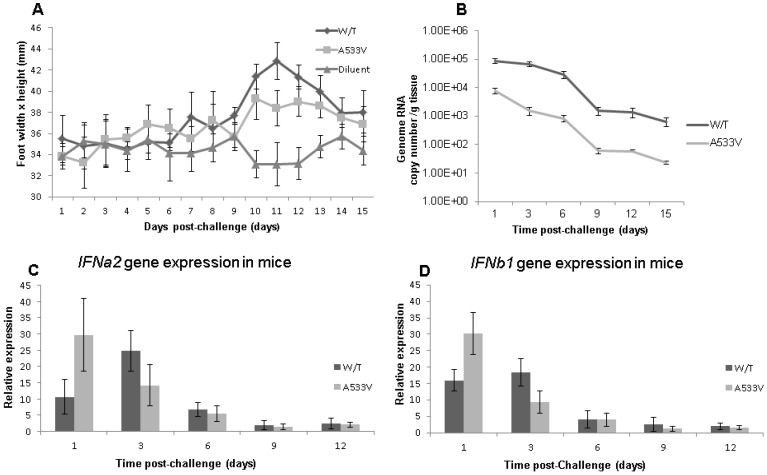
Chikungunya virus (CHIKV) is a mosquito-transmitted alphavirus that, since its re-emergence in 2004, has become recognised as a major public health concern throughout many tropical and sub-tropical regions of the world. Amongst the insights gained from studies on other alphaviruses, several key determinants of virulence have been identified, including one present at the P3 position in the nsP1/nsP2 cleavage domain of the S.A.AR86 Sindbis (SINV) strain. This strain is associated with neurovirulence in adult mice; however, when a threonine-to-isoleucine substitution is engineered at this P3 position, an attenuated phenotype results. A reverse genetics system was developed to evaluate the phenotype that resulted from the substitution of alanine, present at the P3 position in the wild-type CHIKV clone, with valine. The A533V-mutant CHIKV induced milder disease symptoms in the C57BL/6 mouse model than the wild-type virus, in terms of severity of inflammation, length of viraemic period, and histological changes. Furthermore, the induction of type I IFN occurred more rapidly in both CHIKV-infected cell cultures and the mouse model with the mutant CHIKV.
期刊介绍:
Viruses (ISSN 1999-4915) is an open access journal which provides an advanced forum for studies of viruses. It publishes reviews, regular research papers, communications, conference reports and short notes. Our aim is to encourage scientists to publish their experimental and theoretical results in as much detail as possible. There is no restriction on the length of the papers. The full experimental details must be provided so that the results can be reproduced. We also encourage the publication of timely reviews and commentaries on topics of interest to the virology community and feature highlights from the virology literature in the ''News and Views'' section. Electronic files or software regarding the full details of the calculation and experimental procedure, if unable to be published in a normal way, can be deposited as supplementary material.





 京公网安备 11010802042870号
京ICP备2023020795号-1
京公网安备 11010802042870号
京ICP备2023020795号-1

 分享
分享
 求助内容:
求助内容: 应助结果提醒方式:
 扫码关注我们
