Mónica López-Redondo, Davinia Vicente-Campos, Javier Álvarez-González, Alberto Roldán-Ruiz, Sandra Sánchez-Jorge, Jorge Buffet-García, Gabriel Rabanal-Rodríguez, Juan Antonio Valera-Calero
{"title":"Association of Quadratus Lumborum Muscle Stiffness with Chronic Low Back Pain Features: An Observational Study.","authors":"Mónica López-Redondo, Davinia Vicente-Campos, Javier Álvarez-González, Alberto Roldán-Ruiz, Sandra Sánchez-Jorge, Jorge Buffet-García, Gabriel Rabanal-Rodríguez, Juan Antonio Valera-Calero","doi":"10.3390/medicina61020270","DOIUrl":null,"url":null,"abstract":"<p><p><i>Background and Objectives</i>: Low back pain (LBP) is highly prevalent and often associated with altered muscle function, including in the quadratus lumborum (QL) muscle. While some studies have highlighted the clinical relevance of QL muscle stiffness in LBP, the findings remain inconsistent, and the role of this parameter in relation to clinical severity indicators is not well understood. Considering the high prevalence of myofascial trigger points among patients, objectively and reliably quantifying QL stiffness and its association with other clinical parameters could improve the identification of early stages of the condition before other alterations become apparent. Therefore, this study aimed to explore the association between QL stiffness and multiple indicators of LBP severity. <i>Materials and Methods</i>: A cross-sectional observational study was conducted involving the participation of seventy-six patients suffering from chronic LBP. An ultrasound scanner with shear-wave elastography (SWE) was used to determine the participants' QL stiffness. Additional information was collected on LBP-associated pain intensity, disability, central sensitization, and quality of life. <i>Results</i>: QL muscle stiffness was negatively correlated with pain intensity (<i>p</i> < 0.01) and central sensitization (<i>p</i> < 0.01), and it was positively correlated with physical quality of life (<i>p</i> < 0.01). Muscle stiffness influenced the variance in pain intensity along with physical quality of life, central sensitization, and chronicity (together explaining 49% of the variance) but did not explain the variance in central sensitization. <i>Conclusions</i>: Assessing QL muscle stiffness in patients with LBP is recommended, as greater muscle softness is linked to higher pain intensity, central sensitization, and poorer physical quality of life. Regression analyses further highlighted that QL stiffness helps explain the variance in pain intensity, physical quality of life, central sensitization, and chronicity, but it did not directly affect the central sensitization variance.</p>","PeriodicalId":49830,"journal":{"name":"Medicina-Lithuania","volume":"61 2","pages":""},"PeriodicalIF":2.4000,"publicationDate":"2025-02-05","publicationTypes":"Journal Article","fieldsOfStudy":null,"isOpenAccess":false,"openAccessPdf":"https://www.ncbi.nlm.nih.gov/pmc/articles/PMC11857607/pdf/","citationCount":"0","resultStr":null,"platform":"Semanticscholar","paperid":null,"PeriodicalName":"Medicina-Lithuania","FirstCategoryId":"3","ListUrlMain":"https://doi.org/10.3390/medicina61020270","RegionNum":4,"RegionCategory":"医学","ArticlePicture":[],"TitleCN":null,"AbstractTextCN":null,"PMCID":null,"EPubDate":"","PubModel":"","JCR":"Q1","JCRName":"MEDICINE, GENERAL & INTERNAL","Score":null,"Total":0}
引用次数: 0
Abstract
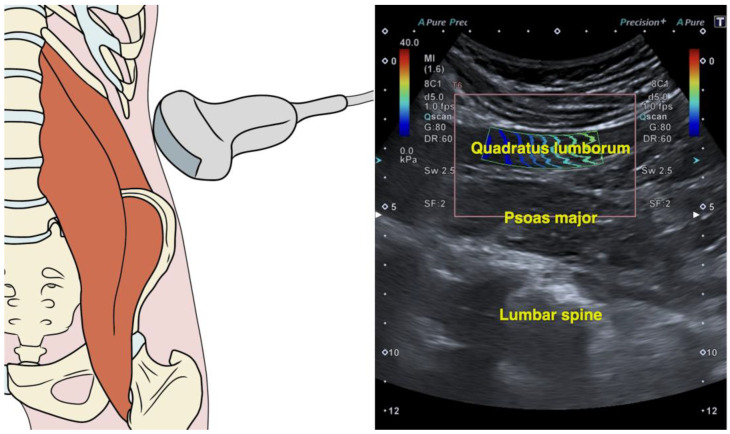
Background and Objectives: Low back pain (LBP) is highly prevalent and often associated with altered muscle function, including in the quadratus lumborum (QL) muscle. While some studies have highlighted the clinical relevance of QL muscle stiffness in LBP, the findings remain inconsistent, and the role of this parameter in relation to clinical severity indicators is not well understood. Considering the high prevalence of myofascial trigger points among patients, objectively and reliably quantifying QL stiffness and its association with other clinical parameters could improve the identification of early stages of the condition before other alterations become apparent. Therefore, this study aimed to explore the association between QL stiffness and multiple indicators of LBP severity. Materials and Methods: A cross-sectional observational study was conducted involving the participation of seventy-six patients suffering from chronic LBP. An ultrasound scanner with shear-wave elastography (SWE) was used to determine the participants' QL stiffness. Additional information was collected on LBP-associated pain intensity, disability, central sensitization, and quality of life. Results: QL muscle stiffness was negatively correlated with pain intensity (p < 0.01) and central sensitization (p < 0.01), and it was positively correlated with physical quality of life (p < 0.01). Muscle stiffness influenced the variance in pain intensity along with physical quality of life, central sensitization, and chronicity (together explaining 49% of the variance) but did not explain the variance in central sensitization. Conclusions: Assessing QL muscle stiffness in patients with LBP is recommended, as greater muscle softness is linked to higher pain intensity, central sensitization, and poorer physical quality of life. Regression analyses further highlighted that QL stiffness helps explain the variance in pain intensity, physical quality of life, central sensitization, and chronicity, but it did not directly affect the central sensitization variance.
期刊介绍:
The journal’s main focus is on reviews as well as clinical and experimental investigations. The journal aims to advance knowledge related to problems in medicine in developing countries as well as developed economies, to disseminate research on global health, and to promote and foster prevention and treatment of diseases worldwide. MEDICINA publications cater to clinicians, diagnosticians and researchers, and serve as a forum to discuss the current status of health-related matters and their impact on a global and local scale.



 京公网安备 11010802042870号
京ICP备2023020795号-1
京公网安备 11010802042870号
京ICP备2023020795号-1

 分享
分享
 求助内容:
求助内容: 应助结果提醒方式:
 扫码关注我们
