{"title":"Boron Nanocomposites for Boron Neutron Capture Therapy and in Biomedicine: Evolvement and Challenges.","authors":"Farooq Ahmad","doi":"10.34133/bmr.0145","DOIUrl":null,"url":null,"abstract":"<p><p>Cancer remains a major concern for human health worldwide. To fight the curse of cancer, boron neutron capture therapy is an incredibly advantageous modality in the treatment of cancer as compared to other radiotherapies. Due to tortuous vasculature in and around tumor regions, boron (<sup>10</sup>B) compounds preferentially house into tumor cells, creating a large dose gradient between the highly mingled cancer cells and normal cells. Epithermal or thermal neutron bombardment leads to tumor-cell-selective killing due to the generation of heavy particles yielded from in situ fission reaction. However, the major challenges for boron nanocomposites' development have been from the synthesis part as well as the requirement for selective cancer targeting and the delivery of therapeutic concentrations of boron (<sup>10</sup>B) with nominal healthy tissue accumulation and retention. To circumvent the above challenges, this review discusses boride nanocomposite design, safety, and biocompatibility for biomedical applications for general public use. This review sparks interest in using boron nanocomposites as boron neutron capture therapy agents and repurposing them in comorbidity treatments, with future scientific challenges and opportunities, with a hope to accelerate the stimulus of developing possible boron composite nanomedicine research and applications worldwide.</p>","PeriodicalId":93902,"journal":{"name":"Biomaterials research","volume":"29 ","pages":"0145"},"PeriodicalIF":9.8000,"publicationDate":"2025-02-25","publicationTypes":"Journal Article","fieldsOfStudy":null,"isOpenAccess":false,"openAccessPdf":"https://www.ncbi.nlm.nih.gov/pmc/articles/PMC11850861/pdf/","citationCount":"0","resultStr":null,"platform":"Semanticscholar","paperid":null,"PeriodicalName":"Biomaterials research","FirstCategoryId":"1085","ListUrlMain":"https://doi.org/10.34133/bmr.0145","RegionNum":0,"RegionCategory":null,"ArticlePicture":[],"TitleCN":null,"AbstractTextCN":null,"PMCID":null,"EPubDate":"2025/1/1 0:00:00","PubModel":"eCollection","JCR":"Q1","JCRName":"ENGINEERING, BIOMEDICAL","Score":null,"Total":0}
引用次数: 0
Abstract
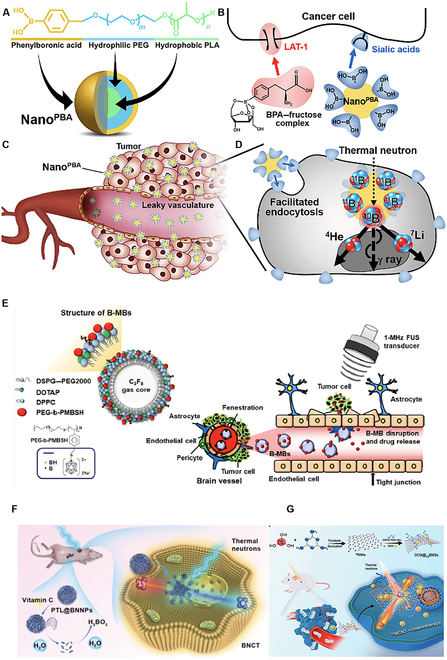
Cancer remains a major concern for human health worldwide. To fight the curse of cancer, boron neutron capture therapy is an incredibly advantageous modality in the treatment of cancer as compared to other radiotherapies. Due to tortuous vasculature in and around tumor regions, boron (10B) compounds preferentially house into tumor cells, creating a large dose gradient between the highly mingled cancer cells and normal cells. Epithermal or thermal neutron bombardment leads to tumor-cell-selective killing due to the generation of heavy particles yielded from in situ fission reaction. However, the major challenges for boron nanocomposites' development have been from the synthesis part as well as the requirement for selective cancer targeting and the delivery of therapeutic concentrations of boron (10B) with nominal healthy tissue accumulation and retention. To circumvent the above challenges, this review discusses boride nanocomposite design, safety, and biocompatibility for biomedical applications for general public use. This review sparks interest in using boron nanocomposites as boron neutron capture therapy agents and repurposing them in comorbidity treatments, with future scientific challenges and opportunities, with a hope to accelerate the stimulus of developing possible boron composite nanomedicine research and applications worldwide.






 京公网安备 11010802042870号
京ICP备2023020795号-1
京公网安备 11010802042870号
京ICP备2023020795号-1

 分享
分享

 求助内容:
求助内容: 应助结果提醒方式:
 扫码关注我们
