Xiaoyi Li, Wannian Yan, Yucheng Wang, Ru-jia Yu, Huanxing Han and Pengfei Zhang*,
{"title":"Plasmon-Enhanced Quantum Dot Nanobead-Based Lateral Flow Assay with Lower Background and Improved Sensitivity","authors":"Xiaoyi Li, Wannian Yan, Yucheng Wang, Ru-jia Yu, Huanxing Han and Pengfei Zhang*, ","doi":"10.1021/acsanm.4c07090","DOIUrl":null,"url":null,"abstract":"<p >Developing a fluorescence lateral flow assay (LFA) is of great importance for achieving ultrasensitive, quantitative, and rapid testing of clinical specimens at point-of-care. However, the fluorescent quantum dot (QD) nanobeads currently used in LFA still have drawbacks, such as large particle size, which leads to high background, easy aggregation, and poor fluidity. To address this issue, a promising strategy is to utilize plasmonic energy transfer from gold nanoparticles to QDs to create smaller and brighter fluorescent nanobeads without simply increasing the amount of QDs encapsulated in one nanobead. In this study, we prepared plasmon-enhanced quantum dot nanobeads (PEQNBs) by encapsulating gold nanoparticles and QDs into polymer nanobeads using a versatile emulsion-solvent evaporation method. As low as about 4000 PEQNB nanoparticles were detected using a gel imager, which is 14.6 times less nanoparticles than that of QD nanobeads of a similar size. The PEQNB-based LFA for interleukin-6 detection exhibited a higher fluorescence intensity and lower background signal than QD nanobeads of similar size. Moreover, compared to larger-sized QD nanobeads with an average diameter of 131.1 nm, PEQNB with an average diameter of 78.6 nm-based LFA exhibited similar levels of fluorescence intensity but 1.55-fold lower background signal and 1.44-fold lower detection limits. The detection limit of PEQNB-based LFA for IL-6 detection can be as low as 13.1 pg/mL in human serum samples. This work demonstrated that optimized plasmon-enhanced QD nanobeads can further increase the sensitivity and lower the background signals of ultrasensitive fluorescent LFA for disease diagnosis at point-of-care.</p>","PeriodicalId":6,"journal":{"name":"ACS Applied Nano Materials","volume":"8 8","pages":"4120–4128 4120–4128"},"PeriodicalIF":5.5000,"publicationDate":"2025-02-18","publicationTypes":"Journal Article","fieldsOfStudy":null,"isOpenAccess":false,"openAccessPdf":"","citationCount":"0","resultStr":null,"platform":"Semanticscholar","paperid":null,"PeriodicalName":"ACS Applied Nano Materials","FirstCategoryId":"88","ListUrlMain":"https://pubs.acs.org/doi/10.1021/acsanm.4c07090","RegionNum":2,"RegionCategory":"材料科学","ArticlePicture":[],"TitleCN":null,"AbstractTextCN":null,"PMCID":null,"EPubDate":"","PubModel":"","JCR":"Q2","JCRName":"MATERIALS SCIENCE, MULTIDISCIPLINARY","Score":null,"Total":0}
引用次数: 0
Abstract
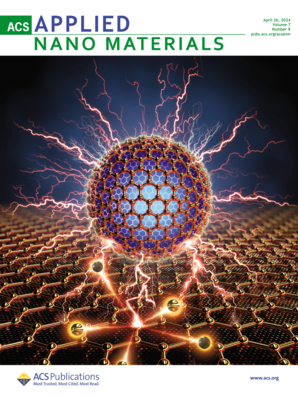
Developing a fluorescence lateral flow assay (LFA) is of great importance for achieving ultrasensitive, quantitative, and rapid testing of clinical specimens at point-of-care. However, the fluorescent quantum dot (QD) nanobeads currently used in LFA still have drawbacks, such as large particle size, which leads to high background, easy aggregation, and poor fluidity. To address this issue, a promising strategy is to utilize plasmonic energy transfer from gold nanoparticles to QDs to create smaller and brighter fluorescent nanobeads without simply increasing the amount of QDs encapsulated in one nanobead. In this study, we prepared plasmon-enhanced quantum dot nanobeads (PEQNBs) by encapsulating gold nanoparticles and QDs into polymer nanobeads using a versatile emulsion-solvent evaporation method. As low as about 4000 PEQNB nanoparticles were detected using a gel imager, which is 14.6 times less nanoparticles than that of QD nanobeads of a similar size. The PEQNB-based LFA for interleukin-6 detection exhibited a higher fluorescence intensity and lower background signal than QD nanobeads of similar size. Moreover, compared to larger-sized QD nanobeads with an average diameter of 131.1 nm, PEQNB with an average diameter of 78.6 nm-based LFA exhibited similar levels of fluorescence intensity but 1.55-fold lower background signal and 1.44-fold lower detection limits. The detection limit of PEQNB-based LFA for IL-6 detection can be as low as 13.1 pg/mL in human serum samples. This work demonstrated that optimized plasmon-enhanced QD nanobeads can further increase the sensitivity and lower the background signals of ultrasensitive fluorescent LFA for disease diagnosis at point-of-care.
期刊介绍:
ACS Applied Nano Materials is an interdisciplinary journal publishing original research covering all aspects of engineering, chemistry, physics and biology relevant to applications of nanomaterials. The journal is devoted to reports of new and original experimental and theoretical research of an applied nature that integrate knowledge in the areas of materials, engineering, physics, bioscience, and chemistry into important applications of nanomaterials.





 京公网安备 11010802042870号
京ICP备2023020795号-1
京公网安备 11010802042870号
京ICP备2023020795号-1

 分享
分享
 求助内容:
求助内容: 应助结果提醒方式:
 扫码关注我们
