{"title":"Forsythin-Loaded PET Membrane with Variable Wettability to Construct a Double-Layer Dressing for Wound Healing","authors":"Yubo Ren, Shuaijie Li, Jingjun Dong, Zhihui Zhao, Zunyuan Wang, Guoxin Wang, Xiaoming Li* and Weichao Chen*, ","doi":"10.1021/acsapm.4c03020","DOIUrl":null,"url":null,"abstract":"<p >The urgent need for efficient wound dressing requires comfortability, reasonable humidity, and anti-inflammatory and pathogen anti-infectivity properties. Herein, the PET micronanofiber pads loaded with forsythin (FT) are successfully designed and prepared by electrospinning. The asymmetric wettability double-layer micronanofiber pad (PET@FT<sub>10%</sub>/PET) has been developed by utilizing the hydrophobic properties of PET. The addition of FT endows super hydrophobic PET with excellent hydrophilic properties and absorbent properties to ensure the dryness of the wound environment. Meanwhile, the hydrophobic PET layer avoids the adhesion of dust and bacteria, providing a barrier to prevent pollution of the complex external environment for the drug-carrying layer. Furthermore, the PET@FT<sub>10%</sub>/PET double-layer micronanofiber pad provides favorable conditions for wound healing with the validation by inhibition of representative pathogens <i>Escherichia coli</i> and <i>Staphylococcus aureus</i>, and the expression of pro-inflammatory factors (IL-6 and TNF-α), and the cell survival rate also achieved excellent results. Therefore, the PET@FT<sub>10%</sub>/PET double-layer micronanofiber pad designed in this paper provides a neoteric strategy with an asymmetric structure design to avoid contamination and accelerate drug delivery for wound healing.</p>","PeriodicalId":7,"journal":{"name":"ACS Applied Polymer Materials","volume":"7 4","pages":"2195–2205 2195–2205"},"PeriodicalIF":5.2000,"publicationDate":"2025-02-09","publicationTypes":"Journal Article","fieldsOfStudy":null,"isOpenAccess":false,"openAccessPdf":"","citationCount":"0","resultStr":null,"platform":"Semanticscholar","paperid":null,"PeriodicalName":"ACS Applied Polymer Materials","FirstCategoryId":"92","ListUrlMain":"https://pubs.acs.org/doi/10.1021/acsapm.4c03020","RegionNum":2,"RegionCategory":"化学","ArticlePicture":[],"TitleCN":null,"AbstractTextCN":null,"PMCID":null,"EPubDate":"","PubModel":"","JCR":"Q2","JCRName":"MATERIALS SCIENCE, MULTIDISCIPLINARY","Score":null,"Total":0}
引用次数: 0
Abstract
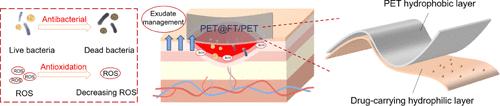
The urgent need for efficient wound dressing requires comfortability, reasonable humidity, and anti-inflammatory and pathogen anti-infectivity properties. Herein, the PET micronanofiber pads loaded with forsythin (FT) are successfully designed and prepared by electrospinning. The asymmetric wettability double-layer micronanofiber pad (PET@FT10%/PET) has been developed by utilizing the hydrophobic properties of PET. The addition of FT endows super hydrophobic PET with excellent hydrophilic properties and absorbent properties to ensure the dryness of the wound environment. Meanwhile, the hydrophobic PET layer avoids the adhesion of dust and bacteria, providing a barrier to prevent pollution of the complex external environment for the drug-carrying layer. Furthermore, the PET@FT10%/PET double-layer micronanofiber pad provides favorable conditions for wound healing with the validation by inhibition of representative pathogens Escherichia coli and Staphylococcus aureus, and the expression of pro-inflammatory factors (IL-6 and TNF-α), and the cell survival rate also achieved excellent results. Therefore, the PET@FT10%/PET double-layer micronanofiber pad designed in this paper provides a neoteric strategy with an asymmetric structure design to avoid contamination and accelerate drug delivery for wound healing.
期刊介绍:
ACS Applied Polymer Materials is an interdisciplinary journal publishing original research covering all aspects of engineering, chemistry, physics, and biology relevant to applications of polymers.
The journal is devoted to reports of new and original experimental and theoretical research of an applied nature that integrates fundamental knowledge in the areas of materials, engineering, physics, bioscience, polymer science and chemistry into important polymer applications. The journal is specifically interested in work that addresses relationships among structure, processing, morphology, chemistry, properties, and function as well as work that provide insights into mechanisms critical to the performance of the polymer for applications.




 京公网安备 11010802042870号
京ICP备2023020795号-1
京公网安备 11010802042870号
京ICP备2023020795号-1

 分享
分享
 求助内容:
求助内容: 应助结果提醒方式:
 扫码关注我们
