O.N. Toptunova , M.A. Motsakov , A.V. Koval , T.S. Ermakova , K.A. Didenko
{"title":"Impact of sudden stratospheric warming on tropospheric circulation and a cold wave formation: The case of the January 2019 event","authors":"O.N. Toptunova , M.A. Motsakov , A.V. Koval , T.S. Ermakova , K.A. Didenko","doi":"10.1016/j.atmosres.2025.107998","DOIUrl":null,"url":null,"abstract":"<div><div>The present study is concerned with the aspects of stratosphere-troposphere dynamic interaction during major sudden stratospheric warming (SSW). The SSW observed in December 2018 – January 2019 was taken for consideration. The influence of the stratospheric polar vortex location on the position of the upper-level frontal zone (UFZ), changes in the steering flows in the middle troposphere, surface temperature anomalies, as well as on the characteristics of the tropopause have been studied using MERRA2 reanalysis data. Analysis has revealed that SSW events influence the location of the upper-level frontal zone (UFZ), subsequently altering steering flows in the troposphere and leading to the development of surface cold waves. Isentropic analysis have shown that SSW caused the intrusion of stratospheric air into the troposphere, which contributed to the intensification of the cold wave. Correlation analysis have demonstrated a statistically significant relationship between stratospheric processes and anomalies of geopotential height in the middle troposphere (500 hPa), exhibiting a two-week time lag following SSW events. Spatial distribution of the maximum correlation coefficient corresponds to the region with the UFZ deformation. In the cross-time interval of the formation of the SSW, 3-dimensional fluxes of planetary wave activity have been calculated. The enhanced reflection of wave activity over Canada during the SSW demonstrated the dynamic influence of the stratosphere on the troposphere, contributing to the formation of the cold wave.</div><div>This confirms the role of stratospheric-tropospheric coupling in surface weather extremes.</div></div>","PeriodicalId":8600,"journal":{"name":"Atmospheric Research","volume":"318 ","pages":"Article 107998"},"PeriodicalIF":4.4000,"publicationDate":"2025-06-01","publicationTypes":"Journal Article","fieldsOfStudy":null,"isOpenAccess":false,"openAccessPdf":"","citationCount":"0","resultStr":null,"platform":"Semanticscholar","paperid":null,"PeriodicalName":"Atmospheric Research","FirstCategoryId":"89","ListUrlMain":"https://www.sciencedirect.com/science/article/pii/S0169809525000900","RegionNum":2,"RegionCategory":"地球科学","ArticlePicture":[],"TitleCN":null,"AbstractTextCN":null,"PMCID":null,"EPubDate":"2025/2/17 0:00:00","PubModel":"Epub","JCR":"Q1","JCRName":"METEOROLOGY & ATMOSPHERIC SCIENCES","Score":null,"Total":0}
引用次数: 0
Abstract
The present study is concerned with the aspects of stratosphere-troposphere dynamic interaction during major sudden stratospheric warming (SSW). The SSW observed in December 2018 – January 2019 was taken for consideration. The influence of the stratospheric polar vortex location on the position of the upper-level frontal zone (UFZ), changes in the steering flows in the middle troposphere, surface temperature anomalies, as well as on the characteristics of the tropopause have been studied using MERRA2 reanalysis data. Analysis has revealed that SSW events influence the location of the upper-level frontal zone (UFZ), subsequently altering steering flows in the troposphere and leading to the development of surface cold waves. Isentropic analysis have shown that SSW caused the intrusion of stratospheric air into the troposphere, which contributed to the intensification of the cold wave. Correlation analysis have demonstrated a statistically significant relationship between stratospheric processes and anomalies of geopotential height in the middle troposphere (500 hPa), exhibiting a two-week time lag following SSW events. Spatial distribution of the maximum correlation coefficient corresponds to the region with the UFZ deformation. In the cross-time interval of the formation of the SSW, 3-dimensional fluxes of planetary wave activity have been calculated. The enhanced reflection of wave activity over Canada during the SSW demonstrated the dynamic influence of the stratosphere on the troposphere, contributing to the formation of the cold wave.
This confirms the role of stratospheric-tropospheric coupling in surface weather extremes.
期刊介绍:
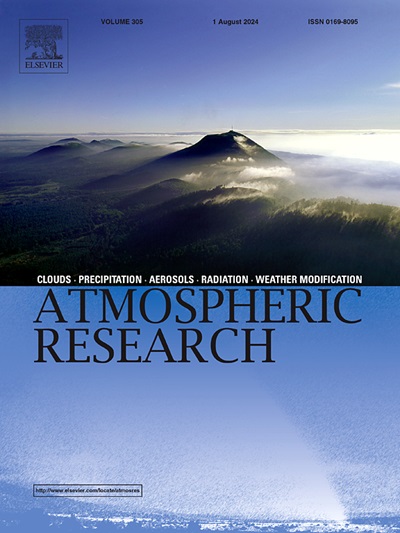
The journal publishes scientific papers (research papers, review articles, letters and notes) dealing with the part of the atmosphere where meteorological events occur. Attention is given to all processes extending from the earth surface to the tropopause, but special emphasis continues to be devoted to the physics of clouds, mesoscale meteorology and air pollution, i.e. atmospheric aerosols; microphysical processes; cloud dynamics and thermodynamics; numerical simulation, climatology, climate change and weather modification.



 京公网安备 11010802042870号
京ICP备2023020795号-1
京公网安备 11010802042870号
京ICP备2023020795号-1

 分享
分享
 求助内容:
求助内容: 应助结果提醒方式:
 扫码关注我们
