{"title":"Genotypic variation and seasonal effects on rice (Oryza sativa L.) grain protein content and yield in tropical savannah environment","authors":"Jadsadapong Kunjaroenruk , Sadawut Kulmanee , Nattawut Singkham , Sompong Chankaew , Khundej Suriharn","doi":"10.1016/j.jafr.2025.101778","DOIUrl":null,"url":null,"abstract":"<div><div>Understanding seasonal responses of grain protein content in high-yielding rice varieties is crucial for developing value-added rice products. This study evaluated the variability in grain protein content and yield of forty-four diverse rice genotypes under tropical savannah conditions across rainy and dry seasons during 2023–2024. Analysis of variance revealed significant effects of genotype, season, and their interaction for most traits. Genotypic variation accounted for 59.7–74.0 % of the total phenotypic variance, indicating strong genetic control while acknowledging environmental influences. Additionally, seasonal effects contributed 0.4–5.6 % for protein content and 5.0–33.1 % for protein yield variation. Cluster analysis based on protein content and yield across rice fractions (paddy, brown, milled, and bran) classified genotypes into five distinct groups. CPHP1344 exhibited the highest protein content across all rice fractions, while Benjamook2 demonstrated superior protein yield while maintaining high grain yield. These genotypes showed contrasting responses to seasonal conditions, with protein content being more stable (20.4–26.5 % G × E interaction) compared to protein yield (18.7–39.8 %). These genotypes represent promising parental materials for breeding programs aimed at developing high-protein, high-yielding rice varieties. The significant G × E interactions suggest that selection for improved protein content should be conducted under multiple seasons to identify genuinely superior genotypes. The findings provide valuable insights for developing efficient breeding strategies for enhanced protein content in rice adapted to tropical savannah environments.</div></div>","PeriodicalId":34393,"journal":{"name":"Journal of Agriculture and Food Research","volume":"20 ","pages":"Article 101778"},"PeriodicalIF":6.2000,"publicationDate":"2025-02-25","publicationTypes":"Journal Article","fieldsOfStudy":null,"isOpenAccess":false,"openAccessPdf":"","citationCount":"0","resultStr":null,"platform":"Semanticscholar","paperid":null,"PeriodicalName":"Journal of Agriculture and Food Research","FirstCategoryId":"1085","ListUrlMain":"https://www.sciencedirect.com/science/article/pii/S2666154325001498","RegionNum":0,"RegionCategory":null,"ArticlePicture":[],"TitleCN":null,"AbstractTextCN":null,"PMCID":null,"EPubDate":"","PubModel":"","JCR":"Q1","JCRName":"AGRICULTURE, MULTIDISCIPLINARY","Score":null,"Total":0}
引用次数: 0
Abstract
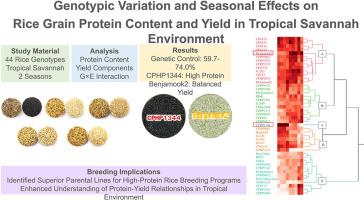
Understanding seasonal responses of grain protein content in high-yielding rice varieties is crucial for developing value-added rice products. This study evaluated the variability in grain protein content and yield of forty-four diverse rice genotypes under tropical savannah conditions across rainy and dry seasons during 2023–2024. Analysis of variance revealed significant effects of genotype, season, and their interaction for most traits. Genotypic variation accounted for 59.7–74.0 % of the total phenotypic variance, indicating strong genetic control while acknowledging environmental influences. Additionally, seasonal effects contributed 0.4–5.6 % for protein content and 5.0–33.1 % for protein yield variation. Cluster analysis based on protein content and yield across rice fractions (paddy, brown, milled, and bran) classified genotypes into five distinct groups. CPHP1344 exhibited the highest protein content across all rice fractions, while Benjamook2 demonstrated superior protein yield while maintaining high grain yield. These genotypes showed contrasting responses to seasonal conditions, with protein content being more stable (20.4–26.5 % G × E interaction) compared to protein yield (18.7–39.8 %). These genotypes represent promising parental materials for breeding programs aimed at developing high-protein, high-yielding rice varieties. The significant G × E interactions suggest that selection for improved protein content should be conducted under multiple seasons to identify genuinely superior genotypes. The findings provide valuable insights for developing efficient breeding strategies for enhanced protein content in rice adapted to tropical savannah environments.




 京公网安备 11010802042870号
京ICP备2023020795号-1
京公网安备 11010802042870号
京ICP备2023020795号-1

 分享
分享
 求助内容:
求助内容: 应助结果提醒方式:
 扫码关注我们
