{"title":"Transethosomes-encapsulated Bouea macrophylla seed extract for anti-acne application: Formulation optimization, antibacterial efficacy, and safety assessment","authors":"Phattharawadee Jaikham , Pimporn Leelapornpisid , Khajornsak Tragoolpua , Pimpisid Koonyosying , Wei-Chao Lin , Worrapan Poomanee","doi":"10.1016/j.jafr.2025.101764","DOIUrl":null,"url":null,"abstract":"<div><div><em>Bouea macrophylla</em> seed extract (B-SE), an agricultural waste, exerts notable antibacterial, antioxidant, and anti-inflammatory properties. However, its instability and limited permeability have restricted its applications in functional food and cosmetics. This study thus aims to develop transethosomes-encapsulated B-SE (TE-B-SE) using the thin-film hydration method to improve overall performance. Initially, five factors: %co-surfactant, types of co-surfactant, %B-SE, %total surfactant, and %phospholipid were preliminarily screened using the 2<sup>5−1</sup> Fractional Factorial Design (FFD). The percentage contribution of each factor on particle size and polydispersity index (PDI) was calculated. Subsequently, significant factors were included in Central Composite Design (CCD) to optimize the transethosomes presenting desirable particle size, narrow PDI, and high entrapment efficiency (EE). The optimized formulation was visualized through transmission electron microscopy (TEM) and its anti-<em>Cutibacterium acnes</em> activity was also examined by agar well diffusion. Additionally, drug release and skin permeation studies were conducted along with an examination of its cytotoxicity to keratinocytes. From the FFD, the type of co-surfactant chiefly influenced particle size and PDI, with %contributions of 18.13 % and 47.93 %, respectively. The system containing propylene glycol, phospholipid, and nonionic surfactants exhibited acceptable characteristics. According to the CCD, %B-SE and %total surfactant significantly impacted the particle size, PDI, and EE. The TEM images illustrate the optimized transethosomes containing spherical bilayer particles with a size of 87.17 ± 0.83 nm, a PDI of 0.271 ± 0.007, and an EE of 93.98 ± 0.17 %. Furthermore, the formulation could inhibit <em>C. acnes</em> with a 15.14 ± 0.68 mm-inhibition zone. Our findings also confirm that transethosomes potentially enhance the skin permeability of B-SE, which potentially offer better therapeutic application.</div></div>","PeriodicalId":34393,"journal":{"name":"Journal of Agriculture and Food Research","volume":"20 ","pages":"Article 101764"},"PeriodicalIF":6.2000,"publicationDate":"2025-02-24","publicationTypes":"Journal Article","fieldsOfStudy":null,"isOpenAccess":false,"openAccessPdf":"","citationCount":"0","resultStr":null,"platform":"Semanticscholar","paperid":null,"PeriodicalName":"Journal of Agriculture and Food Research","FirstCategoryId":"1085","ListUrlMain":"https://www.sciencedirect.com/science/article/pii/S2666154325001358","RegionNum":0,"RegionCategory":null,"ArticlePicture":[],"TitleCN":null,"AbstractTextCN":null,"PMCID":null,"EPubDate":"","PubModel":"","JCR":"Q1","JCRName":"AGRICULTURE, MULTIDISCIPLINARY","Score":null,"Total":0}
引用次数: 0
Abstract
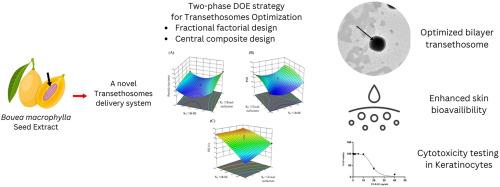
Bouea macrophylla seed extract (B-SE), an agricultural waste, exerts notable antibacterial, antioxidant, and anti-inflammatory properties. However, its instability and limited permeability have restricted its applications in functional food and cosmetics. This study thus aims to develop transethosomes-encapsulated B-SE (TE-B-SE) using the thin-film hydration method to improve overall performance. Initially, five factors: %co-surfactant, types of co-surfactant, %B-SE, %total surfactant, and %phospholipid were preliminarily screened using the 25−1 Fractional Factorial Design (FFD). The percentage contribution of each factor on particle size and polydispersity index (PDI) was calculated. Subsequently, significant factors were included in Central Composite Design (CCD) to optimize the transethosomes presenting desirable particle size, narrow PDI, and high entrapment efficiency (EE). The optimized formulation was visualized through transmission electron microscopy (TEM) and its anti-Cutibacterium acnes activity was also examined by agar well diffusion. Additionally, drug release and skin permeation studies were conducted along with an examination of its cytotoxicity to keratinocytes. From the FFD, the type of co-surfactant chiefly influenced particle size and PDI, with %contributions of 18.13 % and 47.93 %, respectively. The system containing propylene glycol, phospholipid, and nonionic surfactants exhibited acceptable characteristics. According to the CCD, %B-SE and %total surfactant significantly impacted the particle size, PDI, and EE. The TEM images illustrate the optimized transethosomes containing spherical bilayer particles with a size of 87.17 ± 0.83 nm, a PDI of 0.271 ± 0.007, and an EE of 93.98 ± 0.17 %. Furthermore, the formulation could inhibit C. acnes with a 15.14 ± 0.68 mm-inhibition zone. Our findings also confirm that transethosomes potentially enhance the skin permeability of B-SE, which potentially offer better therapeutic application.




 京公网安备 11010802042870号
京ICP备2023020795号-1
京公网安备 11010802042870号
京ICP备2023020795号-1

 分享
分享
 求助内容:
求助内容: 应助结果提醒方式:
 扫码关注我们
