{"title":"Non-Arrhenius migration and structural evolution of a faceted grain boundary in Ni-Cu alloy under shock-loading: Molecular dynamics simulations","authors":"Nitin Kishore Rawat , Sandeep Kumar Singh , Ankur Chaurasia , Naman Jain , Abhishek Kumar Mishra , Akarsh Verma","doi":"10.1016/j.physb.2025.417072","DOIUrl":null,"url":null,"abstract":"<div><div>Understanding the dynamic behavior of a material under high stress is critical in developing durable materials for extreme environments and defence applications. Taking this as the motivation, the authors have utilized molecular dynamics simulations to investigate the behavior of a binary Nickel-Copper (Ni-Cu) alloy under shock-loading conditions, which exhibits significant compressive deformation and abrupt stress fronts. In particular, the effect of shock-loading on a special faceted Σ3 [111] 60° {11 8 5} grain boundary (GB) incorporated in the Ni-Cu alloy domain was predicted. Varying solute concentrations and temperatures were the other parameters considered in this investigation. Interestingly, we observed non-Arrhenius (anti-thermal) GB migration behavior for this particular faceted Σ3 GB under shock-loading conditions. This non-Arrhenius behavior was found to be diminishing with the increase in the solute content. Our findings also indicated that higher solute concentrations reduced the GB mobility (due to the solute drag phenomenon), which resulted in enhanced shock resistance. Additionally, the presence of solute stabilized the GB, which further enhanced the shock resistance ability of the material. Common neighbour analysis of the configurations revealed a shock-induced phase transition from the face-centered cubic (FCC) structure to hexagonal close-packed (HCP) and body-centered cubic (BCC) structures. This FCC-to-BCC transition was facilitated by the stacking faults that acted as the nucleation sites for the BCC phase. These phase transformations were more pronounced in pure nickel than in the Ni-Cu alloys.</div></div>","PeriodicalId":20116,"journal":{"name":"Physica B-condensed Matter","volume":"704 ","pages":"Article 417072"},"PeriodicalIF":2.8000,"publicationDate":"2025-05-01","publicationTypes":"Journal Article","fieldsOfStudy":null,"isOpenAccess":false,"openAccessPdf":"","citationCount":"0","resultStr":null,"platform":"Semanticscholar","paperid":null,"PeriodicalName":"Physica B-condensed Matter","FirstCategoryId":"101","ListUrlMain":"https://www.sciencedirect.com/science/article/pii/S0921452625001899","RegionNum":3,"RegionCategory":"物理与天体物理","ArticlePicture":[],"TitleCN":null,"AbstractTextCN":null,"PMCID":null,"EPubDate":"2025/2/21 0:00:00","PubModel":"Epub","JCR":"Q2","JCRName":"PHYSICS, CONDENSED MATTER","Score":null,"Total":0}
引用次数: 0
Abstract
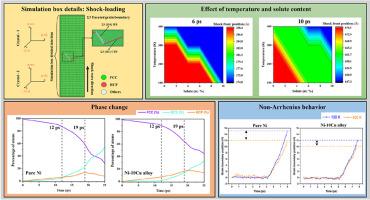
Understanding the dynamic behavior of a material under high stress is critical in developing durable materials for extreme environments and defence applications. Taking this as the motivation, the authors have utilized molecular dynamics simulations to investigate the behavior of a binary Nickel-Copper (Ni-Cu) alloy under shock-loading conditions, which exhibits significant compressive deformation and abrupt stress fronts. In particular, the effect of shock-loading on a special faceted Σ3 [111] 60° {11 8 5} grain boundary (GB) incorporated in the Ni-Cu alloy domain was predicted. Varying solute concentrations and temperatures were the other parameters considered in this investigation. Interestingly, we observed non-Arrhenius (anti-thermal) GB migration behavior for this particular faceted Σ3 GB under shock-loading conditions. This non-Arrhenius behavior was found to be diminishing with the increase in the solute content. Our findings also indicated that higher solute concentrations reduced the GB mobility (due to the solute drag phenomenon), which resulted in enhanced shock resistance. Additionally, the presence of solute stabilized the GB, which further enhanced the shock resistance ability of the material. Common neighbour analysis of the configurations revealed a shock-induced phase transition from the face-centered cubic (FCC) structure to hexagonal close-packed (HCP) and body-centered cubic (BCC) structures. This FCC-to-BCC transition was facilitated by the stacking faults that acted as the nucleation sites for the BCC phase. These phase transformations were more pronounced in pure nickel than in the Ni-Cu alloys.
期刊介绍:
Physica B: Condensed Matter comprises all condensed matter and material physics that involve theoretical, computational and experimental work.
Papers should contain further developments and a proper discussion on the physics of experimental or theoretical results in one of the following areas:
-Magnetism
-Materials physics
-Nanostructures and nanomaterials
-Optics and optical materials
-Quantum materials
-Semiconductors
-Strongly correlated systems
-Superconductivity
-Surfaces and interfaces



 京公网安备 11010802042870号
京ICP备2023020795号-1
京公网安备 11010802042870号
京ICP备2023020795号-1

 分享
分享
 求助内容:
求助内容: 应助结果提醒方式:
 扫码关注我们
