Sophia Huang, Nicole Ng, Mina Vaez, Boris Hinz, Iona Leong, Laurent Bozec
{"title":"Collagen Hybridizing Peptides Promote Collagen Fibril Growth <i>In Vitro</i>.","authors":"Sophia Huang, Nicole Ng, Mina Vaez, Boris Hinz, Iona Leong, Laurent Bozec","doi":"10.1021/acsabm.4c01509","DOIUrl":null,"url":null,"abstract":"<p><p>Recreating the structural and mechanical properties of native tissues <i>in vitro</i> presents significant challenges, particularly in mimicking the dense fibrillar network of extracellular matrixes such as skin and tendons. This study develops a reversible collagen film through cycling collagen self-assembly and disassembly, offering an innovative approach to address these challenges. We first generated an engineered collagen scaffold by applying plastic compression to the collagen hydrogel. The reversibility of the collagen assembly was explored by treating the scaffold with lactic acid, leading to its breakdown into an amorphous gel─a process termed defibrillogenesis. Subsequent immersion of this gel in phosphate buffer facilitated the reassembly of collagen into fibrils larger than those in the original scaffold yet with the D-banding pattern characteristic of collagen fibrils. Transfer learning of the mobileNetV2 convolutional neural network trained on atomic force microscope images of collagen nanoscale D-banding patterns was created with 99% training and testing accuracy. In addition, extensive external validation was performed, and the model achieved high robustness and generalization with unseen data sets. Further innovation was introduced by applying collagen hybridizing peptides, which significantly accelerated and directed the assembly of collagen fibrils, promoting a more organized and aligned fibrillar structure. This study not only demonstrates the feasibility of creating a reversible collagen film that closely mimics the density and structural properties of the native matrix but also highlights the potential of using collagen hybridizing peptides to control and enhance collagen fibrillogenesis. Our findings offer promising tissue engineering and regenerative medicine strategies by enabling precise manipulation of collagen structures <i>in vitro</i>.</p>","PeriodicalId":2,"journal":{"name":"ACS Applied Bio Materials","volume":" ","pages":"2003-2014"},"PeriodicalIF":4.7000,"publicationDate":"2025-03-17","publicationTypes":"Journal Article","fieldsOfStudy":null,"isOpenAccess":false,"openAccessPdf":"https://www.ncbi.nlm.nih.gov/pmc/articles/PMC11921027/pdf/","citationCount":"0","resultStr":null,"platform":"Semanticscholar","paperid":null,"PeriodicalName":"ACS Applied Bio Materials","FirstCategoryId":"1085","ListUrlMain":"https://doi.org/10.1021/acsabm.4c01509","RegionNum":0,"RegionCategory":null,"ArticlePicture":[],"TitleCN":null,"AbstractTextCN":null,"PMCID":null,"EPubDate":"2025/2/26 0:00:00","PubModel":"Epub","JCR":"Q2","JCRName":"MATERIALS SCIENCE, BIOMATERIALS","Score":null,"Total":0}
引用次数: 0
Abstract
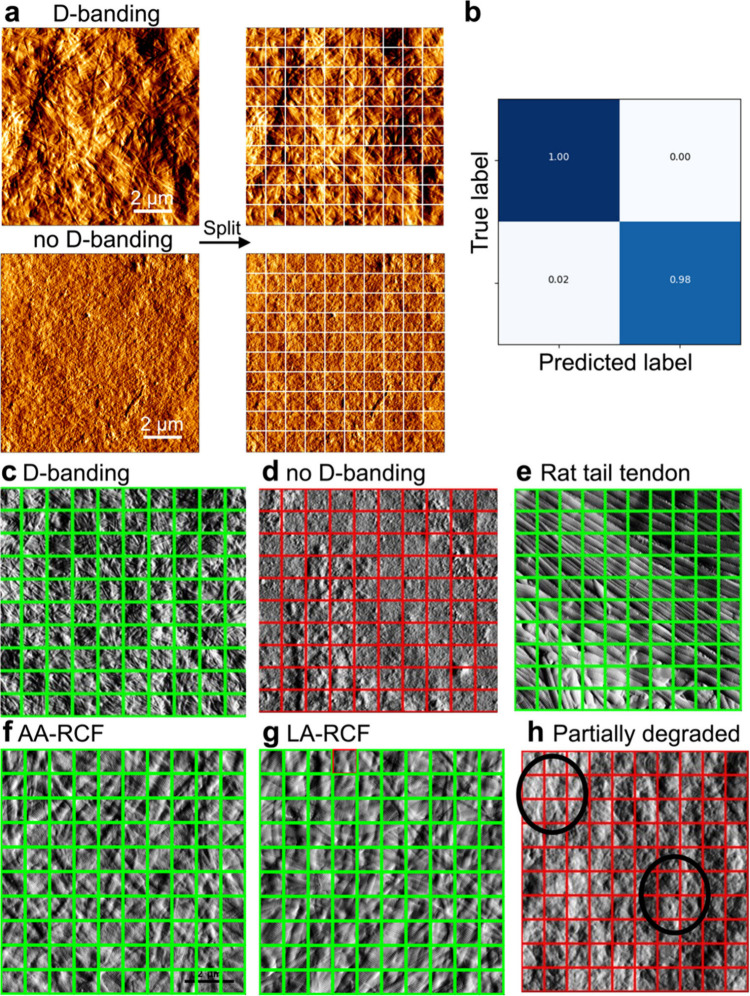
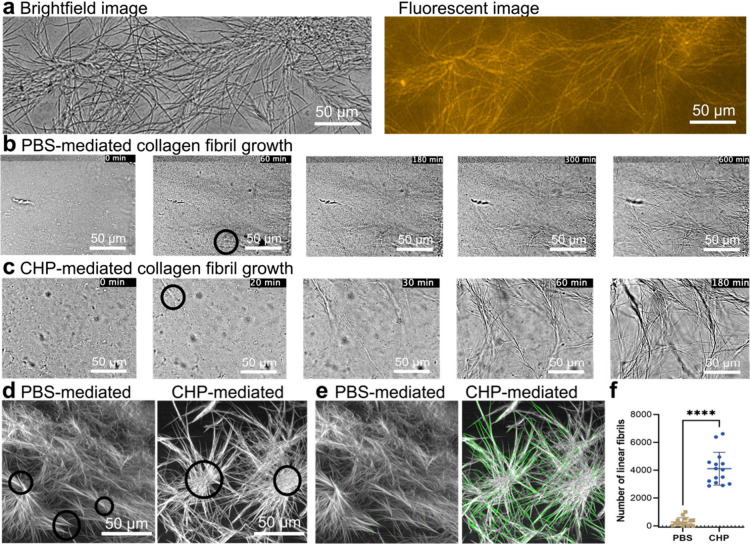
Recreating the structural and mechanical properties of native tissues in vitro presents significant challenges, particularly in mimicking the dense fibrillar network of extracellular matrixes such as skin and tendons. This study develops a reversible collagen film through cycling collagen self-assembly and disassembly, offering an innovative approach to address these challenges. We first generated an engineered collagen scaffold by applying plastic compression to the collagen hydrogel. The reversibility of the collagen assembly was explored by treating the scaffold with lactic acid, leading to its breakdown into an amorphous gel─a process termed defibrillogenesis. Subsequent immersion of this gel in phosphate buffer facilitated the reassembly of collagen into fibrils larger than those in the original scaffold yet with the D-banding pattern characteristic of collagen fibrils. Transfer learning of the mobileNetV2 convolutional neural network trained on atomic force microscope images of collagen nanoscale D-banding patterns was created with 99% training and testing accuracy. In addition, extensive external validation was performed, and the model achieved high robustness and generalization with unseen data sets. Further innovation was introduced by applying collagen hybridizing peptides, which significantly accelerated and directed the assembly of collagen fibrils, promoting a more organized and aligned fibrillar structure. This study not only demonstrates the feasibility of creating a reversible collagen film that closely mimics the density and structural properties of the native matrix but also highlights the potential of using collagen hybridizing peptides to control and enhance collagen fibrillogenesis. Our findings offer promising tissue engineering and regenerative medicine strategies by enabling precise manipulation of collagen structures in vitro.
期刊介绍:
ACS Applied Bio Materials is an interdisciplinary journal publishing original research covering all aspects of biomaterials and biointerfaces including and beyond the traditional biosensing, biomedical and therapeutic applications.
The journal is devoted to reports of new and original experimental and theoretical research of an applied nature that integrates knowledge in the areas of materials, engineering, physics, bioscience, and chemistry into important bio applications. The journal is specifically interested in work that addresses the relationship between structure and function and assesses the stability and degradation of materials under relevant environmental and biological conditions.





 京公网安备 11010802042870号
京ICP备2023020795号-1
京公网安备 11010802042870号
京ICP备2023020795号-1

 分享
分享
 求助内容:
求助内容: 应助结果提醒方式:
 扫码关注我们
