Yue Zhao, Shengyuan Huang, Min Xu, Ye Wang, Xi Zhang, Kuiji Wang, Jiang Lin
{"title":"Characteristics and risk factors in odontogenic maxillary sinusitis from different dental infections: a retrospective study based on sinus CT imaging.","authors":"Yue Zhao, Shengyuan Huang, Min Xu, Ye Wang, Xi Zhang, Kuiji Wang, Jiang Lin","doi":"10.1186/s12903-025-05690-3","DOIUrl":null,"url":null,"abstract":"<p><strong>Background: </strong>Odontogenic maxillary sinusitis is a common type of maxillary sinusitis, which is secondary to adjacent infectious maxillary dental lesions. However, the prevalence and the different odontogenic risk factors that influence the pathogenesis of odontogenic maxillary sinusitis are not clear. Thus, odontogenic maxillary sinusitis is often overlooked and facing great difficulties of multi-disciplinary treatment decisions for odontogenic maxillary sinusitis. The objective of this study was to analyze the different dental potential risk factors of odontogenic maxillary sinusitis and optimize dental decision-making of odontogenic maxillary sinusitis, which finally provides evidence-based options for multi-disciplinary treatment.</p><p><strong>Methods: </strong>968 patients diagnosed with maxillary sinusitis were included based on sinus Computed Tomography, among which 261 patients were categorized as odontogenic maxillary sinusitis. The maxillary sinus and ostiomeatal complex Lund-Mackay score were used to evaluate the severity of sinus infection. Different dental lesions and relevant risk factors that may impact the severity of maxillary sinusitis are systematically evaluated with radiologic data. P < 0.05 were considered statistically significant.</p><p><strong>Results: </strong>The prevalence of odontogenic maxillary sinusitis in maxillary sinusitis patients was 26.96% and in odontogenic lesions present simultaneously with unilaterally maxillary sinusitis reached up to 79.63%. The Lund-Mackay score of odontogenic maxillary sinusitis was significantly higher than that of non-odontogenic maxillary sinusitis. The first molar involved accounts for the highest tooth position in odontogenic lesions. The highest incidence of dental origin was peri-root origin, followed by apical origin and oral-antral fistula. The maxillary sinus Lund-Mackay score was significantly increased when the distance between the maxillary sinus floor and the odontogenic lesion was less than 3.32 mm. When the maxillary sinus floor bone was discontinuous, peri-root origin lesions led to a higher ostiomeatal complex Lund-Mackay score.</p><p><strong>Conclusion: </strong>Odontogenic maxillary sinusitis has more severe pathogenesis than non- odontogenic maxillary sinusitis and accounts for 26.96% of maxillary sinusitis. The distance between the sinus floor and the odontogenic lesion, and also the type of odontogenic lesions are important risk factors in the severity of odontogenic maxillary sinusitis, which provided new references for guiding the clinical diagnosis and dental treatment of odontogenic maxillary sinusitis.</p>","PeriodicalId":9072,"journal":{"name":"BMC Oral Health","volume":"25 1","pages":"308"},"PeriodicalIF":3.1000,"publicationDate":"2025-02-26","publicationTypes":"Journal Article","fieldsOfStudy":null,"isOpenAccess":false,"openAccessPdf":"https://www.ncbi.nlm.nih.gov/pmc/articles/PMC11866870/pdf/","citationCount":"0","resultStr":null,"platform":"Semanticscholar","paperid":null,"PeriodicalName":"BMC Oral Health","FirstCategoryId":"3","ListUrlMain":"https://doi.org/10.1186/s12903-025-05690-3","RegionNum":2,"RegionCategory":"医学","ArticlePicture":[],"TitleCN":null,"AbstractTextCN":null,"PMCID":null,"EPubDate":"","PubModel":"","JCR":"Q1","JCRName":"DENTISTRY, ORAL SURGERY & MEDICINE","Score":null,"Total":0}
引用次数: 0
Abstract
Background: Odontogenic maxillary sinusitis is a common type of maxillary sinusitis, which is secondary to adjacent infectious maxillary dental lesions. However, the prevalence and the different odontogenic risk factors that influence the pathogenesis of odontogenic maxillary sinusitis are not clear. Thus, odontogenic maxillary sinusitis is often overlooked and facing great difficulties of multi-disciplinary treatment decisions for odontogenic maxillary sinusitis. The objective of this study was to analyze the different dental potential risk factors of odontogenic maxillary sinusitis and optimize dental decision-making of odontogenic maxillary sinusitis, which finally provides evidence-based options for multi-disciplinary treatment.
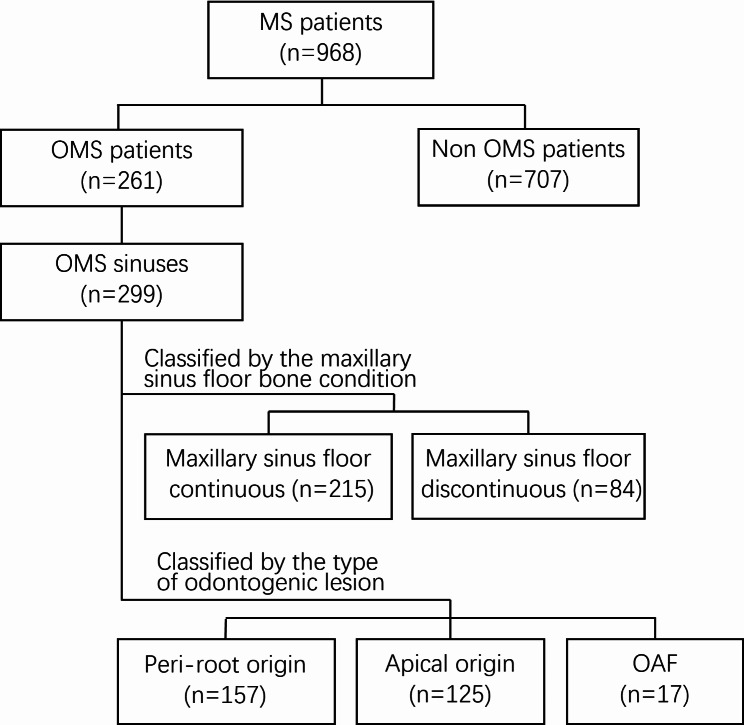
Methods: 968 patients diagnosed with maxillary sinusitis were included based on sinus Computed Tomography, among which 261 patients were categorized as odontogenic maxillary sinusitis. The maxillary sinus and ostiomeatal complex Lund-Mackay score were used to evaluate the severity of sinus infection. Different dental lesions and relevant risk factors that may impact the severity of maxillary sinusitis are systematically evaluated with radiologic data. P < 0.05 were considered statistically significant.
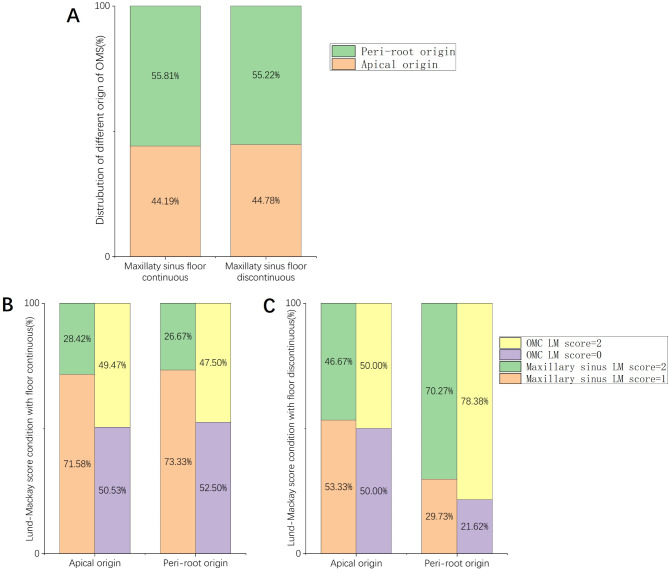
Results: The prevalence of odontogenic maxillary sinusitis in maxillary sinusitis patients was 26.96% and in odontogenic lesions present simultaneously with unilaterally maxillary sinusitis reached up to 79.63%. The Lund-Mackay score of odontogenic maxillary sinusitis was significantly higher than that of non-odontogenic maxillary sinusitis. The first molar involved accounts for the highest tooth position in odontogenic lesions. The highest incidence of dental origin was peri-root origin, followed by apical origin and oral-antral fistula. The maxillary sinus Lund-Mackay score was significantly increased when the distance between the maxillary sinus floor and the odontogenic lesion was less than 3.32 mm. When the maxillary sinus floor bone was discontinuous, peri-root origin lesions led to a higher ostiomeatal complex Lund-Mackay score.
Conclusion: Odontogenic maxillary sinusitis has more severe pathogenesis than non- odontogenic maxillary sinusitis and accounts for 26.96% of maxillary sinusitis. The distance between the sinus floor and the odontogenic lesion, and also the type of odontogenic lesions are important risk factors in the severity of odontogenic maxillary sinusitis, which provided new references for guiding the clinical diagnosis and dental treatment of odontogenic maxillary sinusitis.
期刊介绍:
BMC Oral Health is an open access, peer-reviewed journal that considers articles on all aspects of the prevention, diagnosis and management of disorders of the mouth, teeth and gums, as well as related molecular genetics, pathophysiology, and epidemiology.




 京公网安备 11010802042870号
京ICP备2023020795号-1
京公网安备 11010802042870号
京ICP备2023020795号-1

 分享
分享
 求助内容:
求助内容: 应助结果提醒方式:
 扫码关注我们
