Edma Santos Antonio, Ricardo Evangelista Fraga, Priscila Sacramento, Ayane Lima de Freitas, Ana Clara Barbosa Santana, Sabrina Barbosa, Ramon Costa Dominato, Janisete Gomes Silva
{"title":"Molecular assessment of Chlamydia psittaci and Circovirus in psittacines from a CETAS in Bahia, Brazil.","authors":"Edma Santos Antonio, Ricardo Evangelista Fraga, Priscila Sacramento, Ayane Lima de Freitas, Ana Clara Barbosa Santana, Sabrina Barbosa, Ramon Costa Dominato, Janisete Gomes Silva","doi":"10.1007/s42770-025-01649-2","DOIUrl":null,"url":null,"abstract":"<p><p>Mistreatment and unsanitary conditions to which trafficked animals are subjected provide an environment conducive to the proliferation and dissemination of pathogens. The Centros de Triagem de Animais Silvestres (CETAS - Wild Animal Screening Centers), which receive trafficked animals, aim to release them back into the wild, thus making the investigation of pathogens essential. The objective of this study was to conduct an epidemiological study of infections by Chlamydia psittaci and Circovirus in psittacines from wildlife trafficking housed at a CETAS in Bahia. Cloacal swab and blood samples were collected from 135 psittacines, both residents and newly arrived in quarantine, housed at the CETAS in Vitória da Conquista, Bahia. The presence of pathogens was determined by conventional PCR. The PCRs consisted of amplifying the opmA gene and ORF1 to detect C. psittaci and Circovirus, respectively. For C. psittaci, three (2.2%) animals were diagnosed as positive, then treated with antibiotics, retested, and included in the CETAS population after testing negative for the bacterium. Among the 135 psittacines evaluated, 22 (16%) showed feathering abnormalities despite testing negative for Circovirus. This research was the first epidemiological survey of Circovirus infection in psittacines in Bahia and improved the sanitary safety of wildlife release programs.</p>","PeriodicalId":9090,"journal":{"name":"Brazilian Journal of Microbiology","volume":" ","pages":"927-938"},"PeriodicalIF":1.9000,"publicationDate":"2025-06-01","publicationTypes":"Journal Article","fieldsOfStudy":null,"isOpenAccess":false,"openAccessPdf":"https://www.ncbi.nlm.nih.gov/pmc/articles/PMC12095694/pdf/","citationCount":"0","resultStr":null,"platform":"Semanticscholar","paperid":null,"PeriodicalName":"Brazilian Journal of Microbiology","FirstCategoryId":"99","ListUrlMain":"https://doi.org/10.1007/s42770-025-01649-2","RegionNum":4,"RegionCategory":"生物学","ArticlePicture":[],"TitleCN":null,"AbstractTextCN":null,"PMCID":null,"EPubDate":"2025/2/26 0:00:00","PubModel":"Epub","JCR":"Q3","JCRName":"MICROBIOLOGY","Score":null,"Total":0}
引用次数: 0
Abstract
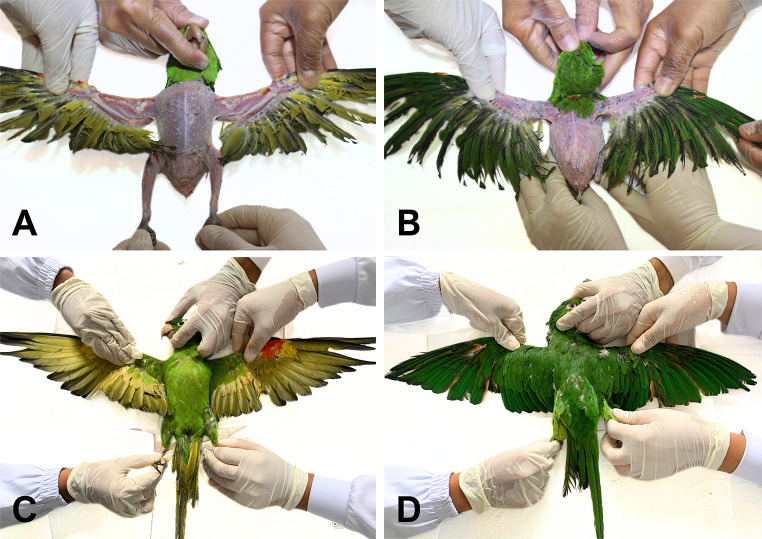
Mistreatment and unsanitary conditions to which trafficked animals are subjected provide an environment conducive to the proliferation and dissemination of pathogens. The Centros de Triagem de Animais Silvestres (CETAS - Wild Animal Screening Centers), which receive trafficked animals, aim to release them back into the wild, thus making the investigation of pathogens essential. The objective of this study was to conduct an epidemiological study of infections by Chlamydia psittaci and Circovirus in psittacines from wildlife trafficking housed at a CETAS in Bahia. Cloacal swab and blood samples were collected from 135 psittacines, both residents and newly arrived in quarantine, housed at the CETAS in Vitória da Conquista, Bahia. The presence of pathogens was determined by conventional PCR. The PCRs consisted of amplifying the opmA gene and ORF1 to detect C. psittaci and Circovirus, respectively. For C. psittaci, three (2.2%) animals were diagnosed as positive, then treated with antibiotics, retested, and included in the CETAS population after testing negative for the bacterium. Among the 135 psittacines evaluated, 22 (16%) showed feathering abnormalities despite testing negative for Circovirus. This research was the first epidemiological survey of Circovirus infection in psittacines in Bahia and improved the sanitary safety of wildlife release programs.
被贩运的动物所遭受的虐待和不卫生的条件为病原体的扩散和传播提供了有利的环境。野生动物筛选中心(CETAS -野生动物筛选中心)接收被贩运的动物,目的是将它们放回野外,从而使病原体的调查变得至关重要。本研究的目的是对巴伊亚州CETAS饲养的野生动物走私鹦鹉进行鹦鹉热衣原体和圆环病毒感染的流行病学研究。从巴伊亚州Vitória da Conquista的CETAS中饲养的135只鹦鹉身上收集了粪便拭子和血液样本,这些鹦鹉既有居民也有新到的检疫者。采用常规PCR检测病原菌的存在。pcr扩增opmA基因和ORF1基因,分别检测鹦鹉螺和圆环病毒。对于鹦鹉螺,3只(2.2%)动物被诊断为阳性,然后用抗生素治疗,重新检测,并在细菌检测为阴性后纳入CETAS群体。在评估的135只鹦鹉中,22只(16%)尽管圆环病毒检测呈阴性,但仍显示羽毛异常。本研究首次对巴伊亚州鹦鹉圆环病毒感染进行了流行病学调查,提高了野生动物放生项目的卫生安全性。
期刊介绍:
The Brazilian Journal of Microbiology is an international peer reviewed journal that covers a wide-range of research on fundamental and applied aspects of microbiology.
The journal considers for publication original research articles, short communications, reviews, and letters to the editor, that may be submitted to the following sections: Biotechnology and Industrial Microbiology, Food Microbiology, Bacterial and Fungal Pathogenesis, Clinical Microbiology, Environmental Microbiology, Veterinary Microbiology, Fungal and Bacterial Physiology, Bacterial, Fungal and Virus Molecular Biology, Education in Microbiology. For more details on each section, please check out the instructions for authors.
The journal is the official publication of the Brazilian Society of Microbiology and currently publishes 4 issues per year.





 京公网安备 11010802042870号
京ICP备2023020795号-1
京公网安备 11010802042870号
京ICP备2023020795号-1

 分享
分享
 求助内容:
求助内容: 应助结果提醒方式:
 扫码关注我们
