{"title":"Impact of sleep chronotype on blood pressure and metabolic markers.","authors":"Weiwei Huang, Qinglu Wang, Yuan Gao, Jiefeng Wang, Feihao Wang, Jiyou Tang","doi":"10.3389/fneur.2025.1510222","DOIUrl":null,"url":null,"abstract":"<p><strong>Objective: </strong>The aim of this study was to investigate the correlation between sleep chronotype and metabolic markers to further reveal the influence of sleep chronotype on human health.</p><p><strong>Methods: </strong>The Morningness-Eveningness Questionnaire was administered to 442 volunteers aged 23-70 years old. The sleep chronotype was divided into morning type (167 cases), neither type (224 cases), and evening type (51 cases). Blood pressure was recorded, and fasting venous blood samples were collected to assess liver function, renal function, blood glucose levels, blood lipid profile, and other biochemical parameters.</p><p><strong>Results: </strong>1. There was a statistically significant difference in the age of the morning type, neither type, and evening type (<i>p</i> < 0.01), but there was no significant difference in gender, height, weight, and BMI (<i>p</i>s > 0.05). 2. After controlling for the influence of age-related factors, significant differences were seen between morning type, neither type, and evening type groups in creatinine and aspartate aminotransferase (<i>p</i> < 0.05). 3. After controlling for the influence of age-related factors, the evening type group had lower systolic blood pressure, diastolic pressure, and mean arterial pressure (MAP) compared to the morning type and neither type (<i>p</i> < 0.05). 4. After controlling the influence of age-related factors, the MEQ scores were positively correlated with systolic blood pressure, diastolic blood pressure, and mean arterial pressure (<i>r</i> = 0.099, 0.096, 0.104, <i>p</i>s < 0.05).</p><p><strong>Conclusion: </strong>The evening sleep type is more prone to daytime sleepiness. There were significant differences observed in systolic blood pressure, diastolic blood pressure, and MAP. These variations may be linked to the effects of different sleep chronotype on blood pressure regulation or the blood pressure's autonomous rhythm.</p>","PeriodicalId":12575,"journal":{"name":"Frontiers in Neurology","volume":"16 ","pages":"1510222"},"PeriodicalIF":2.8000,"publicationDate":"2025-02-12","publicationTypes":"Journal Article","fieldsOfStudy":null,"isOpenAccess":false,"openAccessPdf":"https://www.ncbi.nlm.nih.gov/pmc/articles/PMC11862233/pdf/","citationCount":"0","resultStr":null,"platform":"Semanticscholar","paperid":null,"PeriodicalName":"Frontiers in Neurology","FirstCategoryId":"3","ListUrlMain":"https://doi.org/10.3389/fneur.2025.1510222","RegionNum":3,"RegionCategory":"医学","ArticlePicture":[],"TitleCN":null,"AbstractTextCN":null,"PMCID":null,"EPubDate":"2025/1/1 0:00:00","PubModel":"eCollection","JCR":"Q2","JCRName":"CLINICAL NEUROLOGY","Score":null,"Total":0}
引用次数: 0
Abstract
Objective: The aim of this study was to investigate the correlation between sleep chronotype and metabolic markers to further reveal the influence of sleep chronotype on human health.
Methods: The Morningness-Eveningness Questionnaire was administered to 442 volunteers aged 23-70 years old. The sleep chronotype was divided into morning type (167 cases), neither type (224 cases), and evening type (51 cases). Blood pressure was recorded, and fasting venous blood samples were collected to assess liver function, renal function, blood glucose levels, blood lipid profile, and other biochemical parameters.
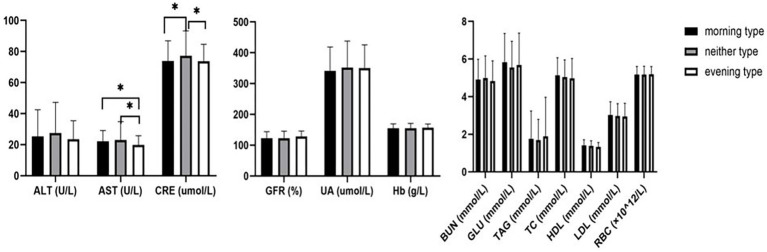
Results: 1. There was a statistically significant difference in the age of the morning type, neither type, and evening type (p < 0.01), but there was no significant difference in gender, height, weight, and BMI (ps > 0.05). 2. After controlling for the influence of age-related factors, significant differences were seen between morning type, neither type, and evening type groups in creatinine and aspartate aminotransferase (p < 0.05). 3. After controlling for the influence of age-related factors, the evening type group had lower systolic blood pressure, diastolic pressure, and mean arterial pressure (MAP) compared to the morning type and neither type (p < 0.05). 4. After controlling the influence of age-related factors, the MEQ scores were positively correlated with systolic blood pressure, diastolic blood pressure, and mean arterial pressure (r = 0.099, 0.096, 0.104, ps < 0.05).
Conclusion: The evening sleep type is more prone to daytime sleepiness. There were significant differences observed in systolic blood pressure, diastolic blood pressure, and MAP. These variations may be linked to the effects of different sleep chronotype on blood pressure regulation or the blood pressure's autonomous rhythm.
期刊介绍:
The section Stroke aims to quickly and accurately publish important experimental, translational and clinical studies, and reviews that contribute to the knowledge of stroke, its causes, manifestations, diagnosis, and management.





 京公网安备 11010802042870号
京ICP备2023020795号-1
京公网安备 11010802042870号
京ICP备2023020795号-1

 分享
分享
 求助内容:
求助内容: 应助结果提醒方式:
 扫码关注我们
