{"title":"A Systematic Review and Meta-Analysis on the Efficacy and Safety of Topical Pilocarpine 1.25% in Presbyopia Treatment.","authors":"Mamta Singh, Bibhuti Prassan Sinha, Siddhartha Dutta, Kunal Khanderao Deokar, Deepak Mishra, Khyati Goswami","doi":"10.4103/joco.joco_262_23","DOIUrl":null,"url":null,"abstract":"<p><strong>Purpose: </strong>To do a qualitative and quantitative assessment of the existing literature on the effectiveness and safety of pilocarpine 1.25% eye drops in presbyopia management.</p><p><strong>Methods: </strong>Relevant articles were extracted from the online database using keywords - \"pilocarpine and presbyopia\", \"AGN-190584 and presbyopia\", and \"Vuity and presbyopia\". The primary outcome measure considered was an improvement in distance-corrected near visual acuity (DCNVA) and secondary outcome measures were improvement in distance-corrected intermediate visual acuity (DCIVA) and adverse events (AEs). Risk of bias (ROB) assessment was done using the ROB2 tool and R software was used for quantitative analysis.</p><p><strong>Results: </strong>The 3 included randomized control trials (RCTs) had a total of 980 participants between 40-55 years of age. They were randomized into 2 groups - 489 in the pilocarpine group and 491 in the vehicle group. In the pilocarpine group, 1.25% of pilocarpine was used either once (in the Gemini 1 and 2 trials) or twice daily (Virgo trial). A significantly higher proportion of patients reported improvement of DCIVA and gain of ≥ 3 lines in binocular DCNVA in the pilocarpine group than the vehicle group (<i>P</i> < 0.01). Headache was the most commonly reported AE (13.49% of participants). Three case reports published on pilocarpine use for presbyopia management have reported vitreomacular traction in 1 and retinal detachment in 5 eyes.</p><p><strong>Conclusions: </strong>The available evidence documents significant improvement in near and intermediate vision in presbyopia participants with pilocarpine 1.25% drop. However, more RCTs, involving a wider age group, larger refractive error, longer follow-up, and clinical testing in a real-world scenario are required to conclusively prove its role in presbyopia management.</p>","PeriodicalId":15423,"journal":{"name":"Journal of Current Ophthalmology","volume":"36 2","pages":"111-121"},"PeriodicalIF":0.9000,"publicationDate":"2025-01-18","publicationTypes":"Journal Article","fieldsOfStudy":null,"isOpenAccess":false,"openAccessPdf":"https://www.ncbi.nlm.nih.gov/pmc/articles/PMC11856121/pdf/","citationCount":"0","resultStr":null,"platform":"Semanticscholar","paperid":null,"PeriodicalName":"Journal of Current Ophthalmology","FirstCategoryId":"1085","ListUrlMain":"https://doi.org/10.4103/joco.joco_262_23","RegionNum":0,"RegionCategory":null,"ArticlePicture":[],"TitleCN":null,"AbstractTextCN":null,"PMCID":null,"EPubDate":"2024/4/1 0:00:00","PubModel":"eCollection","JCR":"Q3","JCRName":"OPHTHALMOLOGY","Score":null,"Total":0}
引用次数: 0
Abstract
Purpose: To do a qualitative and quantitative assessment of the existing literature on the effectiveness and safety of pilocarpine 1.25% eye drops in presbyopia management.
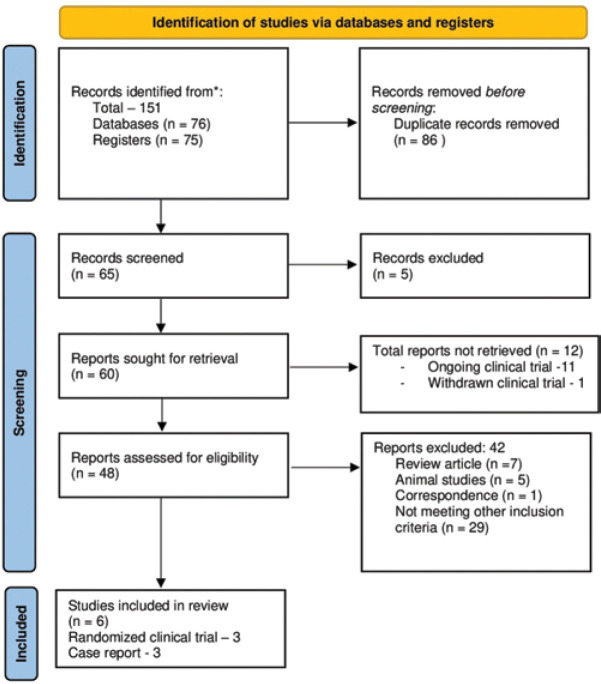
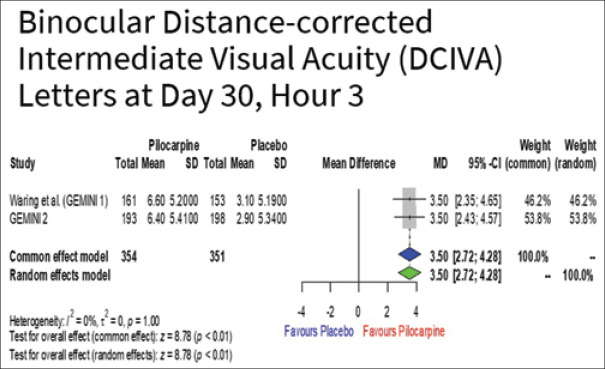
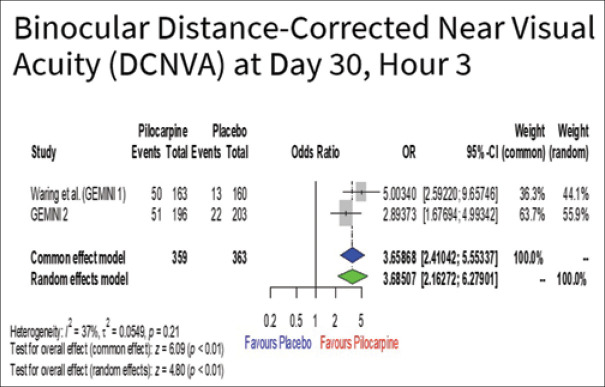
Methods: Relevant articles were extracted from the online database using keywords - "pilocarpine and presbyopia", "AGN-190584 and presbyopia", and "Vuity and presbyopia". The primary outcome measure considered was an improvement in distance-corrected near visual acuity (DCNVA) and secondary outcome measures were improvement in distance-corrected intermediate visual acuity (DCIVA) and adverse events (AEs). Risk of bias (ROB) assessment was done using the ROB2 tool and R software was used for quantitative analysis.
Results: The 3 included randomized control trials (RCTs) had a total of 980 participants between 40-55 years of age. They were randomized into 2 groups - 489 in the pilocarpine group and 491 in the vehicle group. In the pilocarpine group, 1.25% of pilocarpine was used either once (in the Gemini 1 and 2 trials) or twice daily (Virgo trial). A significantly higher proportion of patients reported improvement of DCIVA and gain of ≥ 3 lines in binocular DCNVA in the pilocarpine group than the vehicle group (P < 0.01). Headache was the most commonly reported AE (13.49% of participants). Three case reports published on pilocarpine use for presbyopia management have reported vitreomacular traction in 1 and retinal detachment in 5 eyes.
Conclusions: The available evidence documents significant improvement in near and intermediate vision in presbyopia participants with pilocarpine 1.25% drop. However, more RCTs, involving a wider age group, larger refractive error, longer follow-up, and clinical testing in a real-world scenario are required to conclusively prove its role in presbyopia management.
目的:对现有文献对1.25%匹罗卡品滴眼液治疗老花眼的有效性和安全性进行定性和定量评价。方法:使用关键词“匹罗卡品与老花眼”、“AGN-190584与老花眼”、“Vuity and presbyopia”从在线数据库中提取相关文章。考虑的主要结局指标是距离矫正近视力(DCNVA)的改善,次要结局指标是距离矫正中视力(DCIVA)和不良事件(ae)的改善。采用ROB2工具进行偏倚风险(Risk of bias, ROB)评估,采用R软件进行定量分析。结果:纳入的3项随机对照试验(RCTs)共有980名参与者,年龄在40-55岁之间。随机分为两组,匹罗卡品组489例,载药组491例。在匹罗卡品组中,1.25%的匹罗卡品每天使用一次(双子座1号和2号试验)或两次(处女座试验)。匹罗卡平组DCIVA改善及双眼DCNVA≥3条线增加的比例显著高于载药组(P < 0.01)。头痛是最常见的AE(13.49%的参与者)。匹罗卡平用于老花眼治疗的三例报告报告了1例玻璃体黄斑牵拉和5例视网膜脱离。结论:现有证据表明,匹罗卡品降低1.25%后,老花眼患者的近、中期视力有显著改善。然而,需要更多的随机对照试验,涉及更广泛的年龄组,更大的屈光不正,更长的随访时间,以及在真实场景中的临床试验来最终证明其在老花眼治疗中的作用。
期刊介绍:
Peer Review under the responsibility of Iranian Society of Ophthalmology Journal of Current Ophthalmology, the official publication of the Iranian Society of Ophthalmology, is a peer-reviewed, open-access, scientific journal that welcomes high quality original articles related to vision science and all fields of ophthalmology. Journal of Current Ophthalmology is the continuum of Iranian Journal of Ophthalmology published since 1969.





 京公网安备 11010802042870号
京ICP备2023020795号-1
京公网安备 11010802042870号
京ICP备2023020795号-1

 分享
分享
 求助内容:
求助内容: 应助结果提醒方式:
 扫码关注我们
