Klára Janečková, Christian Roos, Petr Andrla, Pavla Fedrová, Nikola Tom, Simone Lueert, Julius D Keyyu, Idrissa S Chuma, David Šmajs, Sascha Knauf
{"title":"Whole-genome sequencing reveals evidence for inter-species transmission of the yaws bacterium among nonhuman primates in Tanzania.","authors":"Klára Janečková, Christian Roos, Petr Andrla, Pavla Fedrová, Nikola Tom, Simone Lueert, Julius D Keyyu, Idrissa S Chuma, David Šmajs, Sascha Knauf","doi":"10.1371/journal.pntd.0012887","DOIUrl":null,"url":null,"abstract":"<p><strong>Background: </strong>Treponema pallidum subspecies pertenue (TPE) is the causative agent of human and nonhuman primate (NHP) yaws infection. The discovery of yaws bacterium in wild populations of NHPs opened the question of transmission mechanisms within NHPs, and this work aims to take a closer look at the transmission of the disease.</p><p><strong>Methodology/principal findings: </strong>Our study determined eleven whole TPE genomes from NHP isolates collected from three national parks in Tanzania: Lake Manyara National Park (NP), Serengeti NP, and Ruaha NP. The bacteria were isolated from four species of NHPs: Chlorocebus pygerythrus (vervet monkey), Cercopithecus mitis (blue monkey), Papio anubis (olive baboon), and Papio cynocephalus (yellow baboon). Combined with previously generated genomes of TPE originating from NHPs in Tanzania (n = 11), 22 whole-genome TPE sequences have now been analyzed. Out of 231 possible combinations of genome-to-genome comparisons, five revealed an unexpectedly high degree of genetic similarity in samples collected from different NHP species, consistent with inter-species transmission of TPE among NHPs. We estimated a substitution rate of TPE of NHP origin, ranging between 1.77 × 10⁻⁷ and 3.43 × 10⁻⁷ per genomic site per year.</p><p><strong>Conclusions/significance: </strong>The model estimations predicted that the inter-species transmission happened recently, within decades, roughly in an order of magnitude shorter time compared to time needed for the natural diversification of all tested TPE of Tanzanian NHP origin. Moreover, the geographical separation of the sampling sites (NPs) does not preclude TPE transmission between and within NHP species.</p>","PeriodicalId":49000,"journal":{"name":"PLoS Neglected Tropical Diseases","volume":"19 2","pages":"e0012887"},"PeriodicalIF":3.4000,"publicationDate":"2025-02-26","publicationTypes":"Journal Article","fieldsOfStudy":null,"isOpenAccess":false,"openAccessPdf":"https://www.ncbi.nlm.nih.gov/pmc/articles/PMC11864524/pdf/","citationCount":"0","resultStr":null,"platform":"Semanticscholar","paperid":null,"PeriodicalName":"PLoS Neglected Tropical Diseases","FirstCategoryId":"3","ListUrlMain":"https://doi.org/10.1371/journal.pntd.0012887","RegionNum":2,"RegionCategory":"医学","ArticlePicture":[],"TitleCN":null,"AbstractTextCN":null,"PMCID":null,"EPubDate":"2025/2/1 0:00:00","PubModel":"eCollection","JCR":"Q1","JCRName":"PARASITOLOGY","Score":null,"Total":0}
引用次数: 0
Abstract
Background: Treponema pallidum subspecies pertenue (TPE) is the causative agent of human and nonhuman primate (NHP) yaws infection. The discovery of yaws bacterium in wild populations of NHPs opened the question of transmission mechanisms within NHPs, and this work aims to take a closer look at the transmission of the disease.
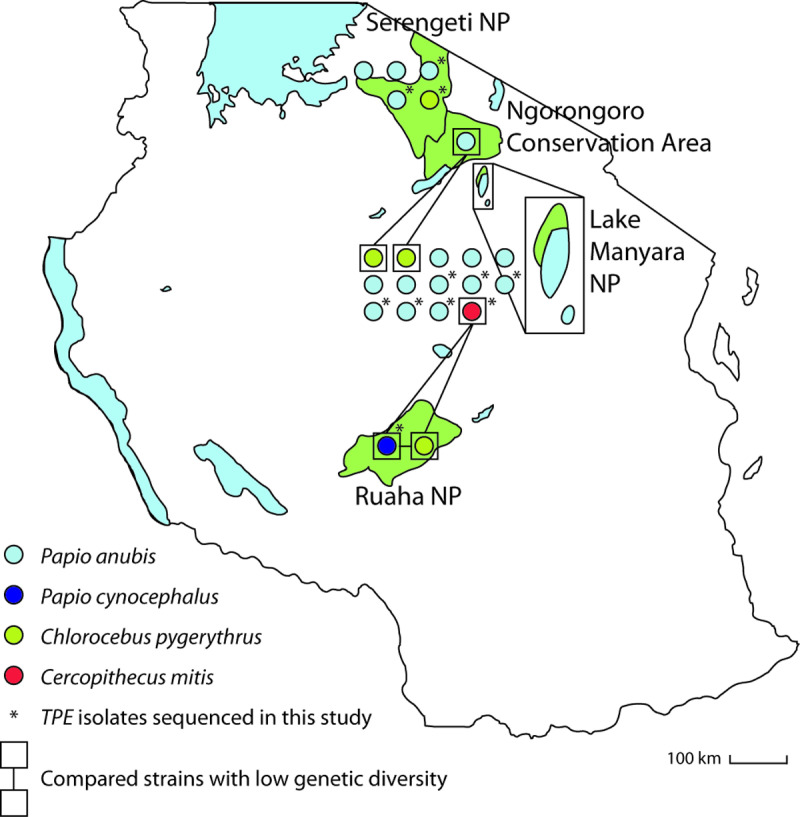
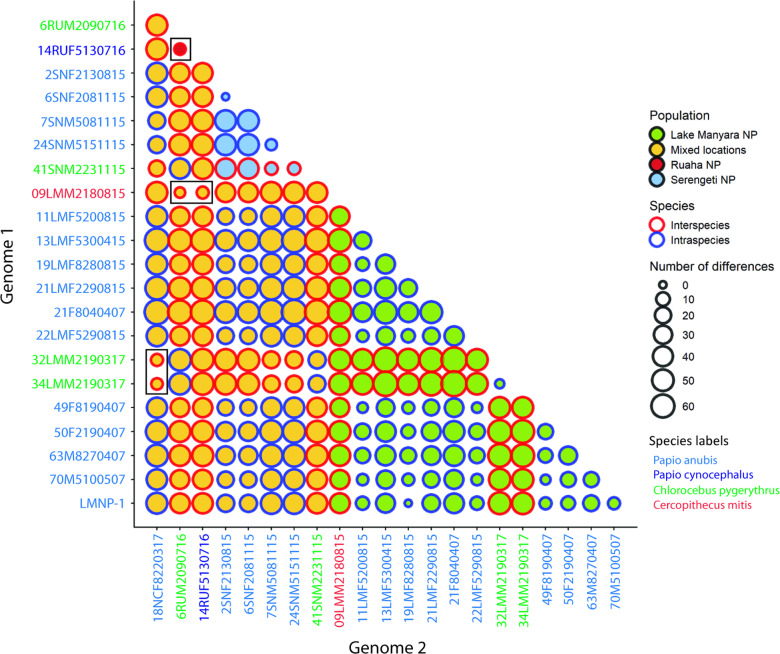
Methodology/principal findings: Our study determined eleven whole TPE genomes from NHP isolates collected from three national parks in Tanzania: Lake Manyara National Park (NP), Serengeti NP, and Ruaha NP. The bacteria were isolated from four species of NHPs: Chlorocebus pygerythrus (vervet monkey), Cercopithecus mitis (blue monkey), Papio anubis (olive baboon), and Papio cynocephalus (yellow baboon). Combined with previously generated genomes of TPE originating from NHPs in Tanzania (n = 11), 22 whole-genome TPE sequences have now been analyzed. Out of 231 possible combinations of genome-to-genome comparisons, five revealed an unexpectedly high degree of genetic similarity in samples collected from different NHP species, consistent with inter-species transmission of TPE among NHPs. We estimated a substitution rate of TPE of NHP origin, ranging between 1.77 × 10⁻⁷ and 3.43 × 10⁻⁷ per genomic site per year.
Conclusions/significance: The model estimations predicted that the inter-species transmission happened recently, within decades, roughly in an order of magnitude shorter time compared to time needed for the natural diversification of all tested TPE of Tanzanian NHP origin. Moreover, the geographical separation of the sampling sites (NPs) does not preclude TPE transmission between and within NHP species.
期刊介绍:
PLOS Neglected Tropical Diseases publishes research devoted to the pathology, epidemiology, prevention, treatment and control of the neglected tropical diseases (NTDs), as well as relevant public policy.
The NTDs are defined as a group of poverty-promoting chronic infectious diseases, which primarily occur in rural areas and poor urban areas of low-income and middle-income countries. Their impact on child health and development, pregnancy, and worker productivity, as well as their stigmatizing features limit economic stability.
All aspects of these diseases are considered, including:
Pathogenesis
Clinical features
Pharmacology and treatment
Diagnosis
Epidemiology
Vector biology
Vaccinology and prevention
Demographic, ecological and social determinants
Public health and policy aspects (including cost-effectiveness analyses).





 京公网安备 11010802042870号
京ICP备2023020795号-1
京公网安备 11010802042870号
京ICP备2023020795号-1

 分享
分享
 求助内容:
求助内容: 应助结果提醒方式:
 扫码关注我们
