Occult Ventricular Fibrillation Visualized by Echocardiogram During Cardiac Arrest: A Retrospective Observational Study From the Real-Time Evaluation and Assessment for Sonography-Outcomes Network (REASON).
Romolo Gaspari, Srikar Adhikari, Timothy Gleeson, Monica Kapoor, Robert Lindsay, Vicki Noble, Jason T Nomura, Anthony Weekes, Dan Theodoro
{"title":"Occult Ventricular Fibrillation Visualized by Echocardiogram During Cardiac Arrest: A Retrospective Observational Study From the Real-Time Evaluation and Assessment for Sonography-Outcomes Network (REASON).","authors":"Romolo Gaspari, Srikar Adhikari, Timothy Gleeson, Monica Kapoor, Robert Lindsay, Vicki Noble, Jason T Nomura, Anthony Weekes, Dan Theodoro","doi":"10.1016/j.acepjo.2024.100028","DOIUrl":null,"url":null,"abstract":"<p><strong>Objectives: </strong>Cardiac arrest patients with a shockable rhythm are more likely to survive an out-of-hospital cardiac arrest (OHCA) compared with a nonshockable rhythm. An electrocardiogram (ECG) is the most common way to identify a shockable rhythm, but it can miss patients with clinically significant ventricular fibrillation (vfib). We sought to determine the percentage of nonshockable OHCA patients that demonstrated vfib on echo.</p><p><strong>Methods: </strong>Secondary analysis of echo images recorded from a prior study from our group, Real-Time Evaluation and Assessment for Sonography-Outcomes Network (REASON), a multicenter, observational study of OHCA patients presenting to the emergency department with nonshockable rhythms. Using ECG and echocardiogram images recorded during the initial cardiopulmonary resuscitation (CPR) pause, 2 independent emergency physicians determined the presence of vfib. Two experienced emergency physicians (R.G. and T.G.) reviewed echo images with adjudication by a third if necessary. ECG interpretation was unblinded to patient information. The primary outcome was the proportion of patients in occult vfib.</p><p><strong>Results: </strong>During the first CPR pause, reviewers noted occult vfib in 22/685 (3.2%; 95% CI, 2.1%-4.8%) subjects. Patients with ECG vfib (n = 55) were defibrillated immediately during the first pause in CPR, but no patients with occult vfib during the first pause in CPR were defibrillated. Subsequently, 50% (11 of 22) of occult vfib patients were defibrillated when ECG vfib was recognized during an ensuing pause in CPR.</p><p><strong>Conclusion: </strong>One in 33 OHCAs with a nonshockable ECG rhythm exhibits VF on echocardiogram. Patients presenting to the emergency department in a presumed nonshockable rhythm following OHCA may benefit from prompt defibrillation if personnel recognize occult vfib on echo.</p>","PeriodicalId":73967,"journal":{"name":"Journal of the American College of Emergency Physicians open","volume":"6 1","pages":"100028"},"PeriodicalIF":1.8000,"publicationDate":"2025-01-13","publicationTypes":"Journal Article","fieldsOfStudy":null,"isOpenAccess":false,"openAccessPdf":"https://www.ncbi.nlm.nih.gov/pmc/articles/PMC11853361/pdf/","citationCount":"0","resultStr":null,"platform":"Semanticscholar","paperid":null,"PeriodicalName":"Journal of the American College of Emergency Physicians open","FirstCategoryId":"1085","ListUrlMain":"https://doi.org/10.1016/j.acepjo.2024.100028","RegionNum":0,"RegionCategory":null,"ArticlePicture":[],"TitleCN":null,"AbstractTextCN":null,"PMCID":null,"EPubDate":"2025/2/1 0:00:00","PubModel":"eCollection","JCR":"Q2","JCRName":"EMERGENCY MEDICINE","Score":null,"Total":0}
引用次数: 0
Abstract
Objectives: Cardiac arrest patients with a shockable rhythm are more likely to survive an out-of-hospital cardiac arrest (OHCA) compared with a nonshockable rhythm. An electrocardiogram (ECG) is the most common way to identify a shockable rhythm, but it can miss patients with clinically significant ventricular fibrillation (vfib). We sought to determine the percentage of nonshockable OHCA patients that demonstrated vfib on echo.
Methods: Secondary analysis of echo images recorded from a prior study from our group, Real-Time Evaluation and Assessment for Sonography-Outcomes Network (REASON), a multicenter, observational study of OHCA patients presenting to the emergency department with nonshockable rhythms. Using ECG and echocardiogram images recorded during the initial cardiopulmonary resuscitation (CPR) pause, 2 independent emergency physicians determined the presence of vfib. Two experienced emergency physicians (R.G. and T.G.) reviewed echo images with adjudication by a third if necessary. ECG interpretation was unblinded to patient information. The primary outcome was the proportion of patients in occult vfib.
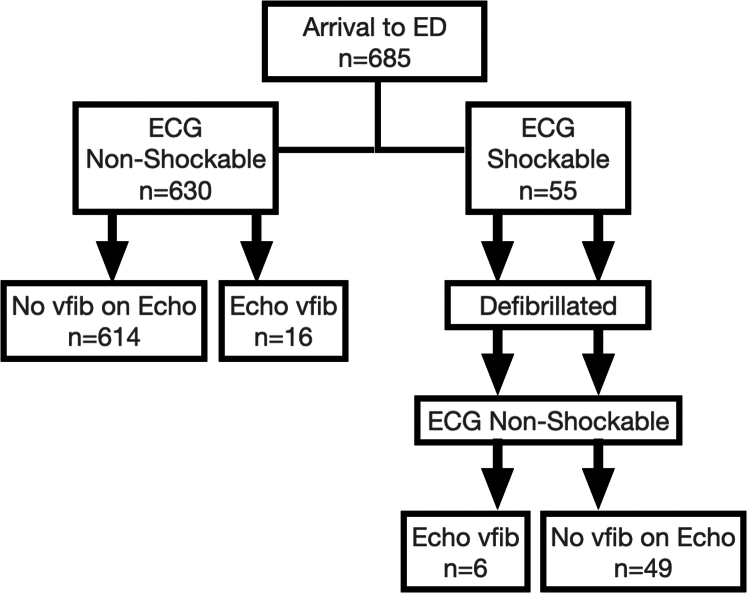
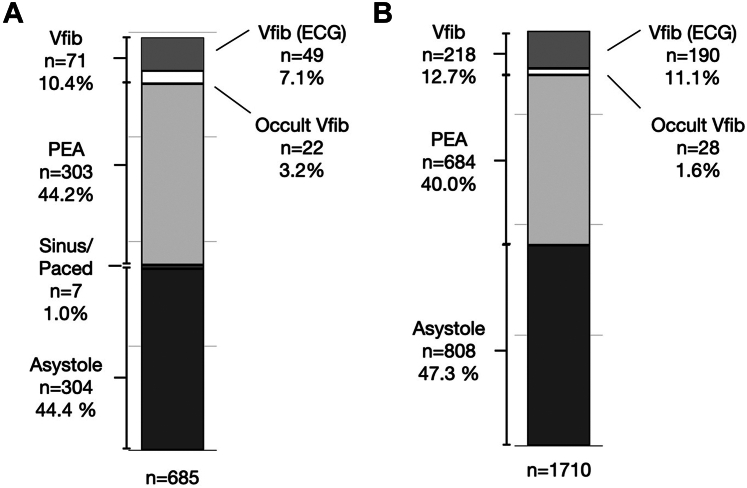
Results: During the first CPR pause, reviewers noted occult vfib in 22/685 (3.2%; 95% CI, 2.1%-4.8%) subjects. Patients with ECG vfib (n = 55) were defibrillated immediately during the first pause in CPR, but no patients with occult vfib during the first pause in CPR were defibrillated. Subsequently, 50% (11 of 22) of occult vfib patients were defibrillated when ECG vfib was recognized during an ensuing pause in CPR.
Conclusion: One in 33 OHCAs with a nonshockable ECG rhythm exhibits VF on echocardiogram. Patients presenting to the emergency department in a presumed nonshockable rhythm following OHCA may benefit from prompt defibrillation if personnel recognize occult vfib on echo.





 京公网安备 11010802042870号
京ICP备2023020795号-1
京公网安备 11010802042870号
京ICP备2023020795号-1

 分享
分享

 求助内容:
求助内容: 应助结果提醒方式:
 扫码关注我们
