{"title":"Targeting catabolite control protein A in Staphylococcus aureus with auranofin†","authors":"Wenjing Lin, Jingjing Chen, Ziying Huang, Haijun Li, Yushou Chen, Xuemin Duan, Yanshi Xiong, Bingjie Han, Guijuan Jiang, Jintao Wang and Xiangwen Liao","doi":"10.1039/D5QI00073D","DOIUrl":null,"url":null,"abstract":"<p >The emergence of antibiotic-resistant <em>Staphylococcus aureus</em> poses a huge threat to public health. Therefore, novel strategies to overcome antibiotic resistance are urgently needed. Auranofin, a marketed metallodrug for rheumatoid arthritis, has been recognized as a promising agent against multiple clinical isolates of <em>S. aureus</em>. However, its antibacterial mechanism is not yet well understood. Herein, we verified that the catabolite control protein A (CcpA) in <em>S. aureus</em> is an important target of auranofin. Auranofin was found to directly bind to CcpA <em>via</em> two cysteine residues. Importantly, both <em>in vitro</em> and animal infection model assays demonstrated that auranofin could disrupt the biological activity of CcpA, which attenuated bacterial growth, inhibited toxin secretion and enhanced the efficacy of aminoglycoside antibiotic. Together, these findings further revealed the bactericidal mechanism of auranofin against <em>S. aureus</em>.</p>","PeriodicalId":79,"journal":{"name":"Inorganic Chemistry Frontiers","volume":" 10","pages":" 3582-3594"},"PeriodicalIF":6.4000,"publicationDate":"2025-02-28","publicationTypes":"Journal Article","fieldsOfStudy":null,"isOpenAccess":false,"openAccessPdf":"","citationCount":"0","resultStr":null,"platform":"Semanticscholar","paperid":null,"PeriodicalName":"Inorganic Chemistry Frontiers","FirstCategoryId":"92","ListUrlMain":"https://pubs.rsc.org/en/content/articlelanding/2025/qi/d5qi00073d","RegionNum":1,"RegionCategory":"化学","ArticlePicture":[],"TitleCN":null,"AbstractTextCN":null,"PMCID":null,"EPubDate":"","PubModel":"","JCR":"Q1","JCRName":"CHEMISTRY, INORGANIC & NUCLEAR","Score":null,"Total":0}
引用次数: 0
Abstract
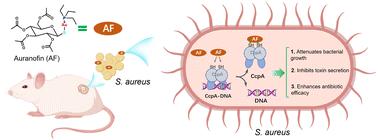
The emergence of antibiotic-resistant Staphylococcus aureus poses a huge threat to public health. Therefore, novel strategies to overcome antibiotic resistance are urgently needed. Auranofin, a marketed metallodrug for rheumatoid arthritis, has been recognized as a promising agent against multiple clinical isolates of S. aureus. However, its antibacterial mechanism is not yet well understood. Herein, we verified that the catabolite control protein A (CcpA) in S. aureus is an important target of auranofin. Auranofin was found to directly bind to CcpA via two cysteine residues. Importantly, both in vitro and animal infection model assays demonstrated that auranofin could disrupt the biological activity of CcpA, which attenuated bacterial growth, inhibited toxin secretion and enhanced the efficacy of aminoglycoside antibiotic. Together, these findings further revealed the bactericidal mechanism of auranofin against S. aureus.



 京公网安备 11010802042870号
京ICP备2023020795号-1
京公网安备 11010802042870号
京ICP备2023020795号-1

 分享
分享
 求助内容:
求助内容: 应助结果提醒方式:
 扫码关注我们
