Ruiqi Fang, Jie Kang, Fengliang Wang, Xin Zhao, Yingwei Li
{"title":"One-Pot Synthesis of Valeric Biofuels via Esterification–Hydrogenolysis","authors":"Ruiqi Fang, Jie Kang, Fengliang Wang, Xin Zhao, Yingwei Li","doi":"10.1021/acscatal.5c00636","DOIUrl":null,"url":null,"abstract":"The production of valerate esters, a class of transportation biofuels (additives), usually undergoes alternate hydrogenation and acid-catalysis dehydration processes that suffer from inevitable coke deposition and undesirable side reactions. We report a one-pot esterification–hydrogenolysis reaction pathway for valeric biofuels synthesis from biomass-derived 2-furoic acid, which was proceeded over the elaborate CoPt<sub><i>X</i></sub>@Co<sub>3</sub>O<sub>4</sub>-NC (<i>X</i> = 0.01, 0.02, 0.05, and 0.1) catalysts. The catalysts were constructed through a MOF-engaged etching-pyrolysis-replacement strategy to obtain mesoporous pocket cube nanoboxes-in-nanobox morphology and uniform CoPt<sub><i>X</i></sub>@Co<sub>3</sub>O<sub>4</sub> core–shell nanoparticles with Pt moieties in tunable content and size (from single-atom scale to 2.4 nm). The obtained acid-free CoPt<sub><i>X</i></sub>@Co<sub>3</sub>O<sub>4</sub>-NC catalyst achieved an average 92.2% yield of ethyl valerate at a complete conversion of 2-furoic acid, and the reaction ran steadily in a microchannel continuous flow reactor for at least 200 h, which also inhibited the byproduct generation and coke deposition. A mechanistic study suggested that 2-furoic acid was preferably adsorbed on the oxyphilic Co<sub>3</sub>O<sub>4</sub> shell for esterification initially; then the generated esters underwent sequential and exclusive hydrogenolysis steps over the CoPt core to yield valerate esters. The high industrial application prospect of this reaction pathway was additionally highlighted by producing 12 kinds of valeric biofuels from 2-furoic acid and the corresponding C<sub>1</sub> ∼ C<sub>7</sub> primary, secondary, and tertiary alcohols.","PeriodicalId":9,"journal":{"name":"ACS Catalysis ","volume":"22 1","pages":""},"PeriodicalIF":13.1000,"publicationDate":"2025-02-27","publicationTypes":"Journal Article","fieldsOfStudy":null,"isOpenAccess":false,"openAccessPdf":"","citationCount":"0","resultStr":null,"platform":"Semanticscholar","paperid":null,"PeriodicalName":"ACS Catalysis ","FirstCategoryId":"92","ListUrlMain":"https://doi.org/10.1021/acscatal.5c00636","RegionNum":1,"RegionCategory":"化学","ArticlePicture":[],"TitleCN":null,"AbstractTextCN":null,"PMCID":null,"EPubDate":"","PubModel":"","JCR":"Q1","JCRName":"CHEMISTRY, PHYSICAL","Score":null,"Total":0}
引用次数: 0
Abstract
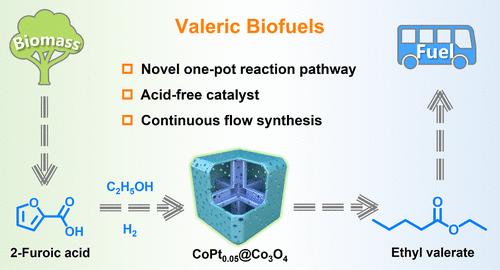
The production of valerate esters, a class of transportation biofuels (additives), usually undergoes alternate hydrogenation and acid-catalysis dehydration processes that suffer from inevitable coke deposition and undesirable side reactions. We report a one-pot esterification–hydrogenolysis reaction pathway for valeric biofuels synthesis from biomass-derived 2-furoic acid, which was proceeded over the elaborate CoPtX@Co3O4-NC (X = 0.01, 0.02, 0.05, and 0.1) catalysts. The catalysts were constructed through a MOF-engaged etching-pyrolysis-replacement strategy to obtain mesoporous pocket cube nanoboxes-in-nanobox morphology and uniform CoPtX@Co3O4 core–shell nanoparticles with Pt moieties in tunable content and size (from single-atom scale to 2.4 nm). The obtained acid-free CoPtX@Co3O4-NC catalyst achieved an average 92.2% yield of ethyl valerate at a complete conversion of 2-furoic acid, and the reaction ran steadily in a microchannel continuous flow reactor for at least 200 h, which also inhibited the byproduct generation and coke deposition. A mechanistic study suggested that 2-furoic acid was preferably adsorbed on the oxyphilic Co3O4 shell for esterification initially; then the generated esters underwent sequential and exclusive hydrogenolysis steps over the CoPt core to yield valerate esters. The high industrial application prospect of this reaction pathway was additionally highlighted by producing 12 kinds of valeric biofuels from 2-furoic acid and the corresponding C1 ∼ C7 primary, secondary, and tertiary alcohols.
期刊介绍:
ACS Catalysis is an esteemed journal that publishes original research in the fields of heterogeneous catalysis, molecular catalysis, and biocatalysis. It offers broad coverage across diverse areas such as life sciences, organometallics and synthesis, photochemistry and electrochemistry, drug discovery and synthesis, materials science, environmental protection, polymer discovery and synthesis, and energy and fuels.
The scope of the journal is to showcase innovative work in various aspects of catalysis. This includes new reactions and novel synthetic approaches utilizing known catalysts, the discovery or modification of new catalysts, elucidation of catalytic mechanisms through cutting-edge investigations, practical enhancements of existing processes, as well as conceptual advances in the field. Contributions to ACS Catalysis can encompass both experimental and theoretical research focused on catalytic molecules, macromolecules, and materials that exhibit catalytic turnover.



 京公网安备 11010802042870号
京ICP备2023020795号-1
京公网安备 11010802042870号
京ICP备2023020795号-1

 分享
分享
 求助内容:
求助内容: 应助结果提醒方式:
 扫码关注我们
