Jorge Pardos, Adrián García-Martínez, J. Javier Ruiz-Pernía, Iñaki Tuñón
{"title":"Mechanistic Insights into GTP Hydrolysis by the RhoA Protein: Catalytic Impact of Glutamine Tautomerism","authors":"Jorge Pardos, Adrián García-Martínez, J. Javier Ruiz-Pernía, Iñaki Tuñón","doi":"10.1021/acscatal.5c00719","DOIUrl":null,"url":null,"abstract":"We present a systematic evaluation of different possible reaction mechanisms for GTP hydrolysis in RhoA, a member of the Ras superfamily of enzymes that uses this reaction to switch from an active to an inactive conformation. These enzymes are activated by the presence of a GTPase activating protein (or GAP) that forms an intimate complex with residues of the two proteins present in the active site. We have explored the multidimensional reactional free energy landscape in the active site of the complex formed by RhoA and p50RhoGAP. Our molecular dynamics simulations show that the activating enzyme p50RhoGAP establishes catalytically important interactions with the phosphate groups of GTP through its so-called arginine finger (Arg85) and also with the RhoA residue Gln63. This is a key residue because it not only interacts with the nucleophilic water molecule but also participates actively in the reaction mechanism. Adaptive string method simulations using hybrid quantum mechanics/molecular mechanics (QM/MM) potentials with both tight-binding and density functional Hamiltonians show that GTP hydrolysis proceeds through the formation of a metaphosphate metastable species. Mechanistic proposals differ in the proton transfer rearrangements required to form the inorganic phosphate ion. Our simulations discard a solvent-assisted mechanism and point to the participation of Gln63 in the proton transfer process by means of the side chain tautomerism from the amide to the imide form. The proton transfer required to recover the amide form of Gln63 requires the participation of the inorganic phosphate, and it is the rate-limiting step of the process, with a free energy barrier of 20.2 kcal mol<sup>–1</sup> at the B3LYPD3/MM level, in good agreement with the experimentally derived value. The amide–imide tautomerism could also be relevant in other enzymes, facilitating proton transfer events in complex mechanisms.","PeriodicalId":9,"journal":{"name":"ACS Catalysis ","volume":"66 1","pages":""},"PeriodicalIF":13.1000,"publicationDate":"2025-02-27","publicationTypes":"Journal Article","fieldsOfStudy":null,"isOpenAccess":false,"openAccessPdf":"","citationCount":"0","resultStr":null,"platform":"Semanticscholar","paperid":null,"PeriodicalName":"ACS Catalysis ","FirstCategoryId":"92","ListUrlMain":"https://doi.org/10.1021/acscatal.5c00719","RegionNum":1,"RegionCategory":"化学","ArticlePicture":[],"TitleCN":null,"AbstractTextCN":null,"PMCID":null,"EPubDate":"","PubModel":"","JCR":"Q1","JCRName":"CHEMISTRY, PHYSICAL","Score":null,"Total":0}
引用次数: 0
Abstract
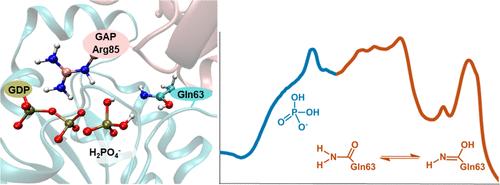
We present a systematic evaluation of different possible reaction mechanisms for GTP hydrolysis in RhoA, a member of the Ras superfamily of enzymes that uses this reaction to switch from an active to an inactive conformation. These enzymes are activated by the presence of a GTPase activating protein (or GAP) that forms an intimate complex with residues of the two proteins present in the active site. We have explored the multidimensional reactional free energy landscape in the active site of the complex formed by RhoA and p50RhoGAP. Our molecular dynamics simulations show that the activating enzyme p50RhoGAP establishes catalytically important interactions with the phosphate groups of GTP through its so-called arginine finger (Arg85) and also with the RhoA residue Gln63. This is a key residue because it not only interacts with the nucleophilic water molecule but also participates actively in the reaction mechanism. Adaptive string method simulations using hybrid quantum mechanics/molecular mechanics (QM/MM) potentials with both tight-binding and density functional Hamiltonians show that GTP hydrolysis proceeds through the formation of a metaphosphate metastable species. Mechanistic proposals differ in the proton transfer rearrangements required to form the inorganic phosphate ion. Our simulations discard a solvent-assisted mechanism and point to the participation of Gln63 in the proton transfer process by means of the side chain tautomerism from the amide to the imide form. The proton transfer required to recover the amide form of Gln63 requires the participation of the inorganic phosphate, and it is the rate-limiting step of the process, with a free energy barrier of 20.2 kcal mol–1 at the B3LYPD3/MM level, in good agreement with the experimentally derived value. The amide–imide tautomerism could also be relevant in other enzymes, facilitating proton transfer events in complex mechanisms.
期刊介绍:
ACS Catalysis is an esteemed journal that publishes original research in the fields of heterogeneous catalysis, molecular catalysis, and biocatalysis. It offers broad coverage across diverse areas such as life sciences, organometallics and synthesis, photochemistry and electrochemistry, drug discovery and synthesis, materials science, environmental protection, polymer discovery and synthesis, and energy and fuels.
The scope of the journal is to showcase innovative work in various aspects of catalysis. This includes new reactions and novel synthetic approaches utilizing known catalysts, the discovery or modification of new catalysts, elucidation of catalytic mechanisms through cutting-edge investigations, practical enhancements of existing processes, as well as conceptual advances in the field. Contributions to ACS Catalysis can encompass both experimental and theoretical research focused on catalytic molecules, macromolecules, and materials that exhibit catalytic turnover.



 京公网安备 11010802042870号
京ICP备2023020795号-1
京公网安备 11010802042870号
京ICP备2023020795号-1

 分享
分享
 求助内容:
求助内容: 应助结果提醒方式:
 扫码关注我们
