Meilin Liu, Yaru Sun, Yi Zhang, Yufu Liu, Zhengbing Liang, Junhao Liu, Hongbao Xin, Xiancheng Zeng, Qingsong Mei
{"title":"Near-Infrared Nanothermometer Reveals Temperature Discrepancy between Organs and Body Surface for Heatstroke Prevention","authors":"Meilin Liu, Yaru Sun, Yi Zhang, Yufu Liu, Zhengbing Liang, Junhao Liu, Hongbao Xin, Xiancheng Zeng, Qingsong Mei","doi":"10.1021/acs.nanolett.4c06532","DOIUrl":null,"url":null,"abstract":"Organ temperatures often vary significantly from body surface temperatures during heatstroke, leading to acute organ failure, although body temperature is continuously controlled. However, the exact temperature discrepancy between them remains unclear due to a lack of noninvasive techniques for real-time monitoring of organ temperature fluctuations. Herein, we developed a near-infrared emissive nanothermometer by codoping Nd<sup>3+</sup> and Yb<sup>3+</sup> to produce two distinct emissions at 980 and 1330 nm under 808 nm excitation. These emissions demonstrated differential responses to temperature variations, enabling the construction of a ratiometric nanoprobe for accurate temperature detection. Notably, the nanoprobe rapidly accumulated in mouse liver after intravenous injection, revealing that liver showed consistently higher temperature than rectum by approximately 1.5 °C. Moreover, liver injury was found to begin at a rectal temperature of 42 °C, rather than the 43 °C conventionally used in heatstroke models. These findings introduce a robust nanothermometer for accurately understanding the pathological progression of heat-related illnesses.","PeriodicalId":53,"journal":{"name":"Nano Letters","volume":"52 1","pages":""},"PeriodicalIF":9.1000,"publicationDate":"2025-02-28","publicationTypes":"Journal Article","fieldsOfStudy":null,"isOpenAccess":false,"openAccessPdf":"","citationCount":"0","resultStr":null,"platform":"Semanticscholar","paperid":null,"PeriodicalName":"Nano Letters","FirstCategoryId":"88","ListUrlMain":"https://doi.org/10.1021/acs.nanolett.4c06532","RegionNum":1,"RegionCategory":"材料科学","ArticlePicture":[],"TitleCN":null,"AbstractTextCN":null,"PMCID":null,"EPubDate":"","PubModel":"","JCR":"Q1","JCRName":"CHEMISTRY, MULTIDISCIPLINARY","Score":null,"Total":0}
引用次数: 0
Abstract
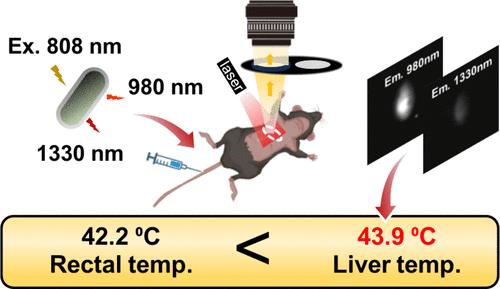
Organ temperatures often vary significantly from body surface temperatures during heatstroke, leading to acute organ failure, although body temperature is continuously controlled. However, the exact temperature discrepancy between them remains unclear due to a lack of noninvasive techniques for real-time monitoring of organ temperature fluctuations. Herein, we developed a near-infrared emissive nanothermometer by codoping Nd3+ and Yb3+ to produce two distinct emissions at 980 and 1330 nm under 808 nm excitation. These emissions demonstrated differential responses to temperature variations, enabling the construction of a ratiometric nanoprobe for accurate temperature detection. Notably, the nanoprobe rapidly accumulated in mouse liver after intravenous injection, revealing that liver showed consistently higher temperature than rectum by approximately 1.5 °C. Moreover, liver injury was found to begin at a rectal temperature of 42 °C, rather than the 43 °C conventionally used in heatstroke models. These findings introduce a robust nanothermometer for accurately understanding the pathological progression of heat-related illnesses.
期刊介绍:
Nano Letters serves as a dynamic platform for promptly disseminating original results in fundamental, applied, and emerging research across all facets of nanoscience and nanotechnology. A pivotal criterion for inclusion within Nano Letters is the convergence of at least two different areas or disciplines, ensuring a rich interdisciplinary scope. The journal is dedicated to fostering exploration in diverse areas, including:
- Experimental and theoretical findings on physical, chemical, and biological phenomena at the nanoscale
- Synthesis, characterization, and processing of organic, inorganic, polymer, and hybrid nanomaterials through physical, chemical, and biological methodologies
- Modeling and simulation of synthetic, assembly, and interaction processes
- Realization of integrated nanostructures and nano-engineered devices exhibiting advanced performance
- Applications of nanoscale materials in living and environmental systems
Nano Letters is committed to advancing and showcasing groundbreaking research that intersects various domains, fostering innovation and collaboration in the ever-evolving field of nanoscience and nanotechnology.



 京公网安备 11010802042870号
京ICP备2023020795号-1
京公网安备 11010802042870号
京ICP备2023020795号-1

 分享
分享
 求助内容:
求助内容: 应助结果提醒方式:
 扫码关注我们
