Quantitative trait loci mapping of circulating metabolites in cerebrospinal fluid to uncover biological mechanisms involved in brain-related phenotypes
Lianne M. Reus, Toni Boltz, Marcelo Francia, Merel Bot, Naren Ramesh, Maria Koromina, Yolande A. L. Pijnenburg, Anouk den Braber, Wiesje M. van der Flier, Pieter Jelle Visser, Sven J. van der Lee, Betty M. Tijms, Charlotte E. Teunissen, Loes Olde Loohuis, Roel A. Ophoff
{"title":"Quantitative trait loci mapping of circulating metabolites in cerebrospinal fluid to uncover biological mechanisms involved in brain-related phenotypes","authors":"Lianne M. Reus, Toni Boltz, Marcelo Francia, Merel Bot, Naren Ramesh, Maria Koromina, Yolande A. L. Pijnenburg, Anouk den Braber, Wiesje M. van der Flier, Pieter Jelle Visser, Sven J. van der Lee, Betty M. Tijms, Charlotte E. Teunissen, Loes Olde Loohuis, Roel A. Ophoff","doi":"10.1038/s41380-025-02934-0","DOIUrl":null,"url":null,"abstract":"Genomic studies of molecular traits have provided mechanistic insights into complex disease, though these lag behind for brain-related traits due to the inaccessibility of brain tissue. We leveraged cerebrospinal fluid (CSF) to study neurobiological mechanisms in vivo, measuring 5543 CSF metabolites, the largest panel in CSF to date, in 977 individuals of European ancestry. Individuals originated from two separate cohorts including cognitively healthy subjects (n = 490) and a well-characterized memory clinic sample, the Amsterdam Dementia Cohort (ADC, n = 487). We performed metabolite quantitative trait loci (mQTL) mapping on CSF metabolomics and found 126 significant mQTLs, representing 65 unique CSF metabolites across 51 independent loci. To better understand the role of CSF mQTLs in brain-related disorders we integrated our CSF mQTL results with pre-existing summary statistics on brain traits, identifying 34 genetic associations between CSF metabolites and brain traits. Over 90% of significant mQTLs demonstrated colocalized associations with brain-specific gene expression, unveiling potential neurobiological pathways.","PeriodicalId":19008,"journal":{"name":"Molecular Psychiatry","volume":"30 8","pages":"3478-3490"},"PeriodicalIF":10.1000,"publicationDate":"2025-02-28","publicationTypes":"Journal Article","fieldsOfStudy":null,"isOpenAccess":false,"openAccessPdf":"","citationCount":"0","resultStr":null,"platform":"Semanticscholar","paperid":null,"PeriodicalName":"Molecular Psychiatry","FirstCategoryId":"3","ListUrlMain":"https://www.nature.com/articles/s41380-025-02934-0","RegionNum":1,"RegionCategory":"医学","ArticlePicture":[],"TitleCN":null,"AbstractTextCN":null,"PMCID":null,"EPubDate":"","PubModel":"","JCR":"Q1","JCRName":"BIOCHEMISTRY & MOLECULAR BIOLOGY","Score":null,"Total":0}
引用次数: 0
Abstract
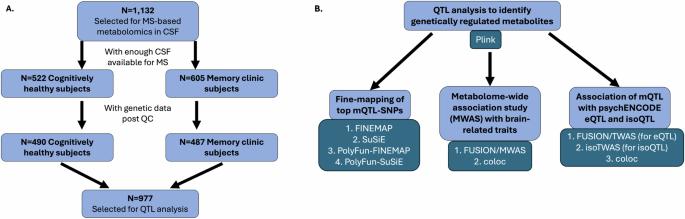
Genomic studies of molecular traits have provided mechanistic insights into complex disease, though these lag behind for brain-related traits due to the inaccessibility of brain tissue. We leveraged cerebrospinal fluid (CSF) to study neurobiological mechanisms in vivo, measuring 5543 CSF metabolites, the largest panel in CSF to date, in 977 individuals of European ancestry. Individuals originated from two separate cohorts including cognitively healthy subjects (n = 490) and a well-characterized memory clinic sample, the Amsterdam Dementia Cohort (ADC, n = 487). We performed metabolite quantitative trait loci (mQTL) mapping on CSF metabolomics and found 126 significant mQTLs, representing 65 unique CSF metabolites across 51 independent loci. To better understand the role of CSF mQTLs in brain-related disorders we integrated our CSF mQTL results with pre-existing summary statistics on brain traits, identifying 34 genetic associations between CSF metabolites and brain traits. Over 90% of significant mQTLs demonstrated colocalized associations with brain-specific gene expression, unveiling potential neurobiological pathways.
期刊介绍:
Molecular Psychiatry focuses on publishing research that aims to uncover the biological mechanisms behind psychiatric disorders and their treatment. The journal emphasizes studies that bridge pre-clinical and clinical research, covering cellular, molecular, integrative, clinical, imaging, and psychopharmacology levels.



 京公网安备 11010802042870号
京ICP备2023020795号-1
京公网安备 11010802042870号
京ICP备2023020795号-1

 分享
分享
 求助内容:
求助内容: 应助结果提醒方式:
 扫码关注我们
