{"title":"A Tutorial on Movable Antennas for Wireless Networks","authors":"Lipeng Zhu;Wenyan Ma;Weidong Mei;Yong Zeng;Qingqing Wu;Boyu Ning;Zhenyu Xiao;Xiaodan Shao;Jun Zhang;Rui Zhang","doi":"10.1109/COMST.2025.3546373","DOIUrl":null,"url":null,"abstract":"Movable antenna (MA) has been recognized as a promising technology to enhance the performance of wireless communication and sensing by enabling antenna movement. Such a significant paradigm shift from conventional fixed antennas (FAs) to MAs offers tremendous new opportunities towards realizing more versatile, adaptive and efficient next-generation wireless networks such as 6G. In this paper, we provide a comprehensive tutorial on the fundamentals and advancements in the area of MA-empowered wireless networks. First, we overview the historical development and contemporary applications of MA technologies. Next, to characterize the continuous variation in wireless channels with respect to antenna position and/or orientation, we present new field-response channel models tailored for MAs, which are applicable to narrowband and wideband systems as well as far-field and near-field propagation conditions. Subsequently, we review the state-of-the-art architectures for implementing MAs and discuss their practical constraints. A general optimization framework is then formulated to fully exploit the spatial degrees of freedom (DoFs) in antenna movement for performance enhancement in wireless systems. In particular, we delve into two major design issues for MA systems. First, we address the intricate antenna movement optimization problem for various communication and/or sensing systems to maximize the performance gains achievable by MAs. Second, we deal with the challenging channel acquisition issue in MA systems for reconstructing the channel mapping between arbitrary antenna positions inside the transmitter and receiver regions. Moreover, we show existing prototypes developed for MA-aided communication/sensing and the experimental results based on them. Finally, the extension of MA design to other wireless systems and its synergy with other emerging wireless technologies are discussed. We also highlight promising research directions in this area to inspire future investigations.","PeriodicalId":55029,"journal":{"name":"IEEE Communications Surveys and Tutorials","volume":"28 ","pages":"3002-3054"},"PeriodicalIF":34.4000,"publicationDate":"2025-02-27","publicationTypes":"Journal Article","fieldsOfStudy":null,"isOpenAccess":false,"openAccessPdf":"","citationCount":"0","resultStr":null,"platform":"Semanticscholar","paperid":null,"PeriodicalName":"IEEE Communications Surveys and Tutorials","FirstCategoryId":"94","ListUrlMain":"https://ieeexplore.ieee.org/document/10906511/","RegionNum":1,"RegionCategory":"计算机科学","ArticlePicture":[],"TitleCN":null,"AbstractTextCN":null,"PMCID":null,"EPubDate":"","PubModel":"","JCR":"Q1","JCRName":"COMPUTER SCIENCE, INFORMATION SYSTEMS","Score":null,"Total":0}
引用次数: 0
Abstract
Movable antenna (MA) has been recognized as a promising technology to enhance the performance of wireless communication and sensing by enabling antenna movement. Such a significant paradigm shift from conventional fixed antennas (FAs) to MAs offers tremendous new opportunities towards realizing more versatile, adaptive and efficient next-generation wireless networks such as 6G. In this paper, we provide a comprehensive tutorial on the fundamentals and advancements in the area of MA-empowered wireless networks. First, we overview the historical development and contemporary applications of MA technologies. Next, to characterize the continuous variation in wireless channels with respect to antenna position and/or orientation, we present new field-response channel models tailored for MAs, which are applicable to narrowband and wideband systems as well as far-field and near-field propagation conditions. Subsequently, we review the state-of-the-art architectures for implementing MAs and discuss their practical constraints. A general optimization framework is then formulated to fully exploit the spatial degrees of freedom (DoFs) in antenna movement for performance enhancement in wireless systems. In particular, we delve into two major design issues for MA systems. First, we address the intricate antenna movement optimization problem for various communication and/or sensing systems to maximize the performance gains achievable by MAs. Second, we deal with the challenging channel acquisition issue in MA systems for reconstructing the channel mapping between arbitrary antenna positions inside the transmitter and receiver regions. Moreover, we show existing prototypes developed for MA-aided communication/sensing and the experimental results based on them. Finally, the extension of MA design to other wireless systems and its synergy with other emerging wireless technologies are discussed. We also highlight promising research directions in this area to inspire future investigations.
期刊介绍:
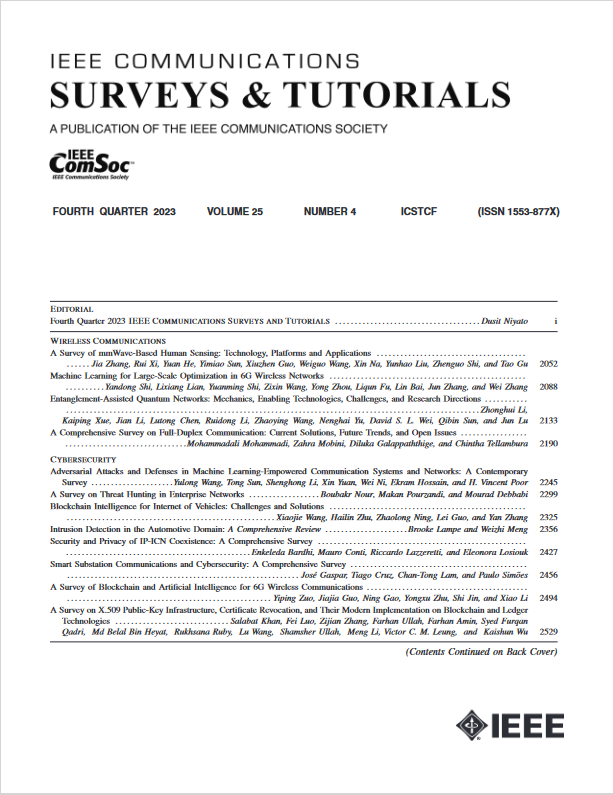
IEEE Communications Surveys & Tutorials is an online journal published by the IEEE Communications Society for tutorials and surveys covering all aspects of the communications field. Telecommunications technology is progressing at a rapid pace, and the IEEE Communications Society is committed to providing researchers and other professionals the information and tools to stay abreast. IEEE Communications Surveys and Tutorials focuses on integrating and adding understanding to the existing literature on communications, putting results in context. Whether searching for in-depth information about a familiar area or an introduction into a new area, IEEE Communications Surveys & Tutorials aims to be the premier source of peer-reviewed, comprehensive tutorials and surveys, and pointers to further sources. IEEE Communications Surveys & Tutorials publishes only articles exclusively written for IEEE Communications Surveys & Tutorials and go through a rigorous review process before their publication in the quarterly issues.
A tutorial article in the IEEE Communications Surveys & Tutorials should be designed to help the reader to become familiar with and learn something specific about a chosen topic. In contrast, the term survey, as applied here, is defined to mean a survey of the literature. A survey article in IEEE Communications Surveys & Tutorials should provide a comprehensive review of developments in a selected area, covering its development from its inception to its current state and beyond, and illustrating its development through liberal citations from the literature. Both tutorials and surveys should be tutorial in nature and should be written in a style comprehensible to readers outside the specialty of the article.



 京公网安备 11010802042870号
京ICP备2023020795号-1
京公网安备 11010802042870号
京ICP备2023020795号-1

 分享
分享
 求助内容:
求助内容: 应助结果提醒方式:
 扫码关注我们
