Ya Guo, Lincoln N Taylor, Ruchir Mishra, Adam G Dolezal, Bryony C Bonning
{"title":"Gut-binding peptides as potential tools to reduce virus binding to honey bee gut surface proteins.","authors":"Ya Guo, Lincoln N Taylor, Ruchir Mishra, Adam G Dolezal, Bryony C Bonning","doi":"10.1128/aem.02418-24","DOIUrl":null,"url":null,"abstract":"<p><p>Colonies of the western honey bee, <i>Apis mellifera,</i> are severely impacted by a wide range of stressors, with <i>Varroa</i> mites and associated viruses being among the most serious threats to honey bee health. Viral load plays an important role in colony demise, with the iflavirus <i>Deformed wing virus</i> (DWV) and the dicistrovirus <i>Israeli acute paralysis virus</i> (IAPV) being of particular concern. By feeding adult honey bees on a phage display library to identify gut-binding peptides (R. Mishra, Y. Guo, P. Kumar, P. E. Cantón, C. S. Tavares, R. Banerjee, S. Kuwar, and B. C. Bonning, Curr Res Insect Sci, 1:100012, https://doi.org/10.1016/j.cris.2021.100012), we identified Bee midgut-Binding Peptide (BBP2.1), which shares 75% and 85% identity with regions on the DWV capsid protein and IAPV ORFx protein, respectively. These viral protein domains are likely to be instrumental in virus interaction with the honey bee gut. Pull-down assays with honey bee gut brush border membrane vesicles were used to confirm peptide-mCherry binding to the gut for BBP2.1 and the two similar virus-derived sequences, peptides BBP2.1<sup>DWV</sup> and BBP2.1<sup>IAPV</sup>. <i>In vitro</i> competition assays showed that all three peptides compete with both IAPV and DWV virions for binding to honey bee gut-derived brush border membrane vesicles, suggesting that the three peptides and the two viruses bind to the same proteins. Ingestion of BBP2.1 reduced the movement of DWV, but not IAPV from the honey bee gut into the body and did not rescue IAPV-associated mortality. These results are discussed in relation to the biological function of IAPV ORFx and the potential utility of virus-blocking peptides for suppression of virus infection to reduce virus load and virus-associated honey bee mortality.IMPORTANCEEach year, approximately 40% of managed honey bee hives in the United States are lost due to a variety of environmental stressors. Although increases in virus infection are among the most important factors resulting in colony loss, there are currently no effective tools for the management of virus infection in honey bees. In this study, we identified a peptide that binds to the gut of the honey bee and competes with two of the most important honey bee viruses, Israeli acute paralysis virus of bees (IAPV) and Deformed wing virus (DWV), for binding to gut proteins. <i>In vivo</i> competition between this peptide and DWV demonstrates the potential utility of gut-binding peptides for the protection of honey bees from virus infection for reduced virus-associated honey bee mortality.</p>","PeriodicalId":8002,"journal":{"name":"Applied and Environmental Microbiology","volume":" ","pages":"e0241824"},"PeriodicalIF":3.7000,"publicationDate":"2025-03-19","publicationTypes":"Journal Article","fieldsOfStudy":null,"isOpenAccess":false,"openAccessPdf":"https://www.ncbi.nlm.nih.gov/pmc/articles/PMC11921348/pdf/","citationCount":"0","resultStr":null,"platform":"Semanticscholar","paperid":null,"PeriodicalName":"Applied and Environmental Microbiology","FirstCategoryId":"99","ListUrlMain":"https://doi.org/10.1128/aem.02418-24","RegionNum":2,"RegionCategory":"生物学","ArticlePicture":[],"TitleCN":null,"AbstractTextCN":null,"PMCID":null,"EPubDate":"2025/2/28 0:00:00","PubModel":"Epub","JCR":"Q2","JCRName":"BIOTECHNOLOGY & APPLIED MICROBIOLOGY","Score":null,"Total":0}
引用次数: 0
Abstract
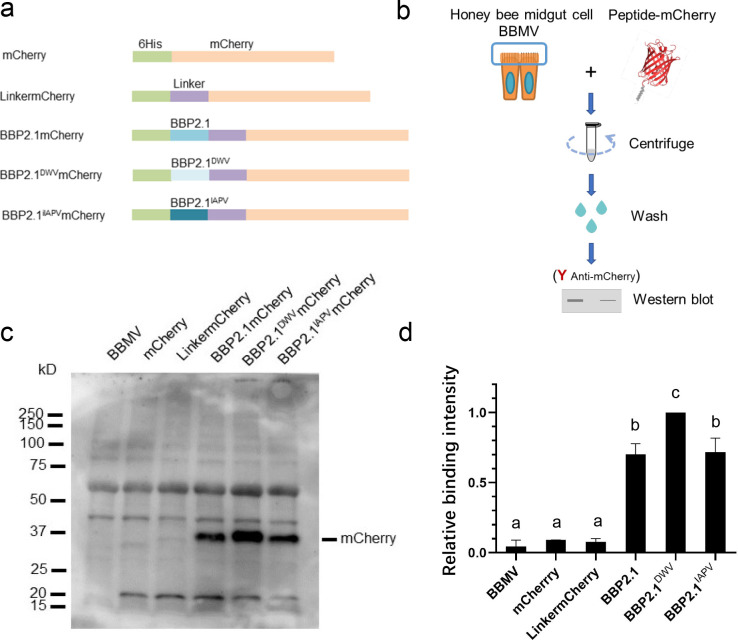
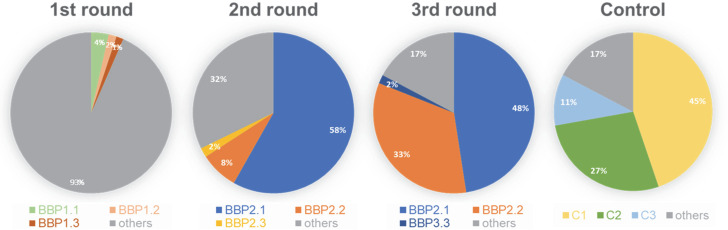
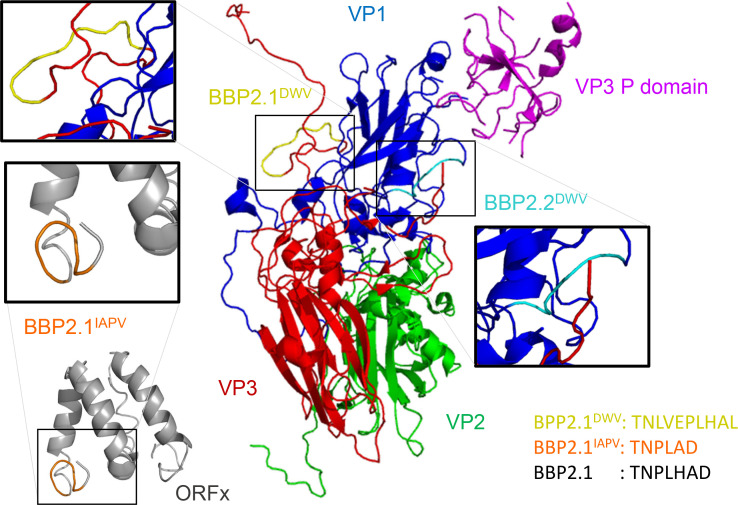
Colonies of the western honey bee, Apis mellifera, are severely impacted by a wide range of stressors, with Varroa mites and associated viruses being among the most serious threats to honey bee health. Viral load plays an important role in colony demise, with the iflavirus Deformed wing virus (DWV) and the dicistrovirus Israeli acute paralysis virus (IAPV) being of particular concern. By feeding adult honey bees on a phage display library to identify gut-binding peptides (R. Mishra, Y. Guo, P. Kumar, P. E. Cantón, C. S. Tavares, R. Banerjee, S. Kuwar, and B. C. Bonning, Curr Res Insect Sci, 1:100012, https://doi.org/10.1016/j.cris.2021.100012), we identified Bee midgut-Binding Peptide (BBP2.1), which shares 75% and 85% identity with regions on the DWV capsid protein and IAPV ORFx protein, respectively. These viral protein domains are likely to be instrumental in virus interaction with the honey bee gut. Pull-down assays with honey bee gut brush border membrane vesicles were used to confirm peptide-mCherry binding to the gut for BBP2.1 and the two similar virus-derived sequences, peptides BBP2.1DWV and BBP2.1IAPV. In vitro competition assays showed that all three peptides compete with both IAPV and DWV virions for binding to honey bee gut-derived brush border membrane vesicles, suggesting that the three peptides and the two viruses bind to the same proteins. Ingestion of BBP2.1 reduced the movement of DWV, but not IAPV from the honey bee gut into the body and did not rescue IAPV-associated mortality. These results are discussed in relation to the biological function of IAPV ORFx and the potential utility of virus-blocking peptides for suppression of virus infection to reduce virus load and virus-associated honey bee mortality.IMPORTANCEEach year, approximately 40% of managed honey bee hives in the United States are lost due to a variety of environmental stressors. Although increases in virus infection are among the most important factors resulting in colony loss, there are currently no effective tools for the management of virus infection in honey bees. In this study, we identified a peptide that binds to the gut of the honey bee and competes with two of the most important honey bee viruses, Israeli acute paralysis virus of bees (IAPV) and Deformed wing virus (DWV), for binding to gut proteins. In vivo competition between this peptide and DWV demonstrates the potential utility of gut-binding peptides for the protection of honey bees from virus infection for reduced virus-associated honey bee mortality.
西方蜜蜂(Apis mellifera)的蜂群受到各种压力因素的严重影响,其中瓦螨和相关病毒是对蜜蜂健康最严重的威胁之一。病毒载量在蜂群死亡中起着重要作用,特别是黄疸病毒变形翼病毒(DWV)和以色列急性麻痹病毒(IAPV)。通过在噬菌体展示文库上饲养成年蜜蜂来鉴定肠道结合肽(R. Mishra, Y. Guo, P. Kumar, P. E. Cantón, C. S. Tavares, R. Banerjee, S. Kuwar, and B. C. Bonning, Curr Res Insect Sci, 1:100012, https://doi.org/10.1016/j.cris.2021.100012),我们鉴定出蜜蜂中肠道结合肽(BBP2.1),它与DWV衣壳蛋白和IAPV ORFx蛋白上的区域分别具有75%和85%的相似性。这些病毒蛋白结构域可能在病毒与蜜蜂肠道的相互作用中起重要作用。利用蜜蜂肠道刷状边界膜囊泡进行下拉实验,证实了肽- mcherry与BBP2.1以及两个类似的病毒衍生序列肽BBP2.1 dwv和BBP2.1 iapv的结合。体外竞争分析表明,这三种多肽都与IAPV和DWV病毒粒子竞争,以结合蜜蜂肠道源性刷状膜囊泡,这表明这三种多肽和两种病毒结合相同的蛋白质。摄入BBP2.1减少了DWV的移动,但没有减少IAPV从蜜蜂肠道进入体内的移动,也没有挽救IAPV相关的死亡率。这些结果与IAPV ORFx的生物学功能以及病毒阻断肽在抑制病毒感染以减少病毒载量和病毒相关的蜜蜂死亡率方面的潜在应用有关。每年,由于各种环境压力因素,美国大约有40%的管理蜂箱消失。虽然病毒感染的增加是导致蜂群损失的最重要因素之一,但目前还没有有效的工具来管理蜜蜂中的病毒感染。在这项研究中,我们发现了一种与蜜蜂肠道结合的肽,并与两种最重要的蜜蜂病毒,以色列蜜蜂急性麻痹病毒(IAPV)和变形翼病毒(DWV)竞争,以与肠道蛋白结合。该肽和DWV之间的体内竞争表明,肠道结合肽在保护蜜蜂免受病毒感染和降低病毒相关蜜蜂死亡率方面具有潜在的效用。
期刊介绍:
Applied and Environmental Microbiology (AEM) publishes papers that make significant contributions to (a) applied microbiology, including biotechnology, protein engineering, bioremediation, and food microbiology, (b) microbial ecology, including environmental, organismic, and genomic microbiology, and (c) interdisciplinary microbiology, including invertebrate microbiology, plant microbiology, aquatic microbiology, and geomicrobiology.



 京公网安备 11010802042870号
京ICP备2023020795号-1
京公网安备 11010802042870号
京ICP备2023020795号-1

 分享
分享
 求助内容:
求助内容: 应助结果提醒方式:
 扫码关注我们
