Effects of multisystem exercises on balance, postural stability, mobility, walking speed, and pain in patients with diabetic peripheral neuropathy: a randomized controlled trial.
Sidra Khurshid, Aruba Saeed, Muhammad Kashif, Aniqa Nasreen, Huma Riaz
{"title":"Effects of multisystem exercises on balance, postural stability, mobility, walking speed, and pain in patients with diabetic peripheral neuropathy: a randomized controlled trial.","authors":"Sidra Khurshid, Aruba Saeed, Muhammad Kashif, Aniqa Nasreen, Huma Riaz","doi":"10.1186/s12868-024-00924-6","DOIUrl":null,"url":null,"abstract":"<p><strong>Background: </strong>Diabetic peripheral neuropathy (DPN), a common complication of diabetes mellitus, is associated with peripheral nerve damage, leading to balance impairments, postural instability, and reduced mobility. Addressing these challenges requires comprehensive interventions that target multiple deficits simultaneously. Evidence suggests that exercise programs combining balance, proprioception, strength, and reaction time training can improve postural stability, enhance mobility, and alleviate pain in individuals with DPN.</p><p><strong>Objective: </strong>The objective of this study was to compare the effects of multisystem exercises and conventional exercises on balance, postural stability, mobility, and walking speed and to reduce pain in patients with diabetic peripheral neuropathy.</p><p><strong>Methods: </strong>This double-blinded, two-arm parallel design randomized controlled trial was conducted at DHQ Hospital, Pakpattan, Pakistan. A total of 50 participants who met the inclusion criteria were recruited using the nonprobability convenience sampling technique. They were randomly assigned to either a multisystem physical exercise (MPE) group (n = 26) and a conventional exercise group (n = 24). The MPE program included balance, proprioception, strength, and reaction time training, while the control group received conventional exercises, consisted of strength, balance, stretching, and range of motion exercises. Both groups underwent 30 min intervention sessions, 3 times per week, for 8 weeks. The outcome measures used for assessing the balance, postural stability, mobility, and pain included the Berg balance scale (BBS), functional reach test (FRT), time up and go test (TUG), 10 min walk test (10-MWT), and numeric pain rating scale (NPRS). The data was analyzed using SPSS version 26.</p><p><strong>Results: </strong>Significant group and time interactions were observed for all outcome measures including BBS, FRT, TUG, 10-MWT, and NPRS (p < 0.001). The between-group analysis also revealed significant differences between the multisystem physical exercise group and the conventional exercise group at both the 4th week and 8th week for BBS, FRT, TUG, 10-MWT, and NPRS (p < 0.05).</p><p><strong>Conclusion: </strong>The study concluded that multisystem exercises resulted in significant improvement in balance, postural stability, mobility, and walking speed, along with reduction in pain, compared to conventional exercises in patients with diabetic peripheral neuropathy.</p><p><strong>Trial registration: </strong>This randomized controlled study was registered prospectively on November 11th, 2023 with the ClinicalTrials.gov (NCT06130917).</p>","PeriodicalId":9031,"journal":{"name":"BMC Neuroscience","volume":"26 1","pages":"16"},"PeriodicalIF":2.3000,"publicationDate":"2025-02-27","publicationTypes":"Journal Article","fieldsOfStudy":null,"isOpenAccess":false,"openAccessPdf":"https://www.ncbi.nlm.nih.gov/pmc/articles/PMC11869634/pdf/","citationCount":"0","resultStr":null,"platform":"Semanticscholar","paperid":null,"PeriodicalName":"BMC Neuroscience","FirstCategoryId":"3","ListUrlMain":"https://doi.org/10.1186/s12868-024-00924-6","RegionNum":4,"RegionCategory":"医学","ArticlePicture":[],"TitleCN":null,"AbstractTextCN":null,"PMCID":null,"EPubDate":"","PubModel":"","JCR":"Q3","JCRName":"NEUROSCIENCES","Score":null,"Total":0}
引用次数: 0
Abstract
Background: Diabetic peripheral neuropathy (DPN), a common complication of diabetes mellitus, is associated with peripheral nerve damage, leading to balance impairments, postural instability, and reduced mobility. Addressing these challenges requires comprehensive interventions that target multiple deficits simultaneously. Evidence suggests that exercise programs combining balance, proprioception, strength, and reaction time training can improve postural stability, enhance mobility, and alleviate pain in individuals with DPN.
Objective: The objective of this study was to compare the effects of multisystem exercises and conventional exercises on balance, postural stability, mobility, and walking speed and to reduce pain in patients with diabetic peripheral neuropathy.
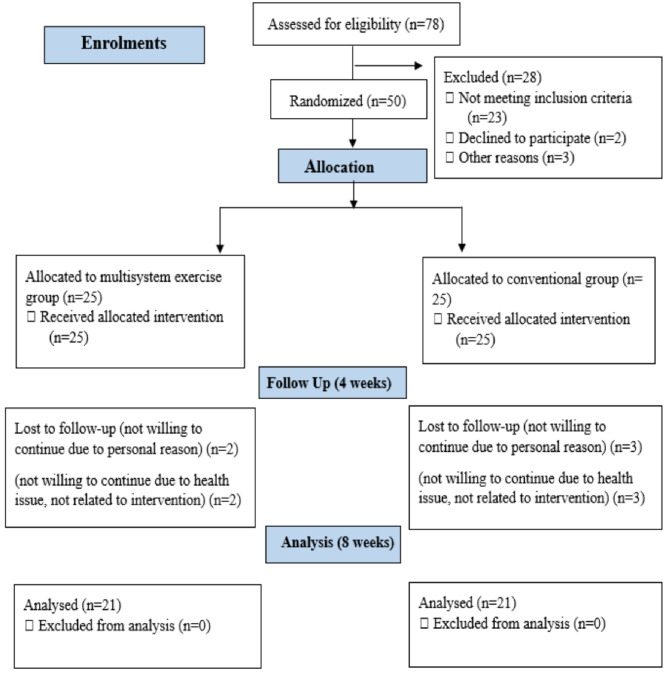
Methods: This double-blinded, two-arm parallel design randomized controlled trial was conducted at DHQ Hospital, Pakpattan, Pakistan. A total of 50 participants who met the inclusion criteria were recruited using the nonprobability convenience sampling technique. They were randomly assigned to either a multisystem physical exercise (MPE) group (n = 26) and a conventional exercise group (n = 24). The MPE program included balance, proprioception, strength, and reaction time training, while the control group received conventional exercises, consisted of strength, balance, stretching, and range of motion exercises. Both groups underwent 30 min intervention sessions, 3 times per week, for 8 weeks. The outcome measures used for assessing the balance, postural stability, mobility, and pain included the Berg balance scale (BBS), functional reach test (FRT), time up and go test (TUG), 10 min walk test (10-MWT), and numeric pain rating scale (NPRS). The data was analyzed using SPSS version 26.
Results: Significant group and time interactions were observed for all outcome measures including BBS, FRT, TUG, 10-MWT, and NPRS (p < 0.001). The between-group analysis also revealed significant differences between the multisystem physical exercise group and the conventional exercise group at both the 4th week and 8th week for BBS, FRT, TUG, 10-MWT, and NPRS (p < 0.05).
Conclusion: The study concluded that multisystem exercises resulted in significant improvement in balance, postural stability, mobility, and walking speed, along with reduction in pain, compared to conventional exercises in patients with diabetic peripheral neuropathy.
Trial registration: This randomized controlled study was registered prospectively on November 11th, 2023 with the ClinicalTrials.gov (NCT06130917).
期刊介绍:
BMC Neuroscience is an open access, peer-reviewed journal that considers articles on all aspects of neuroscience, welcoming studies that provide insight into the molecular, cellular, developmental, genetic and genomic, systems, network, cognitive and behavioral aspects of nervous system function in both health and disease. Both experimental and theoretical studies are within scope, as are studies that describe methodological approaches to monitoring or manipulating nervous system function.



 京公网安备 11010802042870号
京ICP备2023020795号-1
京公网安备 11010802042870号
京ICP备2023020795号-1

 分享
分享
 求助内容:
求助内容: 应助结果提醒方式:
 扫码关注我们
