Saurabh M. Das, Patrick Harrison, Srikakulapu Kiranbabu, Xuyang Zhou, Wolfgang Ludwig, Edgar F. Rauch, Michael Herbig, Christian H. Liebscher
{"title":"Correlating Grain Boundary Character and Composition in 3-Dimensions Using 4D-Scanning Precession Electron Diffraction and Atom Probe Tomography","authors":"Saurabh M. Das, Patrick Harrison, Srikakulapu Kiranbabu, Xuyang Zhou, Wolfgang Ludwig, Edgar F. Rauch, Michael Herbig, Christian H. Liebscher","doi":"10.1002/smtd.202401650","DOIUrl":null,"url":null,"abstract":"<p>Grain boundaries (GBs) are dominant imperfections in nanocrystalline materials that form a complex 3D network. Solute segregation to GBs is strongly coupled to the GB character, which governs the stability and macroscopic properties of nanostructured materials. Here, a 3D transmission electron microscopy and atom probe tomography (APT) correlation framework are developed to retrieve the GB character and composition at the highest spatial resolution and chemical sensitivity by correlating 4D scanning precession electron diffraction tomography (4D-SPEDT) and APT on the same sample. The 3D GB habit plane network and explore the preferential segregation of Cu and Si in a nanocrystalline Ni-W alloy is obtained. The correlation of structural and compositional information reveals that Cu segregates predominantly along high-angle GBs and incoherent twin boundaries, whereas Si segregation to low-angle and incommensurate GBs is observed. The novel full 3D correlative approach employed in this work opens up new possibilities to explore the 3D crystallographic and compositional nature of nanomaterials. This lays the foundation for both probing the true 3D structure-chemistry at the sub-nanometer scale and, consequentially, tailoring the macroscopic properties of advanced nanomaterials.</p>","PeriodicalId":229,"journal":{"name":"Small Methods","volume":"9 5","pages":""},"PeriodicalIF":9.1000,"publicationDate":"2025-02-28","publicationTypes":"Journal Article","fieldsOfStudy":null,"isOpenAccess":false,"openAccessPdf":"https://onlinelibrary.wiley.com/doi/epdf/10.1002/smtd.202401650","citationCount":"0","resultStr":null,"platform":"Semanticscholar","paperid":null,"PeriodicalName":"Small Methods","FirstCategoryId":"88","ListUrlMain":"https://onlinelibrary.wiley.com/doi/10.1002/smtd.202401650","RegionNum":2,"RegionCategory":"材料科学","ArticlePicture":[],"TitleCN":null,"AbstractTextCN":null,"PMCID":null,"EPubDate":"","PubModel":"","JCR":"Q1","JCRName":"CHEMISTRY, PHYSICAL","Score":null,"Total":0}
引用次数: 0
Abstract
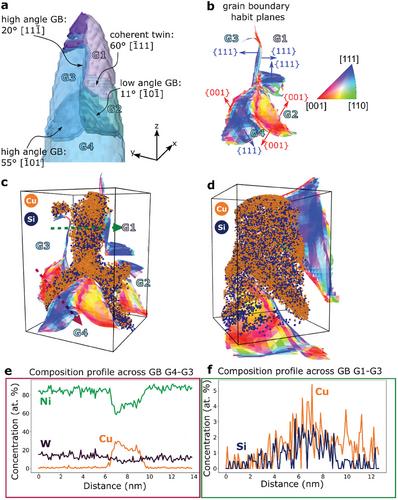
Grain boundaries (GBs) are dominant imperfections in nanocrystalline materials that form a complex 3D network. Solute segregation to GBs is strongly coupled to the GB character, which governs the stability and macroscopic properties of nanostructured materials. Here, a 3D transmission electron microscopy and atom probe tomography (APT) correlation framework are developed to retrieve the GB character and composition at the highest spatial resolution and chemical sensitivity by correlating 4D scanning precession electron diffraction tomography (4D-SPEDT) and APT on the same sample. The 3D GB habit plane network and explore the preferential segregation of Cu and Si in a nanocrystalline Ni-W alloy is obtained. The correlation of structural and compositional information reveals that Cu segregates predominantly along high-angle GBs and incoherent twin boundaries, whereas Si segregation to low-angle and incommensurate GBs is observed. The novel full 3D correlative approach employed in this work opens up new possibilities to explore the 3D crystallographic and compositional nature of nanomaterials. This lays the foundation for both probing the true 3D structure-chemistry at the sub-nanometer scale and, consequentially, tailoring the macroscopic properties of advanced nanomaterials.
Small MethodsMaterials Science-General Materials Science
CiteScore
17.40
自引率
1.60%
发文量
347
期刊介绍:
Small Methods is a multidisciplinary journal that publishes groundbreaking research on methods relevant to nano- and microscale research. It welcomes contributions from the fields of materials science, biomedical science, chemistry, and physics, showcasing the latest advancements in experimental techniques.
With a notable 2022 Impact Factor of 12.4 (Journal Citation Reports, Clarivate Analytics, 2023), Small Methods is recognized for its significant impact on the scientific community.
The online ISSN for Small Methods is 2366-9608.



 京公网安备 11010802042870号
京ICP备2023020795号-1
京公网安备 11010802042870号
京ICP备2023020795号-1

 分享
分享
 求助内容:
求助内容: 应助结果提醒方式:
 扫码关注我们
