Michel Zampieri Fidelis, Gabriele Bolzan Baroncello, Eduardo Abreu, Edivaldo dos Santos Filho, Éder Carlos Ferreira de Souza, Giane Gonçalves Lenzi, Rodrigo Brackmann
{"title":"TiO2/Fe2O3 and Fe2O3/TiO2 heterojunction nanocomposites applied to As(III) decontamination","authors":"Michel Zampieri Fidelis, Gabriele Bolzan Baroncello, Eduardo Abreu, Edivaldo dos Santos Filho, Éder Carlos Ferreira de Souza, Giane Gonçalves Lenzi, Rodrigo Brackmann","doi":"10.1007/s11356-025-36156-2","DOIUrl":null,"url":null,"abstract":"<div><p>Arsenic contamination in water, particularly in its toxic form As(III), is a significant environmental issue in Brazil and globally. To address this, simple oxides of Fe<sub>2</sub>O<sub>3</sub> and TiO<sub>2</sub>, along with heterojunction structures TiO<sub>2</sub>/Fe<sub>2</sub>O<sub>3</sub> and Fe<sub>2</sub>O<sub>3</sub>/TiO<sub>2</sub>, were synthesized using an adapted Pechini method for the decontamination of As(III) via heterogeneous photocatalysis. TiO<sub>2</sub> exhibited only the anatase phase, while Fe<sub>2</sub>O<sub>3</sub> showed only the hematite phase (α-Fe<sub>2</sub>O<sub>3</sub>). The Fe<sub>2</sub>O<sub>3</sub>/TiO<sub>2</sub> structure displayed both the hematite and anatase phases, whereas the TiO<sub>2</sub>/Fe<sub>2</sub>O<sub>3</sub> heterojunction exhibited the anatase, rutile, hematite, and maghemite (γ-Fe<sub>2</sub>O<sub>3</sub>) phases. The materials displayed micro/mesoporous characteristics, with surface areas ranging from 20 to 45 m<sup>2</sup> g<sup>−1</sup>, and band gap energies in the range of 2.1 to 3 eV. Hematite was the most effective adsorbent for arsenic. Under UV light irradiation, photolysis achieved 87% oxidation of As(III) in 20 min. The decontamination efficiencies achieved were 63%, 88%, 88%, and 99% for Fe<sub>2</sub>O<sub>3</sub>, TiO<sub>2</sub>, Fe<sub>2</sub>O<sub>3</sub>/TiO<sub>2</sub>, and TiO<sub>2</sub>/Fe<sub>2</sub>O<sub>3</sub>, respectively. Catalyst reuse tests demonstrated excellent stability, with all catalysts maintaining over 80% decontamination efficiency after four cycles. These results highlight the promising potential of TiO<sub>2</sub>/Fe<sub>2</sub>O<sub>3</sub> heterojunctions for efficient and sustainable As(III) decontamination from contaminated water.</p></div>","PeriodicalId":545,"journal":{"name":"Environmental Science and Pollution Research","volume":"32 11","pages":"6839 - 6855"},"PeriodicalIF":5.8000,"publicationDate":"2025-02-28","publicationTypes":"Journal Article","fieldsOfStudy":null,"isOpenAccess":false,"openAccessPdf":"","citationCount":"0","resultStr":null,"platform":"Semanticscholar","paperid":null,"PeriodicalName":"Environmental Science and Pollution Research","FirstCategoryId":"93","ListUrlMain":"https://link.springer.com/article/10.1007/s11356-025-36156-2","RegionNum":3,"RegionCategory":"环境科学与生态学","ArticlePicture":[],"TitleCN":null,"AbstractTextCN":null,"PMCID":null,"EPubDate":"","PubModel":"","JCR":"0","JCRName":"ENVIRONMENTAL SCIENCES","Score":null,"Total":0}
引用次数: 0
Abstract
Arsenic contamination in water, particularly in its toxic form As(III), is a significant environmental issue in Brazil and globally. To address this, simple oxides of Fe2O3 and TiO2, along with heterojunction structures TiO2/Fe2O3 and Fe2O3/TiO2, were synthesized using an adapted Pechini method for the decontamination of As(III) via heterogeneous photocatalysis. TiO2 exhibited only the anatase phase, while Fe2O3 showed only the hematite phase (α-Fe2O3). The Fe2O3/TiO2 structure displayed both the hematite and anatase phases, whereas the TiO2/Fe2O3 heterojunction exhibited the anatase, rutile, hematite, and maghemite (γ-Fe2O3) phases. The materials displayed micro/mesoporous characteristics, with surface areas ranging from 20 to 45 m2 g−1, and band gap energies in the range of 2.1 to 3 eV. Hematite was the most effective adsorbent for arsenic. Under UV light irradiation, photolysis achieved 87% oxidation of As(III) in 20 min. The decontamination efficiencies achieved were 63%, 88%, 88%, and 99% for Fe2O3, TiO2, Fe2O3/TiO2, and TiO2/Fe2O3, respectively. Catalyst reuse tests demonstrated excellent stability, with all catalysts maintaining over 80% decontamination efficiency after four cycles. These results highlight the promising potential of TiO2/Fe2O3 heterojunctions for efficient and sustainable As(III) decontamination from contaminated water.
期刊介绍:
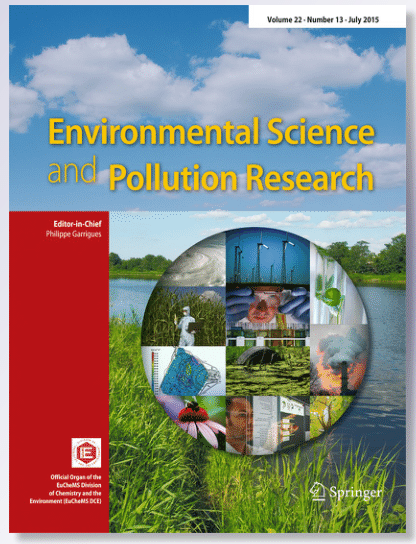
Environmental Science and Pollution Research (ESPR) serves the international community in all areas of Environmental Science and related subjects with emphasis on chemical compounds. This includes:
- Terrestrial Biology and Ecology
- Aquatic Biology and Ecology
- Atmospheric Chemistry
- Environmental Microbiology/Biobased Energy Sources
- Phytoremediation and Ecosystem Restoration
- Environmental Analyses and Monitoring
- Assessment of Risks and Interactions of Pollutants in the Environment
- Conservation Biology and Sustainable Agriculture
- Impact of Chemicals/Pollutants on Human and Animal Health
It reports from a broad interdisciplinary outlook.



 京公网安备 11010802042870号
京ICP备2023020795号-1
京公网安备 11010802042870号
京ICP备2023020795号-1

 分享
分享
 求助内容:
求助内容: 应助结果提醒方式:
 扫码关注我们
