Temperature-controlled Ablation Versus Conventional Ablation for Pulmonary Vein Isolation in the Treatment of AF: A Systematic Review and Meta-Analysis.
Benjamin Clay, Balamrit S Sokhal, Sarah Zeriouh, Neil T Srinivasan, Parag R Gajendragadkar, Claire A Martin
{"title":"Temperature-controlled Ablation Versus Conventional Ablation for Pulmonary Vein Isolation in the Treatment of AF: A Systematic Review and Meta-Analysis.","authors":"Benjamin Clay, Balamrit S Sokhal, Sarah Zeriouh, Neil T Srinivasan, Parag R Gajendragadkar, Claire A Martin","doi":"10.15420/aer.2024.41","DOIUrl":null,"url":null,"abstract":"<p><strong>Background: </strong>This study compared the efficacy and safety of temperature-controlled and conventional contact-force-sensing radiofrequency ablation catheters for pulmonary vein isolation (PVI) in AF.</p><p><strong>Methods: </strong>Seven studies (1,138 patients) were included. Randomised controlled trials and observational (single-arm and two-arm) studies that reported freedom from AF ≥3 months after PVI with temperature-controlled radiofrequency ablation catheters (Biosense Webster QDOT MICRO operating in QMODE or Medtronic DiamondTemp) were included.</p><p><strong>Results: </strong>Freedom from AF at a mean (± SD) follow-up of 9.0 ± 3.6 months did not differ significantly between temperature-controlled and conventional ablation (OR 1.22; 95% CI [-0.79, 1.64]; p=0.24). Total procedure duration (-13.5 minutes; 95% CI [-17.1, -10.0 minutes]; p<0.001) and total ablation duration (-8.9 min; 95% CI [-10.3, -7.5 min]; p<0.01) were significantly shorter for temperature-controlled ablation. There were no significant differences between temperature-controlled and conventional ablation in either the aggregated rates of procedural complications (OR 0.69; 95% CI [-0.15, 1.54]; p=0.11) or in the rate of any individual complication.</p><p><strong>Conclusion: </strong>Temperature-controlled ablation was found to be at least non-inferior to conventional ablation in all measures of efficacy and safety. Further randomised controlled trials are warranted to evaluate long-term rates of freedom from AF and patient comfort.</p>","PeriodicalId":8412,"journal":{"name":"Arrhythmia & Electrophysiology Review","volume":"14 ","pages":"e03"},"PeriodicalIF":3.3000,"publicationDate":"2025-01-30","publicationTypes":"Journal Article","fieldsOfStudy":null,"isOpenAccess":false,"openAccessPdf":"https://www.ncbi.nlm.nih.gov/pmc/articles/PMC11865669/pdf/","citationCount":"0","resultStr":null,"platform":"Semanticscholar","paperid":null,"PeriodicalName":"Arrhythmia & Electrophysiology Review","FirstCategoryId":"1085","ListUrlMain":"https://doi.org/10.15420/aer.2024.41","RegionNum":0,"RegionCategory":null,"ArticlePicture":[],"TitleCN":null,"AbstractTextCN":null,"PMCID":null,"EPubDate":"2025/1/1 0:00:00","PubModel":"eCollection","JCR":"Q2","JCRName":"CARDIAC & CARDIOVASCULAR SYSTEMS","Score":null,"Total":0}
引用次数: 0
Abstract
Background: This study compared the efficacy and safety of temperature-controlled and conventional contact-force-sensing radiofrequency ablation catheters for pulmonary vein isolation (PVI) in AF.
Methods: Seven studies (1,138 patients) were included. Randomised controlled trials and observational (single-arm and two-arm) studies that reported freedom from AF ≥3 months after PVI with temperature-controlled radiofrequency ablation catheters (Biosense Webster QDOT MICRO operating in QMODE or Medtronic DiamondTemp) were included.
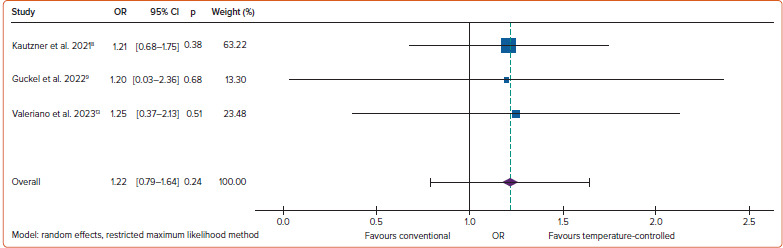
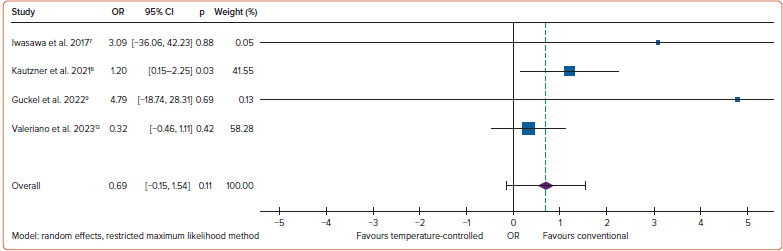
Results: Freedom from AF at a mean (± SD) follow-up of 9.0 ± 3.6 months did not differ significantly between temperature-controlled and conventional ablation (OR 1.22; 95% CI [-0.79, 1.64]; p=0.24). Total procedure duration (-13.5 minutes; 95% CI [-17.1, -10.0 minutes]; p<0.001) and total ablation duration (-8.9 min; 95% CI [-10.3, -7.5 min]; p<0.01) were significantly shorter for temperature-controlled ablation. There were no significant differences between temperature-controlled and conventional ablation in either the aggregated rates of procedural complications (OR 0.69; 95% CI [-0.15, 1.54]; p=0.11) or in the rate of any individual complication.
Conclusion: Temperature-controlled ablation was found to be at least non-inferior to conventional ablation in all measures of efficacy and safety. Further randomised controlled trials are warranted to evaluate long-term rates of freedom from AF and patient comfort.




 京公网安备 11010802042870号
京ICP备2023020795号-1
京公网安备 11010802042870号
京ICP备2023020795号-1

 分享
分享
 求助内容:
求助内容: 应助结果提醒方式:
 扫码关注我们
