{"title":"Prevalence of palatogingival groove and its association with periapical lesions and periodontal bone loss: a cone beam computed tomography study.","authors":"Dilan Pelin Yildirim, Selin Goker Kamali","doi":"10.1186/s12903-025-05676-1","DOIUrl":null,"url":null,"abstract":"<p><strong>Background: </strong>This study aimed to evaluate the prevalence of palatogingival groove (PGG) in maxillary incisors and its association with periapical lesions and periodontal bone loss.</p><p><strong>Methods: </strong>CBCT images from 943 patients were included. Age, sex, and the presence of PGG were recorded. PGG type was determined according to the Gu classification. All maxillary incisors of patients with PGG teeth were evaluated for periapical lesions and periodontal bone loss. Statistical analysis was performed with the Pearson chi-square test and Fisher's exact test.</p><p><strong>Results: </strong>PGGs were present in 107 maxillary incisors (2.8%) of 89 patients (9.4%). PGGs were observed significantly less frequently in maxillary central incisors than in maxillary lateral incisors (p < 0.001). The most common PGG was type I (75.7%), followed by type II (15.9%) and type III (8.4%). PGGs were associated with periapical lesions and periodontal bone loss (p < 0.001). PGG teeth without periapical lesions or periodontal bone loss were mostly type I. When the PGG was type II or III, the teeth mostly had periapical lesions and periodontal bone loss (p < 0.001). A significant relationship was detected between the periapical lesion status and bone loss status in PGG teeth (p < 0.05).</p><p><strong>Conclusions: </strong>PGGs were found mostly in maxillary lateral incisors. Most teeth with type II and III PGGs were characterized by periodontal bone loss and periapical lesions. Additionally, most PGG teeth with periodontal bone loss had periapical lesions. These findings imply that the presence of a PGG should be suspected in a maxillary incisor with a narrow periodontal pocket and periapical lesion but no caries, cracks, or restorations.</p>","PeriodicalId":9072,"journal":{"name":"BMC Oral Health","volume":"25 1","pages":"313"},"PeriodicalIF":3.1000,"publicationDate":"2025-02-27","publicationTypes":"Journal Article","fieldsOfStudy":null,"isOpenAccess":false,"openAccessPdf":"https://www.ncbi.nlm.nih.gov/pmc/articles/PMC11869645/pdf/","citationCount":"0","resultStr":null,"platform":"Semanticscholar","paperid":null,"PeriodicalName":"BMC Oral Health","FirstCategoryId":"3","ListUrlMain":"https://doi.org/10.1186/s12903-025-05676-1","RegionNum":2,"RegionCategory":"医学","ArticlePicture":[],"TitleCN":null,"AbstractTextCN":null,"PMCID":null,"EPubDate":"","PubModel":"","JCR":"Q1","JCRName":"DENTISTRY, ORAL SURGERY & MEDICINE","Score":null,"Total":0}
引用次数: 0
Abstract
Background: This study aimed to evaluate the prevalence of palatogingival groove (PGG) in maxillary incisors and its association with periapical lesions and periodontal bone loss.
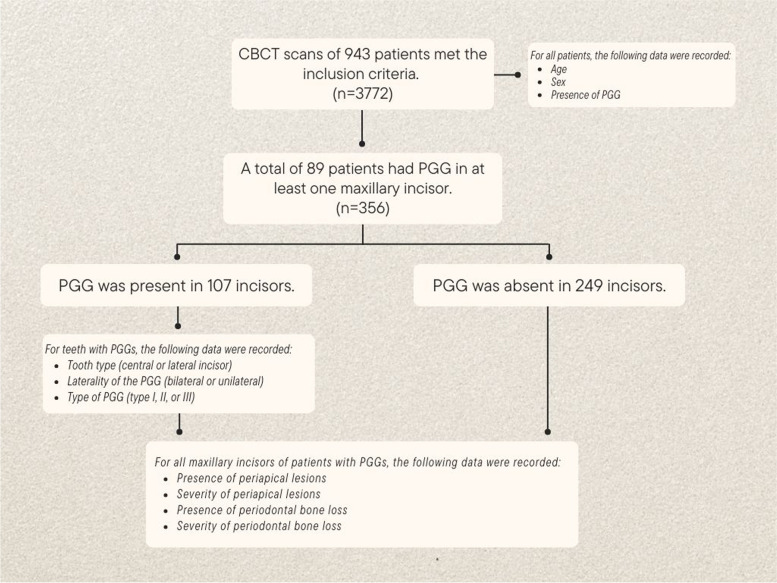
Methods: CBCT images from 943 patients were included. Age, sex, and the presence of PGG were recorded. PGG type was determined according to the Gu classification. All maxillary incisors of patients with PGG teeth were evaluated for periapical lesions and periodontal bone loss. Statistical analysis was performed with the Pearson chi-square test and Fisher's exact test.
Results: PGGs were present in 107 maxillary incisors (2.8%) of 89 patients (9.4%). PGGs were observed significantly less frequently in maxillary central incisors than in maxillary lateral incisors (p < 0.001). The most common PGG was type I (75.7%), followed by type II (15.9%) and type III (8.4%). PGGs were associated with periapical lesions and periodontal bone loss (p < 0.001). PGG teeth without periapical lesions or periodontal bone loss were mostly type I. When the PGG was type II or III, the teeth mostly had periapical lesions and periodontal bone loss (p < 0.001). A significant relationship was detected between the periapical lesion status and bone loss status in PGG teeth (p < 0.05).
Conclusions: PGGs were found mostly in maxillary lateral incisors. Most teeth with type II and III PGGs were characterized by periodontal bone loss and periapical lesions. Additionally, most PGG teeth with periodontal bone loss had periapical lesions. These findings imply that the presence of a PGG should be suspected in a maxillary incisor with a narrow periodontal pocket and periapical lesion but no caries, cracks, or restorations.
期刊介绍:
BMC Oral Health is an open access, peer-reviewed journal that considers articles on all aspects of the prevention, diagnosis and management of disorders of the mouth, teeth and gums, as well as related molecular genetics, pathophysiology, and epidemiology.





 京公网安备 11010802042870号
京ICP备2023020795号-1
京公网安备 11010802042870号
京ICP备2023020795号-1

 分享
分享
 求助内容:
求助内容: 应助结果提醒方式:
 扫码关注我们
