Neurological and immunological characteristics of a novel immortalized bovine brainstem-derived cell line and its susceptibility to arbovirus infection.
{"title":"Neurological and immunological characteristics of a novel immortalized bovine brainstem-derived cell line and its susceptibility to arbovirus infection.","authors":"Rina Ikeda, Tohru Yanase, Misako Konishi, Katsunori Murota, Shogo Tanaka, Takato Takenouchi","doi":"10.3389/fcimb.2025.1518808","DOIUrl":null,"url":null,"abstract":"<p><p>Immortalized bovine neuronal cell lines provide a reliable <i>in vitro</i> model for studying interactions with bovine infectious pathogens that target the host nervous system. Although we previously established an immortalized fetal bovine brain-derived FBBC-1 cell line, there are currently no other bovine neuronal cell lines commonly available. In the present study, we developed a novel immortalized cell line, IKBM, derived from the adult bovine brainstem by transferring a SV40 large T antigen gene using lentiviral vectors, and compared its characteristics to the FBBC-1 cell line. As with FBBC-1 cells, IKBM cells extended neurite-like processes in response to agents that increase cytosolic cyclic AMP levels. A comprehensive analysis using RNA sequencing demonstrated that both cell lines potentially possess neural progenitor cell-like properties and differentiate into dopaminergic neuron-like cells after induction of the outgrowth of neurite-like processes. Unexpectedly, we found that the mRNAs of multiple immunomodulatory molecules were highly expressed in IKBM cells, but not in FBBC-1 cells. Although IKBM cells were susceptible to infection with arboviruses (Akabane and Chuzan viruses) that cause neurological symptoms in cattle, viral titers were lower in IKBM cell cultures than in hamster lung-derived HmLu-1 cell cultures, which are frequently used to isolate arboviruses. The reduced production of viruses in IKBM cell cultures may be related to the high expression of immunomodulatory molecules in these cells. Therefore, IKBM and FBBC-1 cell lines offer the opportunity to develop unique <i>in vitro</i> models of the bovine nervous system for the study of host-pathogen interactions based on their respective properties.</p>","PeriodicalId":12458,"journal":{"name":"Frontiers in Cellular and Infection Microbiology","volume":"15 ","pages":"1518808"},"PeriodicalIF":4.8000,"publicationDate":"2025-02-13","publicationTypes":"Journal Article","fieldsOfStudy":null,"isOpenAccess":false,"openAccessPdf":"https://www.ncbi.nlm.nih.gov/pmc/articles/PMC11865082/pdf/","citationCount":"0","resultStr":null,"platform":"Semanticscholar","paperid":null,"PeriodicalName":"Frontiers in Cellular and Infection Microbiology","FirstCategoryId":"3","ListUrlMain":"https://doi.org/10.3389/fcimb.2025.1518808","RegionNum":2,"RegionCategory":"医学","ArticlePicture":[],"TitleCN":null,"AbstractTextCN":null,"PMCID":null,"EPubDate":"2025/1/1 0:00:00","PubModel":"eCollection","JCR":"Q2","JCRName":"IMMUNOLOGY","Score":null,"Total":0}
引用次数: 0
Abstract
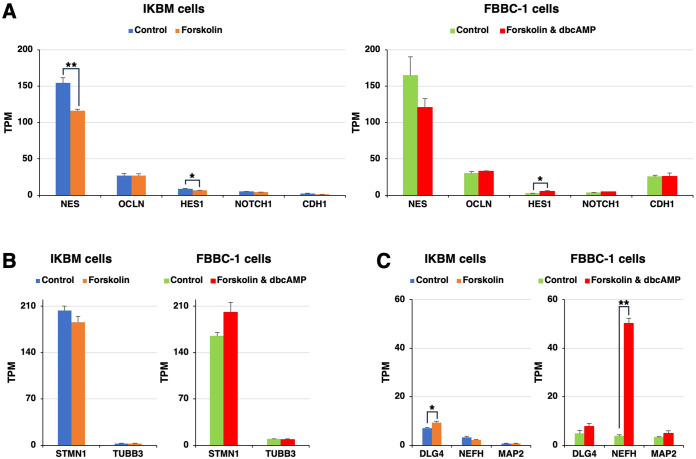
Immortalized bovine neuronal cell lines provide a reliable in vitro model for studying interactions with bovine infectious pathogens that target the host nervous system. Although we previously established an immortalized fetal bovine brain-derived FBBC-1 cell line, there are currently no other bovine neuronal cell lines commonly available. In the present study, we developed a novel immortalized cell line, IKBM, derived from the adult bovine brainstem by transferring a SV40 large T antigen gene using lentiviral vectors, and compared its characteristics to the FBBC-1 cell line. As with FBBC-1 cells, IKBM cells extended neurite-like processes in response to agents that increase cytosolic cyclic AMP levels. A comprehensive analysis using RNA sequencing demonstrated that both cell lines potentially possess neural progenitor cell-like properties and differentiate into dopaminergic neuron-like cells after induction of the outgrowth of neurite-like processes. Unexpectedly, we found that the mRNAs of multiple immunomodulatory molecules were highly expressed in IKBM cells, but not in FBBC-1 cells. Although IKBM cells were susceptible to infection with arboviruses (Akabane and Chuzan viruses) that cause neurological symptoms in cattle, viral titers were lower in IKBM cell cultures than in hamster lung-derived HmLu-1 cell cultures, which are frequently used to isolate arboviruses. The reduced production of viruses in IKBM cell cultures may be related to the high expression of immunomodulatory molecules in these cells. Therefore, IKBM and FBBC-1 cell lines offer the opportunity to develop unique in vitro models of the bovine nervous system for the study of host-pathogen interactions based on their respective properties.
期刊介绍:
Frontiers in Cellular and Infection Microbiology is a leading specialty journal, publishing rigorously peer-reviewed research across all pathogenic microorganisms and their interaction with their hosts. Chief Editor Yousef Abu Kwaik, University of Louisville is supported by an outstanding Editorial Board of international experts. This multidisciplinary open-access journal is at the forefront of disseminating and communicating scientific knowledge and impactful discoveries to researchers, academics, clinicians and the public worldwide.
Frontiers in Cellular and Infection Microbiology includes research on bacteria, fungi, parasites, viruses, endosymbionts, prions and all microbial pathogens as well as the microbiota and its effect on health and disease in various hosts. The research approaches include molecular microbiology, cellular microbiology, gene regulation, proteomics, signal transduction, pathogenic evolution, genomics, structural biology, and virulence factors as well as model hosts. Areas of research to counteract infectious agents by the host include the host innate and adaptive immune responses as well as metabolic restrictions to various pathogenic microorganisms, vaccine design and development against various pathogenic microorganisms, and the mechanisms of antibiotic resistance and its countermeasures.





 京公网安备 11010802042870号
京ICP备2023020795号-1
京公网安备 11010802042870号
京ICP备2023020795号-1

 分享
分享
 求助内容:
求助内容: 应助结果提醒方式:
 扫码关注我们
