Javier de la Fuente, Marc Blasi, Fernando Dávila, Àngels Ribera, Xavier Sala-Blanch, Ramón Balius
{"title":"A1 pulley cutting potential and safety of three ultrasound-guided percutaneous A1 pulley release techniques for trigger finger: a cadaveric study.","authors":"Javier de la Fuente, Marc Blasi, Fernando Dávila, Àngels Ribera, Xavier Sala-Blanch, Ramón Balius","doi":"10.1186/s13018-025-05590-w","DOIUrl":null,"url":null,"abstract":"<p><strong>Background: </strong>There is no consensus as to the best technique for percutaneous trigger finger release.</p><p><strong>Methods: </strong>This assessor-blinded study compared three ultrasound-guided percutaneous trigger finger release techniques using a needle (N), a needle-knife (NK), and a specially designed knife (K). Three physicians simulated A1 pulley release surgery on 56 fingers of 14 fresh-frozen hand cadaver body donors. Both the physicians and the fingers included were randomly selected.</p><p><strong>Results: </strong>The results of repeated-measures ANOVA revealed significantly longer cuts for the NK and K techniques, than for the N technique, both absolute (mean ± SD) (NK = 5.55 ± 3.07 mm, K = 6.29 ± 4.07 mm, and N = 2.02 ± 3.46 mm; N vs. NK p = 0.015, N vs. K p = 0.002, and NK vs. K p = 1.000), and cut percentage in relation to the total pulley length (NK = 51.61 ± 28.34%, K = 54.63 ± 33.72% and N = 18.24 ± 31.09%; N vs. NK p = 0.008, N vs. K p = 0.003, and NK vs. K p = 1.000). No neurovascular bundle injuries were found upon dissection. The overall complication rate was 11%, with no significant differences among the three techniques. Only one major tendon injury occurred in the NK group.</p><p><strong>Conclusions: </strong>In this cadaveric study, the NK and K techniques were more effective at releasing the A1 pulley than the N technique. All three techniques have emerged as equally safe.</p>","PeriodicalId":16629,"journal":{"name":"Journal of Orthopaedic Surgery and Research","volume":"20 1","pages":"215"},"PeriodicalIF":2.8000,"publicationDate":"2025-02-28","publicationTypes":"Journal Article","fieldsOfStudy":null,"isOpenAccess":false,"openAccessPdf":"https://www.ncbi.nlm.nih.gov/pmc/articles/PMC11869403/pdf/","citationCount":"0","resultStr":null,"platform":"Semanticscholar","paperid":null,"PeriodicalName":"Journal of Orthopaedic Surgery and Research","FirstCategoryId":"3","ListUrlMain":"https://doi.org/10.1186/s13018-025-05590-w","RegionNum":3,"RegionCategory":"医学","ArticlePicture":[],"TitleCN":null,"AbstractTextCN":null,"PMCID":null,"EPubDate":"","PubModel":"","JCR":"Q1","JCRName":"ORTHOPEDICS","Score":null,"Total":0}
引用次数: 0
Abstract
Background: There is no consensus as to the best technique for percutaneous trigger finger release.
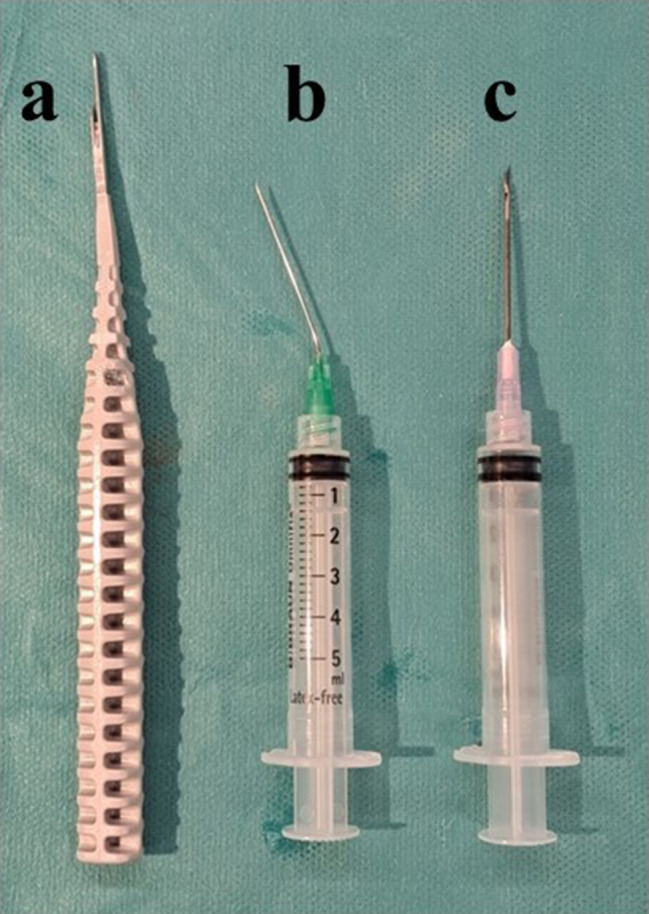
Methods: This assessor-blinded study compared three ultrasound-guided percutaneous trigger finger release techniques using a needle (N), a needle-knife (NK), and a specially designed knife (K). Three physicians simulated A1 pulley release surgery on 56 fingers of 14 fresh-frozen hand cadaver body donors. Both the physicians and the fingers included were randomly selected.
Results: The results of repeated-measures ANOVA revealed significantly longer cuts for the NK and K techniques, than for the N technique, both absolute (mean ± SD) (NK = 5.55 ± 3.07 mm, K = 6.29 ± 4.07 mm, and N = 2.02 ± 3.46 mm; N vs. NK p = 0.015, N vs. K p = 0.002, and NK vs. K p = 1.000), and cut percentage in relation to the total pulley length (NK = 51.61 ± 28.34%, K = 54.63 ± 33.72% and N = 18.24 ± 31.09%; N vs. NK p = 0.008, N vs. K p = 0.003, and NK vs. K p = 1.000). No neurovascular bundle injuries were found upon dissection. The overall complication rate was 11%, with no significant differences among the three techniques. Only one major tendon injury occurred in the NK group.
Conclusions: In this cadaveric study, the NK and K techniques were more effective at releasing the A1 pulley than the N technique. All three techniques have emerged as equally safe.
背景:关于经皮扳机指松解的最佳技术尚无共识。方法:本评估盲法研究比较了三种超声引导下的经皮触发式手指释放技术,分别使用针(N)、针刀(NK)和特制刀(K)。三位医生模拟了14例新鲜冷冻手尸体供体56个手指的A1滑轮释放手术。医生和手指都是随机选择的。结果:重复测量方差分析结果显示,NK技术和K技术的切口明显长于N技术,绝对(平均±SD) (NK = 5.55±3.07 mm, K = 6.29±4.07 mm, N = 2.02±3.46 mm);N vs. NK p = 0.015, N vs. K p = 0.002, NK vs. K p = 1.000),切割百分比与滑轮总长度的关系(NK = 51.61±28.34%,K = 54.63±33.72%,N = 18.24±31.09%;N对NK p = 0.008, N对K p = 0.003, NK对K p = 1.000)。解剖后未见神经血管束损伤。总并发症发生率为11%,三种技术间无显著差异。NK组仅发生1例大肌腱损伤。结论:在尸体研究中,NK和K技术在释放A1滑轮方面比N技术更有效。这三种技术都同样安全。
期刊介绍:
Journal of Orthopaedic Surgery and Research is an open access journal that encompasses all aspects of clinical and basic research studies related to musculoskeletal issues.
Orthopaedic research is conducted at clinical and basic science levels. With the advancement of new technologies and the increasing expectation and demand from doctors and patients, we are witnessing an enormous growth in clinical orthopaedic research, particularly in the fields of traumatology, spinal surgery, joint replacement, sports medicine, musculoskeletal tumour management, hand microsurgery, foot and ankle surgery, paediatric orthopaedic, and orthopaedic rehabilitation. The involvement of basic science ranges from molecular, cellular, structural and functional perspectives to tissue engineering, gait analysis, automation and robotic surgery. Implant and biomaterial designs are new disciplines that complement clinical applications.
JOSR encourages the publication of multidisciplinary research with collaboration amongst clinicians and scientists from different disciplines, which will be the trend in the coming decades.





 京公网安备 11010802042870号
京ICP备2023020795号-1
京公网安备 11010802042870号
京ICP备2023020795号-1

 分享
分享
 求助内容:
求助内容: 应助结果提醒方式:
 扫码关注我们
