{"title":"Examining sound levels across different time scales measured from body-worn dosimeters.","authors":"Erik Jorgensen, Jennifer B Tufts, Erika Skoe","doi":"10.1121/10.0035807","DOIUrl":null,"url":null,"abstract":"<p><p>Studies are increasingly investigating listeners' acoustic environments using real-world data collection methods to personalize interventions for hearing loss and understand individual differences in intervention outcomes. A pressing methods question is the extent to which the time scale of the sample and number of sampling periods need to be considered. The purpose of this study was to characterize the extent to which the sound levels in a listener's vicinity, one common measure of acoustic environments, change across different time scales. Listeners wore a personal noise dosimeter continuously for one-week sampling periods at three time points. The effects of season, week, day of the week, and time of day on acoustic environment demand (proportion of samples ≥ 40 dB LAeq and mean sound levels for samples ≥ 40 dB LAeq) and diversity (the distribution of LAeq values, quantified by entropy) were characterized. Acoustic environment demand and diversity were relatively similar across seasons and weeks but varied more between days and across the day. Results suggest that a single one-week sampling period, collected at any time of year but balanced across days of the week and time of day, may capture sufficient information about a listener's acoustic environments to inform decisions about interventions.</p>","PeriodicalId":17168,"journal":{"name":"Journal of the Acoustical Society of America","volume":"157 2","pages":"1483-1499"},"PeriodicalIF":2.3000,"publicationDate":"2025-02-01","publicationTypes":"Journal Article","fieldsOfStudy":null,"isOpenAccess":false,"openAccessPdf":"https://www.ncbi.nlm.nih.gov/pmc/articles/PMC11878219/pdf/","citationCount":"0","resultStr":null,"platform":"Semanticscholar","paperid":null,"PeriodicalName":"Journal of the Acoustical Society of America","FirstCategoryId":"101","ListUrlMain":"https://doi.org/10.1121/10.0035807","RegionNum":2,"RegionCategory":"物理与天体物理","ArticlePicture":[],"TitleCN":null,"AbstractTextCN":null,"PMCID":null,"EPubDate":"","PubModel":"","JCR":"Q2","JCRName":"ACOUSTICS","Score":null,"Total":0}
引用次数: 0
Abstract
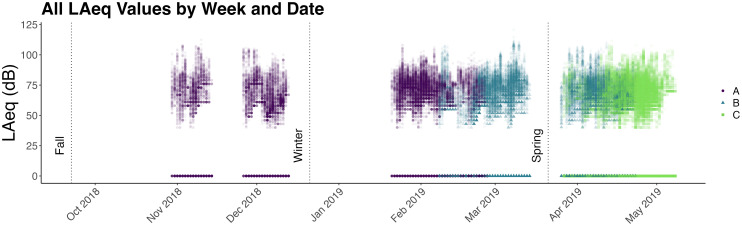
Studies are increasingly investigating listeners' acoustic environments using real-world data collection methods to personalize interventions for hearing loss and understand individual differences in intervention outcomes. A pressing methods question is the extent to which the time scale of the sample and number of sampling periods need to be considered. The purpose of this study was to characterize the extent to which the sound levels in a listener's vicinity, one common measure of acoustic environments, change across different time scales. Listeners wore a personal noise dosimeter continuously for one-week sampling periods at three time points. The effects of season, week, day of the week, and time of day on acoustic environment demand (proportion of samples ≥ 40 dB LAeq and mean sound levels for samples ≥ 40 dB LAeq) and diversity (the distribution of LAeq values, quantified by entropy) were characterized. Acoustic environment demand and diversity were relatively similar across seasons and weeks but varied more between days and across the day. Results suggest that a single one-week sampling period, collected at any time of year but balanced across days of the week and time of day, may capture sufficient information about a listener's acoustic environments to inform decisions about interventions.
越来越多的研究使用真实世界的数据收集方法来调查听者的声环境,以个性化听力损失干预措施,并了解干预结果的个体差异。一个紧迫的方法问题是在多大程度上需要考虑样本的时间尺度和采样周期的数目。这项研究的目的是描述听众附近的声音水平在不同时间尺度上的变化程度,这是声学环境的一种常见测量方法。听众在三个时间点连续佩戴个人噪音剂量计,为期一周。分析了季节、星期、星期中的一天和时间对声环境需求(≥40 dB LAeq的样本比例和≥40 dB LAeq的样本平均声级)和多样性(LAeq值的熵值分布)的影响。不同季节和周的声环境需求和多样性相对相似,但不同天之间和一天之间的变化更大。结果表明,在一年中的任何时间收集为期一周的采样期,但在一周的几天和一天的时间内进行平衡,可能会捕获有关听者声学环境的足够信息,从而为干预决策提供信息。
期刊介绍:
Since 1929 The Journal of the Acoustical Society of America has been the leading source of theoretical and experimental research results in the broad interdisciplinary study of sound. Subject coverage includes: linear and nonlinear acoustics; aeroacoustics, underwater sound and acoustical oceanography; ultrasonics and quantum acoustics; architectural and structural acoustics and vibration; speech, music and noise; psychology and physiology of hearing; engineering acoustics, transduction; bioacoustics, animal bioacoustics.






 京公网安备 11010802042870号
京ICP备2023020795号-1
京公网安备 11010802042870号
京ICP备2023020795号-1

 分享
分享
 求助内容:
求助内容: 应助结果提醒方式:
 扫码关注我们
