Jiaming Lan , Jingyu Zou , He Xin , Jin Sun , Tao Han , Mengchi Sun , Meng Niu
{"title":"Nanomedicines as disruptors or inhibitors of biofilms: Opportunities in addressing antimicrobial resistance","authors":"Jiaming Lan , Jingyu Zou , He Xin , Jin Sun , Tao Han , Mengchi Sun , Meng Niu","doi":"10.1016/j.jconrel.2025.113589","DOIUrl":null,"url":null,"abstract":"<div><div>The problem of antimicrobial resistance (AMR) has caused global concern due to its great threat to human health. Evidences are emerging for a critical role of biofilms, one of the natural protective mechanisms developed by bacteria during growth, in resisting commonly used clinical antibiotics. Advances in nanomedicines with tunable physicochemical properties and unique anti-biofilm mechanisms provide opportunities for solving AMR risks more effectively. In this review, we summarize the five “A” stages (adhesion, amplification, alienation, aging and allocation) of biofilm formation and mechanisms through which they protect the internal bacteria. Aimed at the characteristics of biofilms, we emphasize the design “THAT” principles (targeting, hacking, adhering and transport) of nanomedicines in their interactions with biofilms and internal bacteria. Furthermore, recent progresses in multimodal antibacterial nanomedicines, including biofilms disruption and bactericidal activity, and the types of currently available antibiofilm nanomedicines contained organic and inorganic nanomedicines are outlined and highlighted their potential applications in the development of preclinical research. Last but not least, we offer a perspective for the effectiveness of nanomedicines designed to address AMR and challenges associated with their clinical translation.</div></div>","PeriodicalId":15450,"journal":{"name":"Journal of Controlled Release","volume":"381 ","pages":"Article 113589"},"PeriodicalIF":11.5000,"publicationDate":"2025-03-01","publicationTypes":"Journal Article","fieldsOfStudy":null,"isOpenAccess":false,"openAccessPdf":"","citationCount":"0","resultStr":null,"platform":"Semanticscholar","paperid":null,"PeriodicalName":"Journal of Controlled Release","FirstCategoryId":"3","ListUrlMain":"https://www.sciencedirect.com/science/article/pii/S0168365925001981","RegionNum":1,"RegionCategory":"医学","ArticlePicture":[],"TitleCN":null,"AbstractTextCN":null,"PMCID":null,"EPubDate":"","PubModel":"","JCR":"Q1","JCRName":"CHEMISTRY, MULTIDISCIPLINARY","Score":null,"Total":0}
引用次数: 0
Abstract
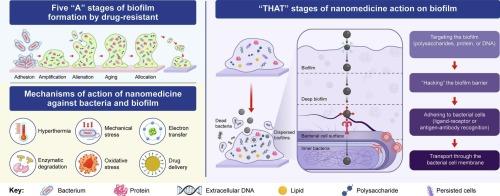
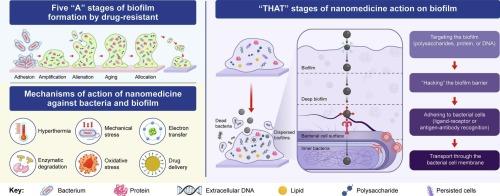
The problem of antimicrobial resistance (AMR) has caused global concern due to its great threat to human health. Evidences are emerging for a critical role of biofilms, one of the natural protective mechanisms developed by bacteria during growth, in resisting commonly used clinical antibiotics. Advances in nanomedicines with tunable physicochemical properties and unique anti-biofilm mechanisms provide opportunities for solving AMR risks more effectively. In this review, we summarize the five “A” stages (adhesion, amplification, alienation, aging and allocation) of biofilm formation and mechanisms through which they protect the internal bacteria. Aimed at the characteristics of biofilms, we emphasize the design “THAT” principles (targeting, hacking, adhering and transport) of nanomedicines in their interactions with biofilms and internal bacteria. Furthermore, recent progresses in multimodal antibacterial nanomedicines, including biofilms disruption and bactericidal activity, and the types of currently available antibiofilm nanomedicines contained organic and inorganic nanomedicines are outlined and highlighted their potential applications in the development of preclinical research. Last but not least, we offer a perspective for the effectiveness of nanomedicines designed to address AMR and challenges associated with their clinical translation.
抗菌药耐药性(AMR)问题已引起全球关注,因为它对人类健康构成了巨大威胁。生物膜是细菌在生长过程中形成的天然保护机制之一,有证据表明生物膜在抵抗临床常用抗生素方面发挥着关键作用。具有可调理化特性和独特抗生物膜机制的纳米药物的进步为更有效地解决 AMR 风险提供了机会。在这篇综述中,我们总结了生物膜形成的五个 "A "阶段(粘附、放大、异化、老化和分配)及其保护内部细菌的机制。针对生物膜的特点,我们强调了纳米药物在与生物膜和内部细菌相互作用时的设计 "THAT "原则(靶向、侵入、粘附和运输)。此外,我们还概述了多模式抗菌纳米药物的最新进展,包括生物膜破坏和杀菌活性,以及目前可用的包含有机和无机纳米药物的抗生物膜纳米药物类型,并强调了它们在临床前研究开发中的潜在应用。最后但并非最不重要的一点是,我们对旨在解决 AMR 的纳米药物的有效性及其临床转化所面临的挑战提出了看法。
期刊介绍:
The Journal of Controlled Release (JCR) proudly serves as the Official Journal of the Controlled Release Society and the Japan Society of Drug Delivery System.
Dedicated to the broad field of delivery science and technology, JCR publishes high-quality research articles covering drug delivery systems and all facets of formulations. This includes the physicochemical and biological properties of drugs, design and characterization of dosage forms, release mechanisms, in vivo testing, and formulation research and development across pharmaceutical, diagnostic, agricultural, environmental, cosmetic, and food industries.
Priority is given to manuscripts that contribute to the fundamental understanding of principles or demonstrate the advantages of novel technologies in terms of safety and efficacy over current clinical standards. JCR strives to be a leading platform for advancements in delivery science and technology.



 京公网安备 11010802042870号
京ICP备2023020795号-1
京公网安备 11010802042870号
京ICP备2023020795号-1

 分享
分享
 求助内容:
求助内容: 应助结果提醒方式:
 扫码关注我们
