Juntao Hu , Yibing Huang , Hao Hao , Pujing Tian , Yinuo Yin , Yuting He , Fengjie Hao , Wantong Jiang , Yanping Zhang , Youzhong Wan , Quan Luo
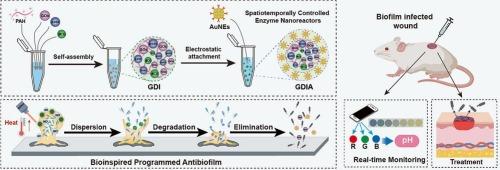
{"title":"Bioinspired programmed antibiofilm strategies for accelerated wound healing via spatiotemporally controlled enzyme nanoreactors","authors":"Juntao Hu , Yibing Huang , Hao Hao , Pujing Tian , Yinuo Yin , Yuting He , Fengjie Hao , Wantong Jiang , Yanping Zhang , Youzhong Wan , Quan Luo","doi":"10.1016/j.jconrel.2025.113582","DOIUrl":null,"url":null,"abstract":"<div><h3>Abstract</h3><div>Biofilms, protected by their dense, self-produced matrix, pose a significant clinical challenge due to their antibiotic resistance, leading to persistent infections and delayed wound healing, particularly in diabetic patients. Tailored to the biofilm life cycle, a double-layered nanoreactor was developed for rapid and complete antibiofilm therapy. The inner layer, cross-linked with poly(allylamine hydrochloride) (PAH)/phosphate, dimeric indocyanine green (dICG), and bromothymol blue (BTB), shields glucose oxidase (GOx) and β-glucanase (β-DEX) from unfavorable environment. The outer layer is coated with bacteria-targeted gold nanozymes (AuNEs). The healing of biofilm-infected diabetic wounds progresses three spatiotemporal stages activated by light irradiation and pH changes. Initially, the photothermal effect of dICG triggers nitric oxide (NO)-mediated biofilm dispersion and lowers the wound pH via a GOx/AuNEs cascade reaction. The resulting acidic environment then induces nanoreactor disassembly, releasing β-DEX to degrade the biofilm matrix and facilitate deeper penetration. Finally, AuNEs specifically recognize and eliminate planktonic bacteria, further disrupting the biofilms and accelerating wound healing by generating reactive oxygen species (ROS) and more toxic reactive nitrogen species (RNS). The wound status can be monitored in real-time using BTB's colorimetric pH analysis for visual feedback on treatment progress. This multifunctional design offers a programmed antibiofilm strategy for dynamic wound management.</div></div>","PeriodicalId":15450,"journal":{"name":"Journal of Controlled Release","volume":"381 ","pages":"Article 113582"},"PeriodicalIF":11.5000,"publicationDate":"2025-03-01","publicationTypes":"Journal Article","fieldsOfStudy":null,"isOpenAccess":false,"openAccessPdf":"","citationCount":"0","resultStr":null,"platform":"Semanticscholar","paperid":null,"PeriodicalName":"Journal of Controlled Release","FirstCategoryId":"3","ListUrlMain":"https://www.sciencedirect.com/science/article/pii/S0168365925001919","RegionNum":1,"RegionCategory":"医学","ArticlePicture":[],"TitleCN":null,"AbstractTextCN":null,"PMCID":null,"EPubDate":"","PubModel":"","JCR":"Q1","JCRName":"CHEMISTRY, MULTIDISCIPLINARY","Score":null,"Total":0}
引用次数: 0
Abstract
Biofilms, protected by their dense, self-produced matrix, pose a significant clinical challenge due to their antibiotic resistance, leading to persistent infections and delayed wound healing, particularly in diabetic patients. Tailored to the biofilm life cycle, a double-layered nanoreactor was developed for rapid and complete antibiofilm therapy. The inner layer, cross-linked with poly(allylamine hydrochloride) (PAH)/phosphate, dimeric indocyanine green (dICG), and bromothymol blue (BTB), shields glucose oxidase (GOx) and β-glucanase (β-DEX) from unfavorable environment. The outer layer is coated with bacteria-targeted gold nanozymes (AuNEs). The healing of biofilm-infected diabetic wounds progresses three spatiotemporal stages activated by light irradiation and pH changes. Initially, the photothermal effect of dICG triggers nitric oxide (NO)-mediated biofilm dispersion and lowers the wound pH via a GOx/AuNEs cascade reaction. The resulting acidic environment then induces nanoreactor disassembly, releasing β-DEX to degrade the biofilm matrix and facilitate deeper penetration. Finally, AuNEs specifically recognize and eliminate planktonic bacteria, further disrupting the biofilms and accelerating wound healing by generating reactive oxygen species (ROS) and more toxic reactive nitrogen species (RNS). The wound status can be monitored in real-time using BTB's colorimetric pH analysis for visual feedback on treatment progress. This multifunctional design offers a programmed antibiofilm strategy for dynamic wound management.
期刊介绍:
The Journal of Controlled Release (JCR) proudly serves as the Official Journal of the Controlled Release Society and the Japan Society of Drug Delivery System.
Dedicated to the broad field of delivery science and technology, JCR publishes high-quality research articles covering drug delivery systems and all facets of formulations. This includes the physicochemical and biological properties of drugs, design and characterization of dosage forms, release mechanisms, in vivo testing, and formulation research and development across pharmaceutical, diagnostic, agricultural, environmental, cosmetic, and food industries.
Priority is given to manuscripts that contribute to the fundamental understanding of principles or demonstrate the advantages of novel technologies in terms of safety and efficacy over current clinical standards. JCR strives to be a leading platform for advancements in delivery science and technology.




 京公网安备 11010802042870号
京ICP备2023020795号-1
京公网安备 11010802042870号
京ICP备2023020795号-1

 分享
分享
 求助内容:
求助内容: 应助结果提醒方式:
 扫码关注我们
