{"title":"Ruthenium(II) polypyridyl complexes inhibit tumor growth through stimulating immune system to increase CD8+ T cell","authors":"Shuang Tian , Haixin Xu , Xiaoyu Wu , Yueyao Ding , Lijuan Liang , Hui Yin , Xiandong Zeng , Yunjun Liu , Wenrun Zhu","doi":"10.1016/j.ejmech.2025.117470","DOIUrl":null,"url":null,"abstract":"<div><div>In this work, we have carefully designed and synthesized two Ru(II) metal complexes: [Ru(phen)<sub>2</sub>(HMPIP)](PF<sub>6</sub>)<sub>2</sub> (<strong>6a</strong>, where phen = 1,10-phenanthroline, HMPIP = 2-(2-hydroxy-3-methylphenyl-1H-imidazo[4,5-f][1,10]phenanthroline) and [Ru(bpy)<sub>2</sub>(HMPIP)](PF<sub>6</sub>)<sub>2</sub> (<strong>6b</strong>, where bpy = 2,2′-bipyridine). Using 3-(4,5-dimethylthiazol-2-yl)-2,5-diphenyltetrazolium bromide (MTT) to explore the cytotoxicity of <strong>6a</strong> and <strong>6b</strong> towards HepG2, B16, A549, SGC-7901, HCT116 and non-cancer LO2. The complexes exhibited cytotoxicity activity against HepG2 cells. The capacity of <strong>6a</strong> and <strong>6b</strong> to impede the proliferation and dissemination of cancer cells was evaluated by conducting proliferation and migration experiments and 3D model. The anticancer mechanism was investigated in detail. The utilization of cycle blocking assays revealed that <strong>6a</strong> and <strong>6b</strong> induced a G0/G1 phase arrest in HepG2 cells. The cellular uptake experiments show that the complexes enter the cell nuclei, then escape from the cell nuclei into the cytoplasm, finally accumulate in the mitochondria. Apoptosis assays and the examination of proteins indicated that the complexes were capable of efficiently inducing apoptosis in HepG2 cells. Additionally, the potential induction of autophagy-mediated cell death was explored. The observed reduction in glutathione (GSH) levels and glutathione peroxidase 4 (GPX4) expression suggested a disruption of redox homeostasis within cancer cells, an increment in malondialdehyde (MDA) amount, together with BODIPY staining experiment, confirm that <strong>6a</strong> and <strong>6b</strong> can induce ferroptosis. Interestingly, in a nude mouse model, <strong>6a</strong> showed a significant suppression of tumor growth with an inhibition rate of 63.4 %, without causing any weight loss of mice. The studies on the mechanism show that <strong>6a</strong> causes immune cell death, increase the amount of TNF-α and IFN-γ, reduce IL-10 content, which further activates immune response to increase CD8<sup>+</sup> T cells to prevent tumor growth. Therefore, <strong>6a</strong> inhibits the tumor growth through stimulating the immune response to increase CD8<sup>+</sup> T cells. In addition, the experiments in vitro show that the complexes through inhibition of PI3K/AKT/mTOR signaling pathway and intrinsic mitochondria pathway to cause cell apoptosis. These results demonstrate that Ru(II) complexes may be potent anticancer candidates for HepG2 tumor.</div></div>","PeriodicalId":314,"journal":{"name":"European Journal of Medicinal Chemistry","volume":"289 ","pages":"Article 117470"},"PeriodicalIF":5.9000,"publicationDate":"2025-02-28","publicationTypes":"Journal Article","fieldsOfStudy":null,"isOpenAccess":false,"openAccessPdf":"","citationCount":"0","resultStr":null,"platform":"Semanticscholar","paperid":null,"PeriodicalName":"European Journal of Medicinal Chemistry","FirstCategoryId":"3","ListUrlMain":"https://www.sciencedirect.com/science/article/pii/S0223523425002351","RegionNum":2,"RegionCategory":"医学","ArticlePicture":[],"TitleCN":null,"AbstractTextCN":null,"PMCID":null,"EPubDate":"","PubModel":"","JCR":"Q1","JCRName":"CHEMISTRY, MEDICINAL","Score":null,"Total":0}
引用次数: 0
Abstract
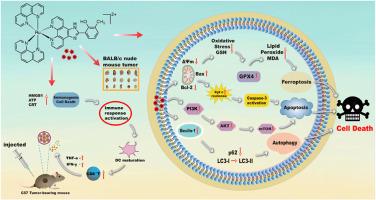
In this work, we have carefully designed and synthesized two Ru(II) metal complexes: [Ru(phen)2(HMPIP)](PF6)2 (6a, where phen = 1,10-phenanthroline, HMPIP = 2-(2-hydroxy-3-methylphenyl-1H-imidazo[4,5-f][1,10]phenanthroline) and [Ru(bpy)2(HMPIP)](PF6)2 (6b, where bpy = 2,2′-bipyridine). Using 3-(4,5-dimethylthiazol-2-yl)-2,5-diphenyltetrazolium bromide (MTT) to explore the cytotoxicity of 6a and 6b towards HepG2, B16, A549, SGC-7901, HCT116 and non-cancer LO2. The complexes exhibited cytotoxicity activity against HepG2 cells. The capacity of 6a and 6b to impede the proliferation and dissemination of cancer cells was evaluated by conducting proliferation and migration experiments and 3D model. The anticancer mechanism was investigated in detail. The utilization of cycle blocking assays revealed that 6a and 6b induced a G0/G1 phase arrest in HepG2 cells. The cellular uptake experiments show that the complexes enter the cell nuclei, then escape from the cell nuclei into the cytoplasm, finally accumulate in the mitochondria. Apoptosis assays and the examination of proteins indicated that the complexes were capable of efficiently inducing apoptosis in HepG2 cells. Additionally, the potential induction of autophagy-mediated cell death was explored. The observed reduction in glutathione (GSH) levels and glutathione peroxidase 4 (GPX4) expression suggested a disruption of redox homeostasis within cancer cells, an increment in malondialdehyde (MDA) amount, together with BODIPY staining experiment, confirm that 6a and 6b can induce ferroptosis. Interestingly, in a nude mouse model, 6a showed a significant suppression of tumor growth with an inhibition rate of 63.4 %, without causing any weight loss of mice. The studies on the mechanism show that 6a causes immune cell death, increase the amount of TNF-α and IFN-γ, reduce IL-10 content, which further activates immune response to increase CD8+ T cells to prevent tumor growth. Therefore, 6a inhibits the tumor growth through stimulating the immune response to increase CD8+ T cells. In addition, the experiments in vitro show that the complexes through inhibition of PI3K/AKT/mTOR signaling pathway and intrinsic mitochondria pathway to cause cell apoptosis. These results demonstrate that Ru(II) complexes may be potent anticancer candidates for HepG2 tumor.
期刊介绍:
The European Journal of Medicinal Chemistry is a global journal that publishes studies on all aspects of medicinal chemistry. It provides a medium for publication of original papers and also welcomes critical review papers.
A typical paper would report on the organic synthesis, characterization and pharmacological evaluation of compounds. Other topics of interest are drug design, QSAR, molecular modeling, drug-receptor interactions, molecular aspects of drug metabolism, prodrug synthesis and drug targeting. The journal expects manuscripts to present the rational for a study, provide insight into the design of compounds or understanding of mechanism, or clarify the targets.




 京公网安备 11010802042870号
京ICP备2023020795号-1
京公网安备 11010802042870号
京ICP备2023020795号-1

 分享
分享
 求助内容:
求助内容: 应助结果提醒方式:
 扫码关注我们
