Deep learning-based weed detection for precision herbicide application in turf

IF 3.8 1区 农林科学 Q1 AGRONOMY Pest Management Science Pub Date : 2025-02-28 DOI:10.1002/ps.8728
Xiaojun Jin, Hua Zhao, Xiaotong Kong, Kang Han, Jinglin Lei, Qiuyu Zu, Yong Chen, Jialin Yu
{"title":"Deep learning-based weed detection for precision herbicide application in turf","authors":"Xiaojun Jin,&nbsp;Hua Zhao,&nbsp;Xiaotong Kong,&nbsp;Kang Han,&nbsp;Jinglin Lei,&nbsp;Qiuyu Zu,&nbsp;Yong Chen,&nbsp;Jialin Yu","doi":"10.1002/ps.8728","DOIUrl":null,"url":null,"abstract":"<div>\n \n \n <section>\n \n <h3> BACKGROUND</h3>\n \n <p>Precision weed mapping in turf according to its susceptibility to selective herbicides allows the smart sprayer to spot-spray the most pertinent herbicides onto the susceptible weeds. The objective of this study was to evaluate the feasibility of implementing herbicide susceptibility-based weed mapping using deep convolutional neural networks (DCNNs) to facilitate targeted and efficient herbicide applications. Additionally, applying path-planning algorithms to weed mapping data to guide the spraying nozzle ensures minimal travel paths for herbicide application.</p>\n </section>\n \n <section>\n \n <h3> RESULTS</h3>\n \n <p>DenseNet achieved high precision, recall, overall accuracy, and F<sub>1</sub> score values for all categories of herbicides and no herbicides, with F<sub>1</sub> scores ranging from 0.996 to 0.999 in the validation dataset and from 0.992 to 0.997 in the testing dataset. The average accuracies attained by DenseNet, GoogLeNet and ResNet were 0.9985, 0.9953 and 0.9980, respectively. By considering both accuracy and computational efficiency, the ResNet model was identified as the most effective among the models compared to weed detection. The performance of the Christofides, Greedy and 2-opt algorithms in optimizing path planning for single or dual spraying nozzles was compared and analyzed. The Greedy algorithm proved the most efficient in optimizing the nozzle's trajectory.</p>\n </section>\n \n <section>\n \n <h3> CONCLUSION</h3>\n \n <p>Implementing herbicide susceptibility-based weed mapping facilitates targeted herbicide application by directing the nozzle to the grid cells containing the weeds susceptible to the herbicides. Moreover, the strategic integration of herbicide susceptibility-based weed mapping with optimized path planning for the spraying mechanism can be adeptly implemented on smart sprayers, which could effectively reduce the herbicide input. © 2025 Society of Chemical Industry.</p>\n </section>\n </div>","PeriodicalId":218,"journal":{"name":"Pest Management Science","volume":"81 7","pages":"3597-3609"},"PeriodicalIF":3.8000,"publicationDate":"2025-02-28","publicationTypes":"Journal Article","fieldsOfStudy":null,"isOpenAccess":false,"openAccessPdf":"","citationCount":"0","resultStr":null,"platform":"Semanticscholar","paperid":null,"PeriodicalName":"Pest Management Science","FirstCategoryId":"97","ListUrlMain":"https://scijournals.onlinelibrary.wiley.com/doi/10.1002/ps.8728","RegionNum":1,"RegionCategory":"农林科学","ArticlePicture":[],"TitleCN":null,"AbstractTextCN":null,"PMCID":null,"EPubDate":"","PubModel":"","JCR":"Q1","JCRName":"AGRONOMY","Score":null,"Total":0}
引用次数: 0

Abstract

BACKGROUND

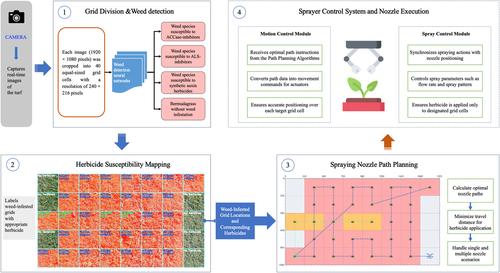
Precision weed mapping in turf according to its susceptibility to selective herbicides allows the smart sprayer to spot-spray the most pertinent herbicides onto the susceptible weeds. The objective of this study was to evaluate the feasibility of implementing herbicide susceptibility-based weed mapping using deep convolutional neural networks (DCNNs) to facilitate targeted and efficient herbicide applications. Additionally, applying path-planning algorithms to weed mapping data to guide the spraying nozzle ensures minimal travel paths for herbicide application.

RESULTS

DenseNet achieved high precision, recall, overall accuracy, and F1 score values for all categories of herbicides and no herbicides, with F1 scores ranging from 0.996 to 0.999 in the validation dataset and from 0.992 to 0.997 in the testing dataset. The average accuracies attained by DenseNet, GoogLeNet and ResNet were 0.9985, 0.9953 and 0.9980, respectively. By considering both accuracy and computational efficiency, the ResNet model was identified as the most effective among the models compared to weed detection. The performance of the Christofides, Greedy and 2-opt algorithms in optimizing path planning for single or dual spraying nozzles was compared and analyzed. The Greedy algorithm proved the most efficient in optimizing the nozzle's trajectory.

CONCLUSION

Implementing herbicide susceptibility-based weed mapping facilitates targeted herbicide application by directing the nozzle to the grid cells containing the weeds susceptible to the herbicides. Moreover, the strategic integration of herbicide susceptibility-based weed mapping with optimized path planning for the spraying mechanism can be adeptly implemented on smart sprayers, which could effectively reduce the herbicide input. © 2025 Society of Chemical Industry.
Abstract Image

查看原文
分享 分享
微信好友 朋友圈 QQ好友 复制链接
本刊更多论文
基于深度学习的杂草检测,实现草坪中除草剂的精准施用
根据草坪对选择性除草剂的敏感性进行精确的杂草测绘,智能喷雾器可以将最相关的除草剂喷洒到易感杂草上。本研究的目的是评估利用深度卷积神经网络(DCNNs)实现基于除草剂敏感性的杂草映射的可行性,以促进有针对性和高效的除草剂应用。此外,将路径规划算法应用于杂草映射数据来引导喷雾器,确保除草剂施用的最小路径。
本文章由计算机程序翻译,如有差异,请以英文原文为准。
求助全文
约1分钟内获得全文 去求助
来源期刊
Pest Management Science
Pest Management Science 农林科学-昆虫学
CiteScore
7.90
自引率
9.80%
发文量
553
审稿时长
4.8 months
期刊介绍: Pest Management Science is the international journal of research and development in crop protection and pest control. Since its launch in 1970, the journal has become the premier forum for papers on the discovery, application, and impact on the environment of products and strategies designed for pest management. Published for SCI by John Wiley & Sons Ltd.
期刊最新文献
Potential of endophytic Beauveria bassiana against Coraebus (Coleoptera: Buprestidae) oak borers. Artificial shelters as dual-purpose tools for monitoring natural enemies and providing microhabitats in orchards. Residue dynamics and metabolic pathways of sulfoxaflor in Cirsium japonicum var. maackii and Olea europaea L. Molecular co-assembly engineering towards natural tea saponin-based nanopesticides for synergistic enhanced foliar affinity. Cytochrome P450 and glutathione S-transferase may confer bensulfuron-methyl resistance in Cyperus iria.
×
引用
GB/T 7714-2015
复制
MLA
复制
APA
复制
导出至
BibTeX EndNote RefMan NoteFirst NoteExpress
×
×
提示
您的信息不完整,为了账户安全,请先补充。
现在去补充
×
提示
您因"违规操作"
具体请查看互助需知
我知道了
×
提示
现在去查看 取消
×
提示
确定
0
微信
客服QQ
Book学术公众号 扫码关注我们
反馈
×
意见反馈
请填写您的意见或建议
请填写您的手机或邮箱
已复制链接
已复制链接
快去分享给好友吧!
我知道了
×
扫码分享
扫码分享
Book学术官方微信
Book学术文献互助
Book学术文献互助群
群 号:604180095
Book学术
文献互助 智能选刊 最新文献 互助须知 联系我们:info@booksci.cn
Book学术提供免费学术资源搜索服务,方便国内外学者检索中英文文献。致力于提供最便捷和优质的服务体验。
Copyright © 2023 Book学术 All rights reserved.
ghs 京公网安备 11010802042870号 京ICP备2023020795号-1





