Wenxiao Ning , Jinbo Zan , Xiaomin Fang , Jian Kang , Shuwen Wang , Zhe Hu
{"title":"Intensified glacial conditions drove the long-term decrease of the hematite content of Asian dust in an icehouse world","authors":"Wenxiao Ning , Jinbo Zan , Xiaomin Fang , Jian Kang , Shuwen Wang , Zhe Hu","doi":"10.1016/j.palaeo.2025.112834","DOIUrl":null,"url":null,"abstract":"<div><div>Hematite is one of the most stable and common iron oxides in rocks and soils worldwide. Hematite-contained atmospheric dust can affect the global climate by modulating radiative forcing and supplying iron to oceanic ecosystems. The Asian arid and semi-arid regions are one of the most important sources of atmospheric mineral dust in the Northern Hemisphere. Elucidating the spatial and temporal variations of the hematite content of Asian dust in the geological past can provide insights into ancient environments and climates. We conducted detailed diffuse reflectance spectroscopy analyses of the Pleistocene Tajikistan loess, combined with a synthesis of published hematite data for contemporaneous dust sequences in NW China. The results showed a consistent decrease in the hematite content of Asian dust encompassing both glacial and interglacial conditions throughout the Pleistocene. We conclude that intensified glacial conditions led to the decrease in the hematite content of Asian dust, via two dominant pathways: increasing sediment supply and decreasing land surface temperature. This decreasing hematite content of Asian dust may have important influences on the global climate by modulating radiative forcing and carbon cycle on geological time scales.</div></div>","PeriodicalId":19928,"journal":{"name":"Palaeogeography, Palaeoclimatology, Palaeoecology","volume":"666 ","pages":"Article 112834"},"PeriodicalIF":2.7000,"publicationDate":"2025-02-24","publicationTypes":"Journal Article","fieldsOfStudy":null,"isOpenAccess":false,"openAccessPdf":"","citationCount":"0","resultStr":null,"platform":"Semanticscholar","paperid":null,"PeriodicalName":"Palaeogeography, Palaeoclimatology, Palaeoecology","FirstCategoryId":"89","ListUrlMain":"https://www.sciencedirect.com/science/article/pii/S0031018225001191","RegionNum":2,"RegionCategory":"地球科学","ArticlePicture":[],"TitleCN":null,"AbstractTextCN":null,"PMCID":null,"EPubDate":"","PubModel":"","JCR":"Q2","JCRName":"GEOGRAPHY, PHYSICAL","Score":null,"Total":0}
引用次数: 0
Abstract
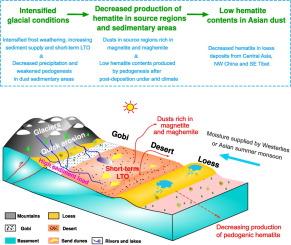
Hematite is one of the most stable and common iron oxides in rocks and soils worldwide. Hematite-contained atmospheric dust can affect the global climate by modulating radiative forcing and supplying iron to oceanic ecosystems. The Asian arid and semi-arid regions are one of the most important sources of atmospheric mineral dust in the Northern Hemisphere. Elucidating the spatial and temporal variations of the hematite content of Asian dust in the geological past can provide insights into ancient environments and climates. We conducted detailed diffuse reflectance spectroscopy analyses of the Pleistocene Tajikistan loess, combined with a synthesis of published hematite data for contemporaneous dust sequences in NW China. The results showed a consistent decrease in the hematite content of Asian dust encompassing both glacial and interglacial conditions throughout the Pleistocene. We conclude that intensified glacial conditions led to the decrease in the hematite content of Asian dust, via two dominant pathways: increasing sediment supply and decreasing land surface temperature. This decreasing hematite content of Asian dust may have important influences on the global climate by modulating radiative forcing and carbon cycle on geological time scales.
期刊介绍:
Palaeogeography, Palaeoclimatology, Palaeoecology is an international medium for the publication of high quality and multidisciplinary, original studies and comprehensive reviews in the field of palaeo-environmental geology. The journal aims at bringing together data with global implications from research in the many different disciplines involved in palaeo-environmental investigations.
By cutting across the boundaries of established sciences, it provides an interdisciplinary forum where issues of general interest can be discussed.



 京公网安备 11010802042870号
京ICP备2023020795号-1
京公网安备 11010802042870号
京ICP备2023020795号-1

 分享
分享
 求助内容:
求助内容: 应助结果提醒方式:
 扫码关注我们
