{"title":"NaDFOB and FEC as Electrolyte Additives Enabling Improved Cyclability of Sodium Metal Batteries and Sodium Ion Batteries","authors":"Dr. Zhengqi Wang, Dr. Andreas Hofmann","doi":"10.1002/celc.202400597","DOIUrl":null,"url":null,"abstract":"<p>Sodium metal is often considered as an anode material to improve the energy-density of sodium metal batteries (SMB) respectively sodium ion-based batteries (SIB). However, the active Na metal anode is a particular challenge. To formulate a suitable electrolyte has therefore been a key issue to stabilize sodium metal anodes. Here we report additive strategies by using the additives sodium difluoro(oxalato) borate (NaDFOB) or/and fluoroethylene carbonate (FEC) in the baseline electrolyte solution of 1 M NaPF<sub>6</sub> in ethylene carbonate/propylene carbonate to overcome these issues. For the SMB with sodium anode and carbon-coated Na<sub>3</sub>V<sub>2</sub>(PO<sub>4</sub>)<sub>3</sub> (NVP) cathode, a stable cell cycling up to 600 cycles (capacity retention about 96±3 %) was reached by using only 1–2 wt. % NaDFOB, compared to only less than 75 cycles of the baseline electrolyte. Sodium plating/stripping tests, voltammetry measurements, impedance analysis as well as cell tests were performed in order to reveal the electrochemical characteristics of the electrolytes including additive effects. The optimal SIB cell performance in cells containing hard carbon and NVP was achieved by using 2 wt.-% NaDFOB. NaDFOB electrolyte can be considered as a beneficial additive for Na metal cell and its application could be also extended for full SIBs.</p>","PeriodicalId":142,"journal":{"name":"ChemElectroChem","volume":"12 5","pages":""},"PeriodicalIF":3.5000,"publicationDate":"2025-01-31","publicationTypes":"Journal Article","fieldsOfStudy":null,"isOpenAccess":false,"openAccessPdf":"https://onlinelibrary.wiley.com/doi/epdf/10.1002/celc.202400597","citationCount":"0","resultStr":null,"platform":"Semanticscholar","paperid":null,"PeriodicalName":"ChemElectroChem","FirstCategoryId":"92","ListUrlMain":"https://chemistry-europe.onlinelibrary.wiley.com/doi/10.1002/celc.202400597","RegionNum":4,"RegionCategory":"化学","ArticlePicture":[],"TitleCN":null,"AbstractTextCN":null,"PMCID":null,"EPubDate":"","PubModel":"","JCR":"Q2","JCRName":"ELECTROCHEMISTRY","Score":null,"Total":0}
引用次数: 0
Abstract
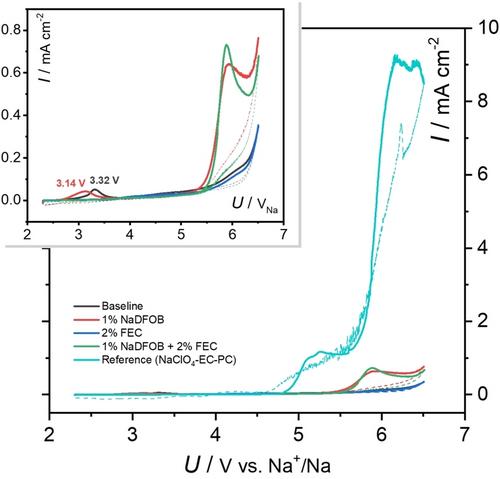
Sodium metal is often considered as an anode material to improve the energy-density of sodium metal batteries (SMB) respectively sodium ion-based batteries (SIB). However, the active Na metal anode is a particular challenge. To formulate a suitable electrolyte has therefore been a key issue to stabilize sodium metal anodes. Here we report additive strategies by using the additives sodium difluoro(oxalato) borate (NaDFOB) or/and fluoroethylene carbonate (FEC) in the baseline electrolyte solution of 1 M NaPF6 in ethylene carbonate/propylene carbonate to overcome these issues. For the SMB with sodium anode and carbon-coated Na3V2(PO4)3 (NVP) cathode, a stable cell cycling up to 600 cycles (capacity retention about 96±3 %) was reached by using only 1–2 wt. % NaDFOB, compared to only less than 75 cycles of the baseline electrolyte. Sodium plating/stripping tests, voltammetry measurements, impedance analysis as well as cell tests were performed in order to reveal the electrochemical characteristics of the electrolytes including additive effects. The optimal SIB cell performance in cells containing hard carbon and NVP was achieved by using 2 wt.-% NaDFOB. NaDFOB electrolyte can be considered as a beneficial additive for Na metal cell and its application could be also extended for full SIBs.
期刊介绍:
ChemElectroChem is aimed to become a top-ranking electrochemistry journal for primary research papers and critical secondary information from authors across the world. The journal covers the entire scope of pure and applied electrochemistry, the latter encompassing (among others) energy applications, electrochemistry at interfaces (including surfaces), photoelectrochemistry and bioelectrochemistry.





 京公网安备 11010802042870号
京ICP备2023020795号-1
京公网安备 11010802042870号
京ICP备2023020795号-1

 分享
分享
 求助内容:
求助内容: 应助结果提醒方式:
 扫码关注我们
