Keris Poelhekken, Monique D Dorrius, Amanda Dibden, Stephen W Duffy, Bert van der Vegt, Geertruida H de Bock, Marcel J W Greuter
{"title":"The natural history of ductal carcinoma in situ: development, validation, and estimated outcomes of the SimDCIS model.","authors":"Keris Poelhekken, Monique D Dorrius, Amanda Dibden, Stephen W Duffy, Bert van der Vegt, Geertruida H de Bock, Marcel J W Greuter","doi":"10.1007/s10549-025-07639-0","DOIUrl":null,"url":null,"abstract":"<p><strong>Purpose: </strong>To develop a novel simulation model for ductal carcinoma in situ (DCIS), fully validate it, and provide new estimates for DCIS in the setting of population-based biennial screening.</p><p><strong>Methods: </strong>A micro-simulation Markov model for DCIS (SimDCIS) was developed. Input parameters were independently derived from the literature and transition parameters were age- and grade-dependent. The model was applied to the Dutch biennial screening program. SimDCIS was internally, cross, and externally validated by comparison of the model output to data from the Netherlands Cancer Registry, a modelling study on the United Kingdom Frequency Trial, and the United Kingdom screening program, respectively. Univariate and probabilistic sensitivity analyses were performed to estimate uncertainty. DCIS regression, progression to invasive breast cancer (IBC), clinical detection, and screen-detection were estimated in Dutch screening setting.</p><p><strong>Results: </strong>SimDCIS matched observed data in internal, external, and cross-validation. The model was most sensitive to DCIS onset probability, and the maximum variation in screen-detection rate was 11%. In Dutch screening setting, DCIS regression, progression to IBC, clinical detection, and screen-detection were estimated at 8% (0-14%), 19% (16-24%), 8% (0-13%), and 61% (56-65%), respectively. Grade distribution was 20% grade 1, 38% grade 2, and 42% grade 3.</p><p><strong>Conclusion: </strong>SimDCIS provides strong accuracy across validation methods and is particularly sensitive to DCIS onset probability. Most DCIS will be found through screening, of which less than 50% of DCIS will be grade 3, less than 1 in 10 will regress, and 1 out of 5 DCIS will progress to IBC in biennial screening setting.</p>","PeriodicalId":9133,"journal":{"name":"Breast Cancer Research and Treatment","volume":" ","pages":"223-231"},"PeriodicalIF":3.0000,"publicationDate":"2025-05-01","publicationTypes":"Journal Article","fieldsOfStudy":null,"isOpenAccess":false,"openAccessPdf":"https://www.ncbi.nlm.nih.gov/pmc/articles/PMC11953075/pdf/","citationCount":"0","resultStr":null,"platform":"Semanticscholar","paperid":null,"PeriodicalName":"Breast Cancer Research and Treatment","FirstCategoryId":"3","ListUrlMain":"https://doi.org/10.1007/s10549-025-07639-0","RegionNum":3,"RegionCategory":"医学","ArticlePicture":[],"TitleCN":null,"AbstractTextCN":null,"PMCID":null,"EPubDate":"2025/3/1 0:00:00","PubModel":"Epub","JCR":"Q2","JCRName":"ONCOLOGY","Score":null,"Total":0}
引用次数: 0
Abstract
Purpose: To develop a novel simulation model for ductal carcinoma in situ (DCIS), fully validate it, and provide new estimates for DCIS in the setting of population-based biennial screening.
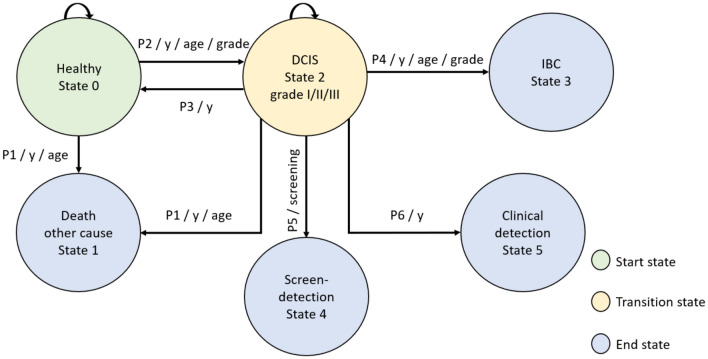
Methods: A micro-simulation Markov model for DCIS (SimDCIS) was developed. Input parameters were independently derived from the literature and transition parameters were age- and grade-dependent. The model was applied to the Dutch biennial screening program. SimDCIS was internally, cross, and externally validated by comparison of the model output to data from the Netherlands Cancer Registry, a modelling study on the United Kingdom Frequency Trial, and the United Kingdom screening program, respectively. Univariate and probabilistic sensitivity analyses were performed to estimate uncertainty. DCIS regression, progression to invasive breast cancer (IBC), clinical detection, and screen-detection were estimated in Dutch screening setting.
Results: SimDCIS matched observed data in internal, external, and cross-validation. The model was most sensitive to DCIS onset probability, and the maximum variation in screen-detection rate was 11%. In Dutch screening setting, DCIS regression, progression to IBC, clinical detection, and screen-detection were estimated at 8% (0-14%), 19% (16-24%), 8% (0-13%), and 61% (56-65%), respectively. Grade distribution was 20% grade 1, 38% grade 2, and 42% grade 3.
Conclusion: SimDCIS provides strong accuracy across validation methods and is particularly sensitive to DCIS onset probability. Most DCIS will be found through screening, of which less than 50% of DCIS will be grade 3, less than 1 in 10 will regress, and 1 out of 5 DCIS will progress to IBC in biennial screening setting.
期刊介绍:
Breast Cancer Research and Treatment provides the surgeon, radiotherapist, medical oncologist, endocrinologist, epidemiologist, immunologist or cell biologist investigating problems in breast cancer a single forum for communication. The journal creates a "market place" for breast cancer topics which cuts across all the usual lines of disciplines, providing a site for presenting pertinent investigations, and for discussing critical questions relevant to the entire field. It seeks to develop a new focus and new perspectives for all those concerned with breast cancer.




 京公网安备 11010802042870号
京ICP备2023020795号-1
京公网安备 11010802042870号
京ICP备2023020795号-1

 分享
分享
 求助内容:
求助内容: 应助结果提醒方式:
 扫码关注我们
