Comprehensive evaluation of diabetes subtypes in a European cohort reveals stronger differences of lifestyle, education and psychosocial parameters compared to metabolic or inflammatory factors.
Nathalie Rohmann, Johannes Epe, Corinna Geisler, Kristina Schlicht, Kathrin Türk, Katharina Hartmann, Lucy Kruse, Julia Koppenhagen, Ahmad Yusuf Kohestani, Tanja Adam, Corinna Bang, Andre Franke, Dominik M Schulte, Tim Hollstein, Matthias Laudes
{"title":"Comprehensive evaluation of diabetes subtypes in a European cohort reveals stronger differences of lifestyle, education and psychosocial parameters compared to metabolic or inflammatory factors.","authors":"Nathalie Rohmann, Johannes Epe, Corinna Geisler, Kristina Schlicht, Kathrin Türk, Katharina Hartmann, Lucy Kruse, Julia Koppenhagen, Ahmad Yusuf Kohestani, Tanja Adam, Corinna Bang, Andre Franke, Dominik M Schulte, Tim Hollstein, Matthias Laudes","doi":"10.1186/s12933-025-02660-5","DOIUrl":null,"url":null,"abstract":"<p><strong>Background: </strong>The traditional binary classification of diabetes into Type 1 and Type 2 fails to capture the heterogeneity among diabetes patients. This study aims to identify and characterize diabetes subtypes within the German FoCus cohort, using the ANDIS cohort's classification framework, and to explore subtype-specific variations in metabolic markers, gut microbiota, lifestyle, social factors, and comorbidities.</p><p><strong>Methods: </strong>We utilized data from 416 participants (208 with diabetes and 208 matched metabolically healthy controls) from the German FoCus cohort. Participants were classified into five subtypes: severe autoimmune diabetes (SAID)-like, severe insulin-deficient diabetes (SIDD)-like, severe insulin-resistant diabetes (SIRD)-like, mild obesity-related diabetes (MOD)-like, and mild age-related diabetes (MARD)-like. Comprehensive characterization included anthropometric measurements, dietary and physical activity questionnaires, blood biomarker analysis, and gut microbiota profiling.</p><p><strong>Results: </strong>The subtype distribution in the FoCus cohort accounted to SAID-like: 2.84%, SIDD-like: 30.81%, SIRD-like: 32.23%, MOD-like: 17.54%, MARD-like: 16.59%. Of interest, inflammatory markers (C-reactive protein (CRP) and Interleukin-6 (IL-6)) and glucagon-like peptide-1 (GLP-1) levels were similarly elevated across all subtypes compared to controls, indicating common aspects in Type 2 diabetes molecular pathology despite different clinical phenotypes. While the gut microbiota and dietary patterns only showed minor differences, smoking status, sleep duration, physical activity and psychological aspects varied significantly between the subtypes. In addition, we observed a lower educational status especially for SIDD-like and SIRD-like groups, which should be considered in establishing future diabetes-related patient education programs. In respect to the development of cardio-metabolic comorbidities, we observe not only significant differences in the presence of the diseases but also for their age-of onset, highlighting the need for early preventive intervention strategies.</p><p><strong>Conclusions: </strong>The study validates the ANDIS classification framework's applicability not only at the time point of manifestation but also in cohorts with pre-existing diabetes. While we did not find major differences regarding the classical metabolic, microbial and nutritional parameters, we identified several significant associations with lifestyle factors. Our findings underscore the importance of personalized, subtype-specific therapies not solely focusing on anthropometric and laboratory markers but comprehensively addressing the patient's own personality and situation of life.</p>","PeriodicalId":9374,"journal":{"name":"Cardiovascular Diabetology","volume":"24 1","pages":"99"},"PeriodicalIF":10.6000,"publicationDate":"2025-02-28","publicationTypes":"Journal Article","fieldsOfStudy":null,"isOpenAccess":false,"openAccessPdf":"https://www.ncbi.nlm.nih.gov/pmc/articles/PMC11871841/pdf/","citationCount":"0","resultStr":null,"platform":"Semanticscholar","paperid":null,"PeriodicalName":"Cardiovascular Diabetology","FirstCategoryId":"3","ListUrlMain":"https://doi.org/10.1186/s12933-025-02660-5","RegionNum":1,"RegionCategory":"医学","ArticlePicture":[],"TitleCN":null,"AbstractTextCN":null,"PMCID":null,"EPubDate":"","PubModel":"","JCR":"Q1","JCRName":"CARDIAC & CARDIOVASCULAR SYSTEMS","Score":null,"Total":0}
引用次数: 0
Abstract
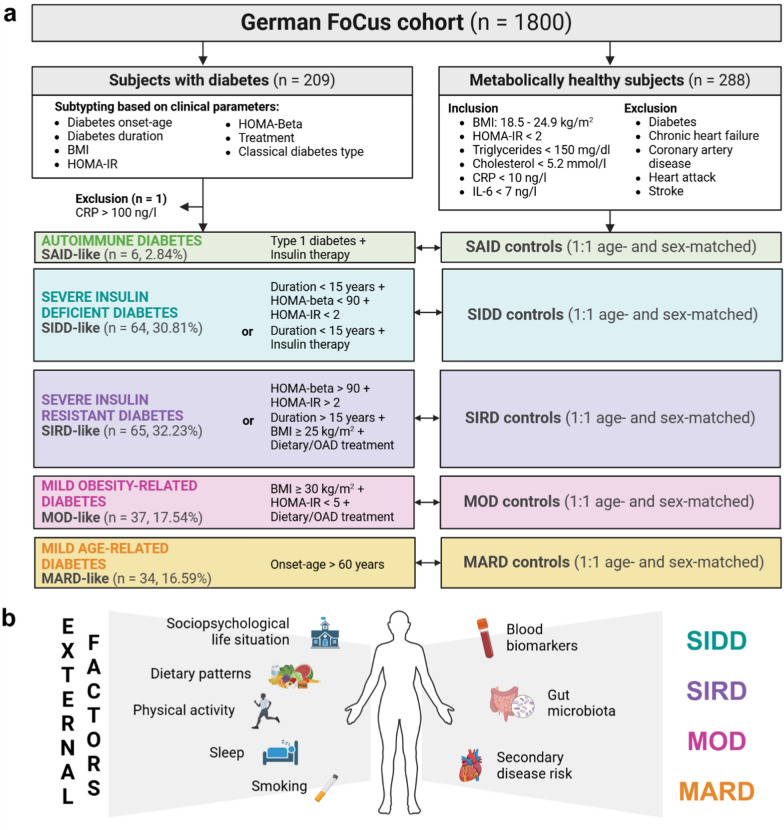
Background: The traditional binary classification of diabetes into Type 1 and Type 2 fails to capture the heterogeneity among diabetes patients. This study aims to identify and characterize diabetes subtypes within the German FoCus cohort, using the ANDIS cohort's classification framework, and to explore subtype-specific variations in metabolic markers, gut microbiota, lifestyle, social factors, and comorbidities.
Methods: We utilized data from 416 participants (208 with diabetes and 208 matched metabolically healthy controls) from the German FoCus cohort. Participants were classified into five subtypes: severe autoimmune diabetes (SAID)-like, severe insulin-deficient diabetes (SIDD)-like, severe insulin-resistant diabetes (SIRD)-like, mild obesity-related diabetes (MOD)-like, and mild age-related diabetes (MARD)-like. Comprehensive characterization included anthropometric measurements, dietary and physical activity questionnaires, blood biomarker analysis, and gut microbiota profiling.
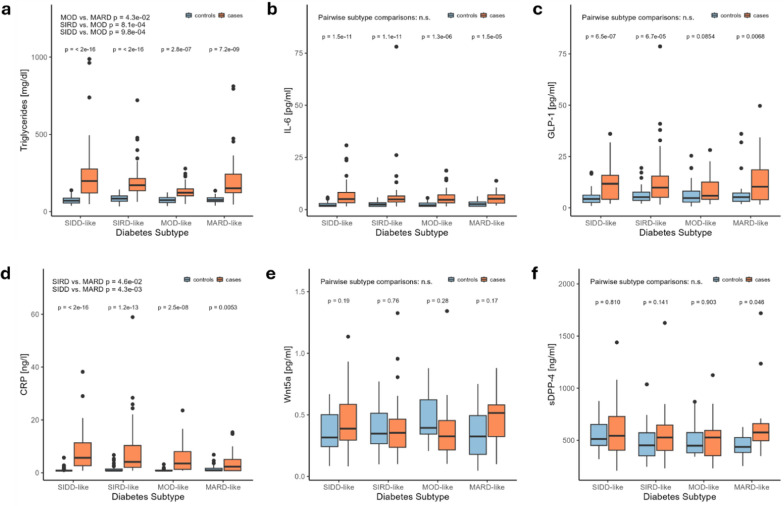
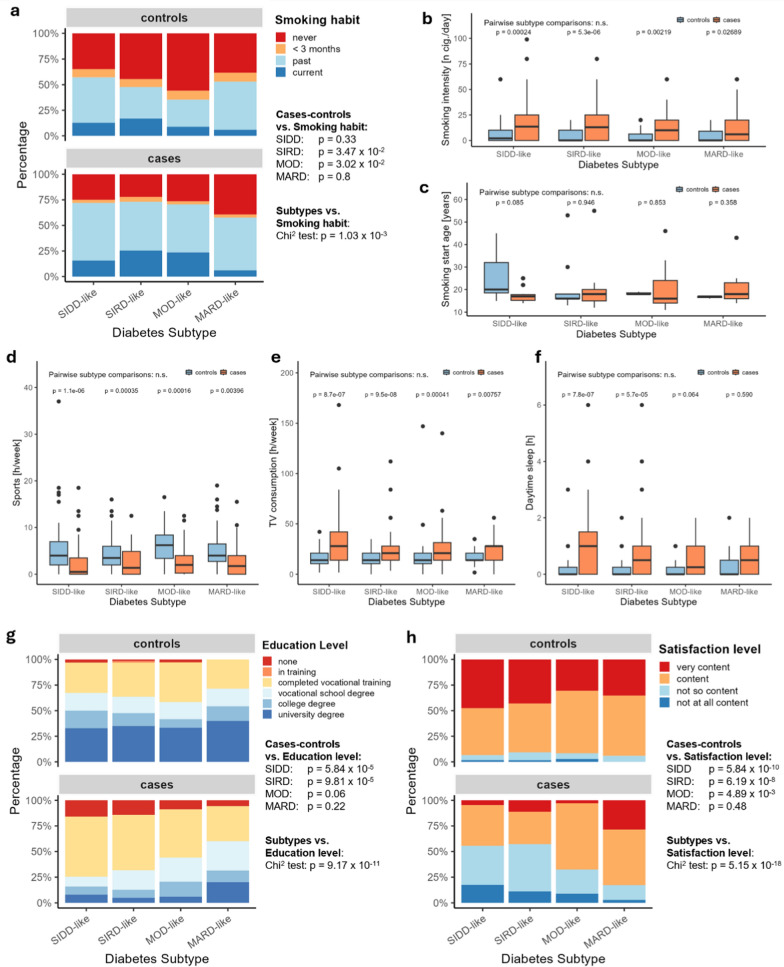
Results: The subtype distribution in the FoCus cohort accounted to SAID-like: 2.84%, SIDD-like: 30.81%, SIRD-like: 32.23%, MOD-like: 17.54%, MARD-like: 16.59%. Of interest, inflammatory markers (C-reactive protein (CRP) and Interleukin-6 (IL-6)) and glucagon-like peptide-1 (GLP-1) levels were similarly elevated across all subtypes compared to controls, indicating common aspects in Type 2 diabetes molecular pathology despite different clinical phenotypes. While the gut microbiota and dietary patterns only showed minor differences, smoking status, sleep duration, physical activity and psychological aspects varied significantly between the subtypes. In addition, we observed a lower educational status especially for SIDD-like and SIRD-like groups, which should be considered in establishing future diabetes-related patient education programs. In respect to the development of cardio-metabolic comorbidities, we observe not only significant differences in the presence of the diseases but also for their age-of onset, highlighting the need for early preventive intervention strategies.
Conclusions: The study validates the ANDIS classification framework's applicability not only at the time point of manifestation but also in cohorts with pre-existing diabetes. While we did not find major differences regarding the classical metabolic, microbial and nutritional parameters, we identified several significant associations with lifestyle factors. Our findings underscore the importance of personalized, subtype-specific therapies not solely focusing on anthropometric and laboratory markers but comprehensively addressing the patient's own personality and situation of life.
期刊介绍:
Cardiovascular Diabetology is a journal that welcomes manuscripts exploring various aspects of the relationship between diabetes, cardiovascular health, and the metabolic syndrome. We invite submissions related to clinical studies, genetic investigations, experimental research, pharmacological studies, epidemiological analyses, and molecular biology research in this field.



 京公网安备 11010802042870号
京ICP备2023020795号-1
京公网安备 11010802042870号
京ICP备2023020795号-1

 分享
分享
 求助内容:
求助内容: 应助结果提醒方式:
 扫码关注我们
