{"title":"Association between triglyceride glucose index and biological aging in U.S. adults: National Health and Nutrition Examination Survey.","authors":"Li-Ya Pan, Li Jin","doi":"10.1186/s12933-025-02631-w","DOIUrl":null,"url":null,"abstract":"<p><strong>Background: </strong>Insulin resistance (IR) has been reported to be associated with aging; however, few studies have investigated the relationship between IR and biological age (BA). The Triglyceride-glucose (TyG) index is a recognized marker of IR. Currently, there is insufficient evidence regarding the relationship between the TyG index and biological aging. This study aims to provide deeper insights into the connections between the TyG index and biological aging.</p><p><strong>Methods: </strong>We conducted a cross-sectional study using data from the National Health and Nutrition Examination Survey (NHANES), including 12,074 adults (aged 20 and older) from the 2001-2010 and 2015-2018 cycles. Comprehensive TyG and BA data were extracted for analysis. To explore the relationship between the TyG index and BA, linear regressions were employed, while logistic regression models were used to examine the association between the TyG index and accelerated aging. Additionally, trend tests, subgroup analyses, and smoothed fitted curves were conducted to assess the robustness of the findings.</p><p><strong>Results: </strong>We included 12,074 participants with a mean age of 46.91 years (SD, 16.64); of these, 50.25% were female and 49.75% were male. Each 1-unit increase in the TyG index was associated with a 1.64-year rise in Klemera-Doubal method (KDM) biological age and a 117% higher risk of accelerated aging. Similarly, each 1-unit increase in the TyG index corresponded to a 0.40-year increase in phenotypic age, resulting in a 15% higher risk of accelerated aging. The analysis also revealed nonlinear positive relationships between the TyG index and biological aging, particularly for KDM biological age (P for non-linearity < 0.001) and phenotypic age (P for non-linearity = 0.005), with a turning point at 8.66. Across all subgroups, the TyG index consistently showed a positive correlation with biological aging, even in the presence of significant interactions.</p><p><strong>Conclusions: </strong>There is a significant positive association between the TyG index and biological aging. Higher TyG levels are linked to increased biological age and a greater risk of accelerated aging.</p>","PeriodicalId":9374,"journal":{"name":"Cardiovascular Diabetology","volume":"24 1","pages":"100"},"PeriodicalIF":10.6000,"publicationDate":"2025-02-28","publicationTypes":"Journal Article","fieldsOfStudy":null,"isOpenAccess":false,"openAccessPdf":"https://www.ncbi.nlm.nih.gov/pmc/articles/PMC11871761/pdf/","citationCount":"0","resultStr":null,"platform":"Semanticscholar","paperid":null,"PeriodicalName":"Cardiovascular Diabetology","FirstCategoryId":"3","ListUrlMain":"https://doi.org/10.1186/s12933-025-02631-w","RegionNum":1,"RegionCategory":"医学","ArticlePicture":[],"TitleCN":null,"AbstractTextCN":null,"PMCID":null,"EPubDate":"","PubModel":"","JCR":"Q1","JCRName":"CARDIAC & CARDIOVASCULAR SYSTEMS","Score":null,"Total":0}
引用次数: 0
Abstract
Background: Insulin resistance (IR) has been reported to be associated with aging; however, few studies have investigated the relationship between IR and biological age (BA). The Triglyceride-glucose (TyG) index is a recognized marker of IR. Currently, there is insufficient evidence regarding the relationship between the TyG index and biological aging. This study aims to provide deeper insights into the connections between the TyG index and biological aging.
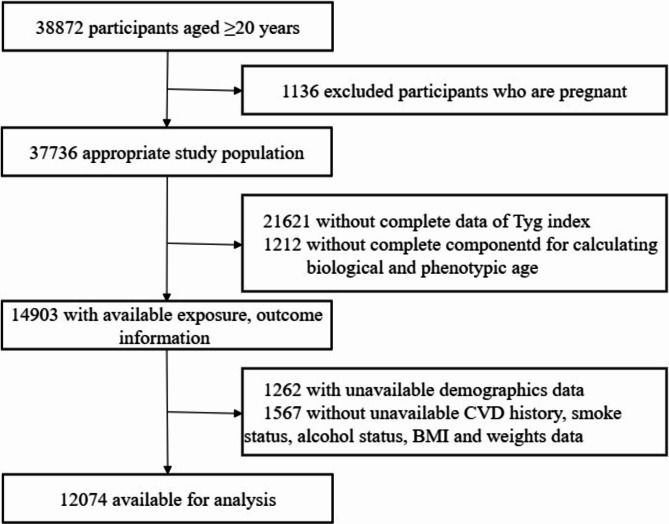
Methods: We conducted a cross-sectional study using data from the National Health and Nutrition Examination Survey (NHANES), including 12,074 adults (aged 20 and older) from the 2001-2010 and 2015-2018 cycles. Comprehensive TyG and BA data were extracted for analysis. To explore the relationship between the TyG index and BA, linear regressions were employed, while logistic regression models were used to examine the association between the TyG index and accelerated aging. Additionally, trend tests, subgroup analyses, and smoothed fitted curves were conducted to assess the robustness of the findings.
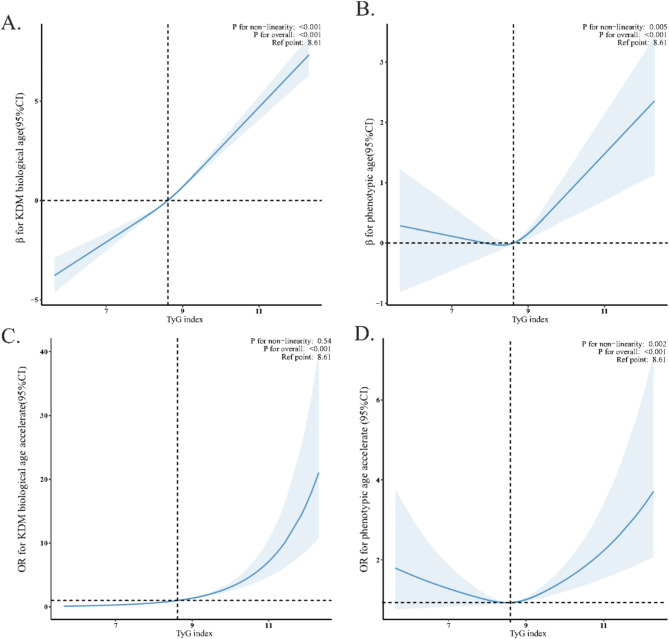
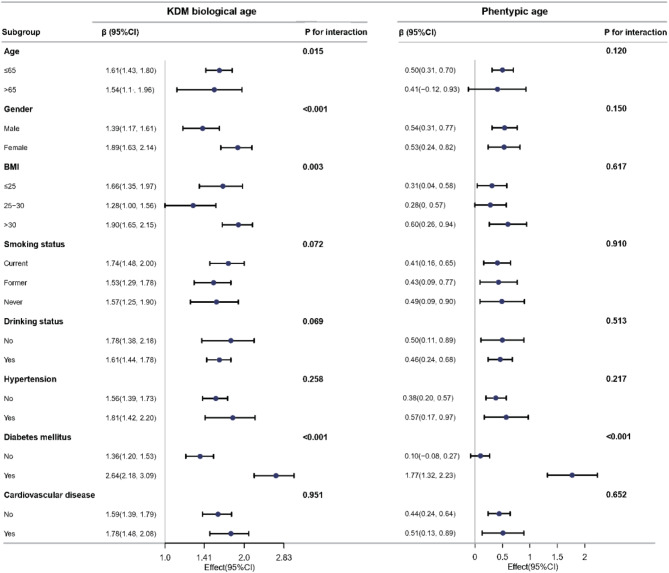
Results: We included 12,074 participants with a mean age of 46.91 years (SD, 16.64); of these, 50.25% were female and 49.75% were male. Each 1-unit increase in the TyG index was associated with a 1.64-year rise in Klemera-Doubal method (KDM) biological age and a 117% higher risk of accelerated aging. Similarly, each 1-unit increase in the TyG index corresponded to a 0.40-year increase in phenotypic age, resulting in a 15% higher risk of accelerated aging. The analysis also revealed nonlinear positive relationships between the TyG index and biological aging, particularly for KDM biological age (P for non-linearity < 0.001) and phenotypic age (P for non-linearity = 0.005), with a turning point at 8.66. Across all subgroups, the TyG index consistently showed a positive correlation with biological aging, even in the presence of significant interactions.
Conclusions: There is a significant positive association between the TyG index and biological aging. Higher TyG levels are linked to increased biological age and a greater risk of accelerated aging.
期刊介绍:
Cardiovascular Diabetology is a journal that welcomes manuscripts exploring various aspects of the relationship between diabetes, cardiovascular health, and the metabolic syndrome. We invite submissions related to clinical studies, genetic investigations, experimental research, pharmacological studies, epidemiological analyses, and molecular biology research in this field.



 京公网安备 11010802042870号
京ICP备2023020795号-1
京公网安备 11010802042870号
京ICP备2023020795号-1

 分享
分享
 求助内容:
求助内容: 应助结果提醒方式:
 扫码关注我们
