Manon Lesturgie-Talarek, Virginie Gonzalez, Alice Combier, Marion Thomas, Margaux Boisson, Lucile Poiroux, Sarah Wanono, Sophie Hecquet, Sandrine Carves, Anne Cauvet, Yannick Allanore, Jérôme Avouac
{"title":"Inflammatory and angiogenic serum profile of refractory rheumatoid arthritis.","authors":"Manon Lesturgie-Talarek, Virginie Gonzalez, Alice Combier, Marion Thomas, Margaux Boisson, Lucile Poiroux, Sarah Wanono, Sophie Hecquet, Sandrine Carves, Anne Cauvet, Yannick Allanore, Jérôme Avouac","doi":"10.1038/s41598-025-87318-8","DOIUrl":null,"url":null,"abstract":"<p><p>The objective was to pinpoint specific circulating angiogenic and inflammatory markers of refractory and active RA. We used Luminex technology to measure the concentrations of 17 RA-representative serum angiogenic and inflammatory markers in 211 RA patients categorized into three groups: refractory (failure of 2 or more targeted therapies) active (persistence of objective signs of disease activity) RA, non-refractory (failure of ≥ 1 csDMARDs or a first line of targeted therapy) active RA and non-active RA (DAS28 ≤ 3.2). Refractory and non-refractory active RA patients differed in disease duration, structural damage and the utilization of biologic therapy. The concentrations of the 17 markers failed to distinguish refractory from non-refractory RA patients. The comparison of active and non-active RA only revealed a strong increase of IL-6 concentration in active RA. Refractory active RA exhibited a limited correlation profile showing only three correlations with markers of disease activity, not significantly different from whose of non-active RA. By contrast, in non-refractory active RA patients, correlograms revealed an extensive proinflammatory and proangiogenic correlation profile with 12 markers correlating with inflammation markers or disease activity. In conclusion, no classical marker of RA emerged as specific for refractory disease in this study. Moreover, refractory and active RA patients exhibited only few correlations with disease activity markers, despite the persistence of clinical and biological signs of disease activity. This may suggest that additional molecules may be implicated in refractory disease outside those herein selected. These findings also highlight the potential limitations of serum analysis in refractory active RA.</p>","PeriodicalId":21811,"journal":{"name":"Scientific Reports","volume":"15 1","pages":"7159"},"PeriodicalIF":3.9000,"publicationDate":"2025-02-28","publicationTypes":"Journal Article","fieldsOfStudy":null,"isOpenAccess":false,"openAccessPdf":"https://www.ncbi.nlm.nih.gov/pmc/articles/PMC11870999/pdf/","citationCount":"0","resultStr":null,"platform":"Semanticscholar","paperid":null,"PeriodicalName":"Scientific Reports","FirstCategoryId":"103","ListUrlMain":"https://doi.org/10.1038/s41598-025-87318-8","RegionNum":2,"RegionCategory":"综合性期刊","ArticlePicture":[],"TitleCN":null,"AbstractTextCN":null,"PMCID":null,"EPubDate":"","PubModel":"","JCR":"Q1","JCRName":"MULTIDISCIPLINARY SCIENCES","Score":null,"Total":0}
引用次数: 0
Abstract
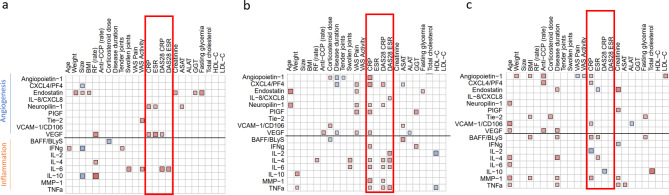
The objective was to pinpoint specific circulating angiogenic and inflammatory markers of refractory and active RA. We used Luminex technology to measure the concentrations of 17 RA-representative serum angiogenic and inflammatory markers in 211 RA patients categorized into three groups: refractory (failure of 2 or more targeted therapies) active (persistence of objective signs of disease activity) RA, non-refractory (failure of ≥ 1 csDMARDs or a first line of targeted therapy) active RA and non-active RA (DAS28 ≤ 3.2). Refractory and non-refractory active RA patients differed in disease duration, structural damage and the utilization of biologic therapy. The concentrations of the 17 markers failed to distinguish refractory from non-refractory RA patients. The comparison of active and non-active RA only revealed a strong increase of IL-6 concentration in active RA. Refractory active RA exhibited a limited correlation profile showing only three correlations with markers of disease activity, not significantly different from whose of non-active RA. By contrast, in non-refractory active RA patients, correlograms revealed an extensive proinflammatory and proangiogenic correlation profile with 12 markers correlating with inflammation markers or disease activity. In conclusion, no classical marker of RA emerged as specific for refractory disease in this study. Moreover, refractory and active RA patients exhibited only few correlations with disease activity markers, despite the persistence of clinical and biological signs of disease activity. This may suggest that additional molecules may be implicated in refractory disease outside those herein selected. These findings also highlight the potential limitations of serum analysis in refractory active RA.
目的是确定难治性和活动性 RA 的特异性循环血管生成和炎症标记物。我们使用 Luminex 技术测量了 211 名 RA 患者的 17 种 RA 代表性血清血管生成和炎症标志物的浓度,这些患者被分为三组:难治性(2 种或 2 种以上靶向疗法失败)活动性(疾病活动的客观迹象持续存在)RA、非难治性(≥ 1 种 csDMARDs 或一线靶向疗法失败)活动性 RA 和非活动性 RA(DAS28 ≤ 3.2)。难治性和非难治性活动性 RA 患者在病程、结构性损伤和使用生物疗法方面存在差异。17种标记物的浓度无法区分难治性和非难治性RA患者。活动性和非活动性RA的比较仅显示活动性RA的IL-6浓度显著增加。难治性活动性 RA 的相关性有限,只显示出与疾病活动性标志物的三项相关性,与非活动性 RA 的相关性无显著差异。相比之下,在非难治性活动性 RA 患者中,相关图显示了广泛的促炎症和促血管生成相关特征,有 12 种标记物与炎症标记物或疾病活动相关。总之,在这项研究中,没有一种经典的 RA 标记物对难治性疾病具有特异性。此外,难治性和活动性 RA 患者尽管持续存在疾病活动的临床和生物学迹象,但与疾病活动性标志物的相关性却很低。这可能表明,在本研究选择的分子之外,还有其他分子可能与难治性疾病有关。这些发现还凸显了对难治性活动性 RA 进行血清分析的潜在局限性。
期刊介绍:
We publish original research from all areas of the natural sciences, psychology, medicine and engineering. You can learn more about what we publish by browsing our specific scientific subject areas below or explore Scientific Reports by browsing all articles and collections.
Scientific Reports has a 2-year impact factor: 4.380 (2021), and is the 6th most-cited journal in the world, with more than 540,000 citations in 2020 (Clarivate Analytics, 2021).
•Engineering
Engineering covers all aspects of engineering, technology, and applied science. It plays a crucial role in the development of technologies to address some of the world''s biggest challenges, helping to save lives and improve the way we live.
•Physical sciences
Physical sciences are those academic disciplines that aim to uncover the underlying laws of nature — often written in the language of mathematics. It is a collective term for areas of study including astronomy, chemistry, materials science and physics.
•Earth and environmental sciences
Earth and environmental sciences cover all aspects of Earth and planetary science and broadly encompass solid Earth processes, surface and atmospheric dynamics, Earth system history, climate and climate change, marine and freshwater systems, and ecology. It also considers the interactions between humans and these systems.
•Biological sciences
Biological sciences encompass all the divisions of natural sciences examining various aspects of vital processes. The concept includes anatomy, physiology, cell biology, biochemistry and biophysics, and covers all organisms from microorganisms, animals to plants.
•Health sciences
The health sciences study health, disease and healthcare. This field of study aims to develop knowledge, interventions and technology for use in healthcare to improve the treatment of patients.





 京公网安备 11010802042870号
京ICP备2023020795号-1
京公网安备 11010802042870号
京ICP备2023020795号-1

 分享
分享
 求助内容:
求助内容: 应助结果提醒方式:
 扫码关注我们
