Tongyu He, Yunyun Ding, Hui Zhang, Chenguang Liu, Xiaofei Lou, Siqi Zhu, Xiaojiao Yang, Li Yang, Hongcun Bai
{"title":"Self-Healing SA@Borax Binder for In Situ Tuning of the Solid Electrolyte Interfaces for Silicon Anodes","authors":"Tongyu He, Yunyun Ding, Hui Zhang, Chenguang Liu, Xiaofei Lou, Siqi Zhu, Xiaojiao Yang, Li Yang, Hongcun Bai","doi":"10.1021/acssuschemeng.4c10154","DOIUrl":null,"url":null,"abstract":"Silicon is a promising anode material for next-generation lithium-ion batteries due to its high specific capacity of 4200 mAh g<sup>–1</sup>, environmental friendliness, and wide availability. However, its significant volume expansion during lithiation/delithiation cycles leads to issues such as material crushing, electrical isolation, delamination, and unstable solid electrolyte interface (SEI) film formation, ultimately degrading the electrochemical performance and reducing the cycle life. This study focuses on developing a sodium alginate and borax composite (SA@Borax) binder for silicon-based anodes. Sodium alginate (SA) provides deformability and self-healing properties through chain sliding and hydrogen bond recombination, while the incorporation of boron–oxygen bonds forms a robust three-dimensional network. This network enhances mechanical stability, accommodates the volume changes of silicon nanoparticles, and maintains electrode integrity during cycling. Furthermore, the SA@Borax binder efficiently regulates the SEI film composition, promoting beneficial components that stabilize the SEI film and improve the lithium-ion diffusion rates. Electrochemical tests demonstrate that the Si anode with SA@Borax binder maintains a discharge specific capacity of 1655.80 mAh g<sup>–1</sup> after 500 cycles at a current density of 0.5 A g<sup>–1</sup>, showcasing excellent long-term cycle stability. This research presents a viable strategy for developing high-performance binders for the next generation of lithium-ion batteries.","PeriodicalId":25,"journal":{"name":"ACS Sustainable Chemistry & Engineering","volume":"17 1","pages":""},"PeriodicalIF":7.3000,"publicationDate":"2025-03-03","publicationTypes":"Journal Article","fieldsOfStudy":null,"isOpenAccess":false,"openAccessPdf":"","citationCount":"0","resultStr":null,"platform":"Semanticscholar","paperid":null,"PeriodicalName":"ACS Sustainable Chemistry & Engineering","FirstCategoryId":"92","ListUrlMain":"https://doi.org/10.1021/acssuschemeng.4c10154","RegionNum":1,"RegionCategory":"化学","ArticlePicture":[],"TitleCN":null,"AbstractTextCN":null,"PMCID":null,"EPubDate":"","PubModel":"","JCR":"Q1","JCRName":"CHEMISTRY, MULTIDISCIPLINARY","Score":null,"Total":0}
引用次数: 0
Abstract
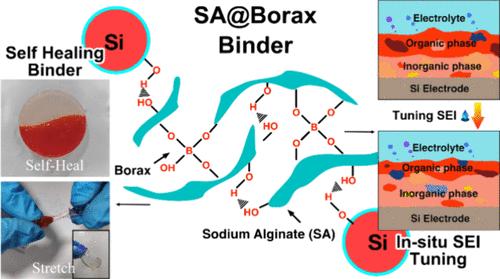
Silicon is a promising anode material for next-generation lithium-ion batteries due to its high specific capacity of 4200 mAh g–1, environmental friendliness, and wide availability. However, its significant volume expansion during lithiation/delithiation cycles leads to issues such as material crushing, electrical isolation, delamination, and unstable solid electrolyte interface (SEI) film formation, ultimately degrading the electrochemical performance and reducing the cycle life. This study focuses on developing a sodium alginate and borax composite (SA@Borax) binder for silicon-based anodes. Sodium alginate (SA) provides deformability and self-healing properties through chain sliding and hydrogen bond recombination, while the incorporation of boron–oxygen bonds forms a robust three-dimensional network. This network enhances mechanical stability, accommodates the volume changes of silicon nanoparticles, and maintains electrode integrity during cycling. Furthermore, the SA@Borax binder efficiently regulates the SEI film composition, promoting beneficial components that stabilize the SEI film and improve the lithium-ion diffusion rates. Electrochemical tests demonstrate that the Si anode with SA@Borax binder maintains a discharge specific capacity of 1655.80 mAh g–1 after 500 cycles at a current density of 0.5 A g–1, showcasing excellent long-term cycle stability. This research presents a viable strategy for developing high-performance binders for the next generation of lithium-ion batteries.
硅具有4200毫安时g-1的高比容量、环境友好性和广泛的可用性,是下一代锂离子电池极具前景的负极材料。然而,在锂化/去锂化循环过程中,其显著的体积膨胀会导致材料破碎、电隔离、分层和不稳定的固体电解质界面(SEI)膜形成等问题,最终会降低电化学性能并降低循环寿命。本研究的重点是开发一种海藻酸钠和硼砂复合材料(SA@Borax)粘结剂用于硅基阳极。海藻酸钠(SA)通过链滑动和氢键重组提供了可变形性和自愈性,而硼氧键的结合形成了坚固的三维网络。该网络增强了机械稳定性,适应硅纳米颗粒的体积变化,并在循环过程中保持电极的完整性。此外,SA@Borax粘结剂有效调节SEI膜的组成,促进稳定SEI膜和提高锂离子扩散速率的有益成分。电化学测试表明,在0.5 a g-1的电流密度下,掺有SA@Borax粘结剂的Si阳极在500次循环后仍保持1655.80 mAh g-1的放电比容量,表现出良好的长期循环稳定性。这项研究为开发下一代锂离子电池的高性能粘合剂提供了可行的策略。
期刊介绍:
ACS Sustainable Chemistry & Engineering is a prestigious weekly peer-reviewed scientific journal published by the American Chemical Society. Dedicated to advancing the principles of green chemistry and green engineering, it covers a wide array of research topics including green chemistry, green engineering, biomass, alternative energy, and life cycle assessment.
The journal welcomes submissions in various formats, including Letters, Articles, Features, and Perspectives (Reviews), that address the challenges of sustainability in the chemical enterprise and contribute to the advancement of sustainable practices. Join us in shaping the future of sustainable chemistry and engineering.




 京公网安备 11010802042870号
京ICP备2023020795号-1
京公网安备 11010802042870号
京ICP备2023020795号-1

 分享
分享
 求助内容:
求助内容: 应助结果提醒方式:
 扫码关注我们
