Sihang Liu, Zamaan Mukadam, Angus Pedersen, Jesús Barrio, Joseph Parker, Helen Tyrrell, Sarah J. Haigh, Maria Magdalena Titirici, Ifan E. L. Stephens, Georg Kastlunger
{"title":"Bridging Outer- and Inner-Sphere Electrosynthesis from Biomass-Derived Furfural Using Single Atom Catalysts","authors":"Sihang Liu, Zamaan Mukadam, Angus Pedersen, Jesús Barrio, Joseph Parker, Helen Tyrrell, Sarah J. Haigh, Maria Magdalena Titirici, Ifan E. L. Stephens, Georg Kastlunger","doi":"10.1021/acs.jpcc.5c00468","DOIUrl":null,"url":null,"abstract":"Nitrogen-doped carbon-based single-atom catalysts offer unique and tunable active sites to catalyze a wide spectrum of electrochemical processes. Despite recent progress on single-atom electrocatalysis, their potential application to upgrade biomass-derived chemicals has rarely been investigated. Herein, we carried out density-functional-theory-based screening of metal–nitrogen–carbon (MNC) single-atom catalysts for electrocatalytic furfural reduction. Using furfural’s adsorption strength as a descriptor, we identified CrNC to promote furfuryl alcohol production in contrast to other single atom motifs which are only selective to hydrofuroin. Its higher selectivity toward furfuryl alcohol can be attributed to the enhanced adsorption strength of furfural via chemisorption of the carbonyl group and its overall enhanced oxygen binding strength. We then synthesized the single-atom motifs via their incorporation in a highly porous nitrogen-doped carbon synthesized through an ionothermal templating process. In agreement with our predictions, CrNC was able to produce furfuryl alcohol with Faradaic efficiency of ca. 18%, while Co, Fe, and NiNC motifs selectively produce hydrofuroin, with limited Faradaic efficiencies to furfuryl alcohol <3%. Our work showcases a proof-of-concept for the design and optimization of single-atom catalysts to bridge the selectivity toward outer- and inner-sphere electron-transfer-based products from biomass-derived chemicals.","PeriodicalId":61,"journal":{"name":"The Journal of Physical Chemistry C","volume":"29 1","pages":""},"PeriodicalIF":3.2000,"publicationDate":"2025-03-03","publicationTypes":"Journal Article","fieldsOfStudy":null,"isOpenAccess":false,"openAccessPdf":"","citationCount":"0","resultStr":null,"platform":"Semanticscholar","paperid":null,"PeriodicalName":"The Journal of Physical Chemistry C","FirstCategoryId":"1","ListUrlMain":"https://doi.org/10.1021/acs.jpcc.5c00468","RegionNum":3,"RegionCategory":"化学","ArticlePicture":[],"TitleCN":null,"AbstractTextCN":null,"PMCID":null,"EPubDate":"","PubModel":"","JCR":"Q2","JCRName":"CHEMISTRY, PHYSICAL","Score":null,"Total":0}
引用次数: 0
Abstract
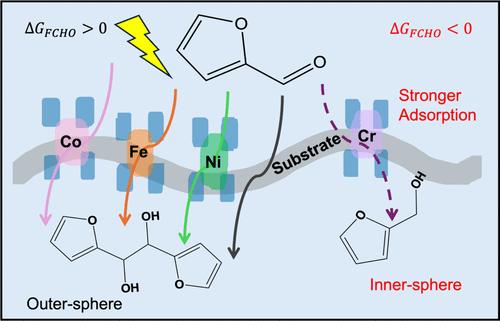
Nitrogen-doped carbon-based single-atom catalysts offer unique and tunable active sites to catalyze a wide spectrum of electrochemical processes. Despite recent progress on single-atom electrocatalysis, their potential application to upgrade biomass-derived chemicals has rarely been investigated. Herein, we carried out density-functional-theory-based screening of metal–nitrogen–carbon (MNC) single-atom catalysts for electrocatalytic furfural reduction. Using furfural’s adsorption strength as a descriptor, we identified CrNC to promote furfuryl alcohol production in contrast to other single atom motifs which are only selective to hydrofuroin. Its higher selectivity toward furfuryl alcohol can be attributed to the enhanced adsorption strength of furfural via chemisorption of the carbonyl group and its overall enhanced oxygen binding strength. We then synthesized the single-atom motifs via their incorporation in a highly porous nitrogen-doped carbon synthesized through an ionothermal templating process. In agreement with our predictions, CrNC was able to produce furfuryl alcohol with Faradaic efficiency of ca. 18%, while Co, Fe, and NiNC motifs selectively produce hydrofuroin, with limited Faradaic efficiencies to furfuryl alcohol <3%. Our work showcases a proof-of-concept for the design and optimization of single-atom catalysts to bridge the selectivity toward outer- and inner-sphere electron-transfer-based products from biomass-derived chemicals.
期刊介绍:
The Journal of Physical Chemistry A/B/C is devoted to reporting new and original experimental and theoretical basic research of interest to physical chemists, biophysical chemists, and chemical physicists.



 京公网安备 11010802042870号
京ICP备2023020795号-1
京公网安备 11010802042870号
京ICP备2023020795号-1

 分享
分享
 求助内容:
求助内容: 应助结果提醒方式:
 扫码关注我们
