Jianmei Gao, Yifan He, Fuguo Shi, Fangqin Hou, Xiaoyu Wu, Yang Yi, Yuandong Zhang, Qihai Gong
{"title":"Activation of Sirt6 by icariside Ⅱ alleviates depressive behaviors in mice with poststroke depression by modulating microbiota-gut-brain axis","authors":"Jianmei Gao, Yifan He, Fuguo Shi, Fangqin Hou, Xiaoyu Wu, Yang Yi, Yuandong Zhang, Qihai Gong","doi":"10.1016/j.jare.2025.03.002","DOIUrl":null,"url":null,"abstract":"<div><h3>Background</h3><div>Sirt6-mediated gut microbiota plays a vital role in poststroke depression (PSD). Icariside Ⅱ (ICS Ⅱ) is a naturally-occurring neuroprotectant with Sirt6 induction potency. However, it is unknown whether ICS Ⅱ protects against PSD through modulation of gut microbiota.</div></div><div><h3>Objective</h3><div>This study aimed to reveal the effect and potential mechanisms of ICS Ⅱ on PSD, and the role of the microbiota-gut-brain axis was investigated.</div></div><div><h3>Methods</h3><div>Using middle cerebral artery occlusion (MCAO) and chronic unpredictable mild stress (CUMS) to establish post-stroke depression (PSD) mice, we assessed anti-depressant effects of ICS Ⅱ <em>via</em> behavioral tests, immunohistochemistry, and western blot. Transcriptome profiling, molecular docking, and surface plasmon resonance were used to identify key targets. 16S rDNA genomic-derived taxonomic profiling and fecal microbiota transplantation (FMT) were conducted to figure out the mechanistic role of the gut microbiota and short-chain fatty acids (SCFAs).</div></div><div><h3>Results</h3><div>ICS Ⅱ ameliorated depressive-like behaviors in PSD mice as evidenced by sucrose preference test, forced swimming test and tail suspension test. ICS Ⅱ restored mitochondrial function, reduced oxidative damage and pro-inflammatory cytokines both in brain and intestine through regulation of Sirt6/NF-κB pathway. ICS Ⅱ significantly increased the abundance of gut microbiota (such as<!--> <!-->Akkermansia and Ligilactobacillus), enhanced SCFAs concentrations, repaired intestinal barrier integrity and upreglated the tight junction protein expression. FMT from ICS II-treated mice replicated these benefits, confirming gut microbiota’s role. Mechanistically, ICS Ⅱ directly bound to Sirt6 and enhanced its activity. However, ICS Ⅱ-mediated neuroprotection was neutralized in PSD mice or hydrogen peroxide-induced enteric glial cells when Sirt6 was absent.</div></div><div><h3>Conclusion</h3><div>Our findings expand the pharmacological properties of ICS II by demonstrating its ability to ameliorate PSD through modulation of the microbiota-gut-brain axis. ICS Ⅱ, as a novel Sirt6 activator, could be translated into an alternative microbiota-targeted avenue for coping with PSD.</div></div>","PeriodicalId":14952,"journal":{"name":"Journal of Advanced Research","volume":"78 ","pages":"Pages 633-645"},"PeriodicalIF":13.0000,"publicationDate":"2025-03-02","publicationTypes":"Journal Article","fieldsOfStudy":null,"isOpenAccess":false,"openAccessPdf":"","citationCount":"0","resultStr":null,"platform":"Semanticscholar","paperid":null,"PeriodicalName":"Journal of Advanced Research","FirstCategoryId":"103","ListUrlMain":"https://www.sciencedirect.com/science/article/pii/S2090123225001420","RegionNum":1,"RegionCategory":"综合性期刊","ArticlePicture":[],"TitleCN":null,"AbstractTextCN":null,"PMCID":null,"EPubDate":"","PubModel":"","JCR":"Q1","JCRName":"MULTIDISCIPLINARY SCIENCES","Score":null,"Total":0}
引用次数: 0
Abstract
Background
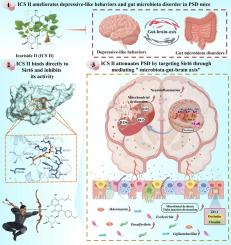
Sirt6-mediated gut microbiota plays a vital role in poststroke depression (PSD). Icariside Ⅱ (ICS Ⅱ) is a naturally-occurring neuroprotectant with Sirt6 induction potency. However, it is unknown whether ICS Ⅱ protects against PSD through modulation of gut microbiota.
Objective
This study aimed to reveal the effect and potential mechanisms of ICS Ⅱ on PSD, and the role of the microbiota-gut-brain axis was investigated.
Methods
Using middle cerebral artery occlusion (MCAO) and chronic unpredictable mild stress (CUMS) to establish post-stroke depression (PSD) mice, we assessed anti-depressant effects of ICS Ⅱ via behavioral tests, immunohistochemistry, and western blot. Transcriptome profiling, molecular docking, and surface plasmon resonance were used to identify key targets. 16S rDNA genomic-derived taxonomic profiling and fecal microbiota transplantation (FMT) were conducted to figure out the mechanistic role of the gut microbiota and short-chain fatty acids (SCFAs).
Results
ICS Ⅱ ameliorated depressive-like behaviors in PSD mice as evidenced by sucrose preference test, forced swimming test and tail suspension test. ICS Ⅱ restored mitochondrial function, reduced oxidative damage and pro-inflammatory cytokines both in brain and intestine through regulation of Sirt6/NF-κB pathway. ICS Ⅱ significantly increased the abundance of gut microbiota (such as Akkermansia and Ligilactobacillus), enhanced SCFAs concentrations, repaired intestinal barrier integrity and upreglated the tight junction protein expression. FMT from ICS II-treated mice replicated these benefits, confirming gut microbiota’s role. Mechanistically, ICS Ⅱ directly bound to Sirt6 and enhanced its activity. However, ICS Ⅱ-mediated neuroprotection was neutralized in PSD mice or hydrogen peroxide-induced enteric glial cells when Sirt6 was absent.
Conclusion
Our findings expand the pharmacological properties of ICS II by demonstrating its ability to ameliorate PSD through modulation of the microbiota-gut-brain axis. ICS Ⅱ, as a novel Sirt6 activator, could be translated into an alternative microbiota-targeted avenue for coping with PSD.
期刊介绍:
Journal of Advanced Research (J. Adv. Res.) is an applied/natural sciences, peer-reviewed journal that focuses on interdisciplinary research. The journal aims to contribute to applied research and knowledge worldwide through the publication of original and high-quality research articles in the fields of Medicine, Pharmaceutical Sciences, Dentistry, Physical Therapy, Veterinary Medicine, and Basic and Biological Sciences.
The following abstracting and indexing services cover the Journal of Advanced Research: PubMed/Medline, Essential Science Indicators, Web of Science, Scopus, PubMed Central, PubMed, Science Citation Index Expanded, Directory of Open Access Journals (DOAJ), and INSPEC.




 京公网安备 11010802042870号
京ICP备2023020795号-1
京公网安备 11010802042870号
京ICP备2023020795号-1

 分享
分享
 求助内容:
求助内容: 应助结果提醒方式:
 扫码关注我们
