Zhimin Ma , Yifan Sheng , Xiaoxue Liu , Jiayue Guo , Pengjie Wang , Fazheng Ren , Lida Wu , Yingchao Liang , Baocai Xu , Siyuan Liu
{"title":"Inhibitory effects of water-soluble hemicelluloses from corn bran with varying molecular weights on wheat starch digestibility","authors":"Zhimin Ma , Yifan Sheng , Xiaoxue Liu , Jiayue Guo , Pengjie Wang , Fazheng Ren , Lida Wu , Yingchao Liang , Baocai Xu , Siyuan Liu","doi":"10.1016/j.foodchem.2025.143649","DOIUrl":null,"url":null,"abstract":"<div><div>This study examined effects of corn bran hemicellulose (CBH) with three molecular weight levels—CBH-H (<span><math><msub><mi>M</mi><mi>w</mi></msub></math></span> = 789 × 10<sup>3</sup>), CBH-M (<span><math><msub><mi>M</mi><mi>w</mi></msub></math></span> = 15 × 10<sup>3</sup>), and CBH-L (<span><math><msub><mi>M</mi><mi>w</mi></msub></math></span> = 1 × 10<sup>3</sup>)—on wheat starch digestion and explored the underlying mechanism by investigating their interactions with starch and enzymatic activities. The results demonstrated that when heated at 100 °C and 130 °C, CBH-H exhibited the strongest inhibition on peak and setback viscosity, reducing them by 49.3 % and 44.0 %, respectively. CBH-H also inhibited retrogradation after 14 d, with its relative crystallinity decreasing the most, forming an orderly honeycomb-like structure. Fluorescence spectra revealed that CBH-H shifted emission peaks of α-amylase and amyloglucosidase, thereby reducing their activities to 71.2 % and 67.7 %, respectively. Furthermore, CBH-H showed the greatest inhibition against starch digestion <em>in vitro</em> and <em>in vivo</em>, achieving 31.1 % resistant starch content and reducing postprandial blood glucose levels by 47.5 %. These findings provide new insights into the application of CBH-H in functional starchy foods.</div></div>","PeriodicalId":318,"journal":{"name":"Food Chemistry","volume":"478 ","pages":"Article 143649"},"PeriodicalIF":9.8000,"publicationDate":"2025-03-03","publicationTypes":"Journal Article","fieldsOfStudy":null,"isOpenAccess":false,"openAccessPdf":"","citationCount":"0","resultStr":null,"platform":"Semanticscholar","paperid":null,"PeriodicalName":"Food Chemistry","FirstCategoryId":"97","ListUrlMain":"https://www.sciencedirect.com/science/article/pii/S0308814625009008","RegionNum":1,"RegionCategory":"农林科学","ArticlePicture":[],"TitleCN":null,"AbstractTextCN":null,"PMCID":null,"EPubDate":"","PubModel":"","JCR":"Q1","JCRName":"CHEMISTRY, APPLIED","Score":null,"Total":0}
引用次数: 0
Abstract
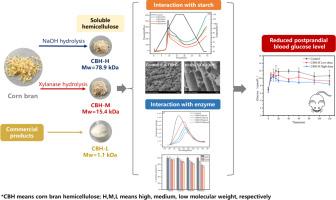
This study examined effects of corn bran hemicellulose (CBH) with three molecular weight levels—CBH-H ( = 789 × 103), CBH-M ( = 15 × 103), and CBH-L ( = 1 × 10³)—on wheat starch digestion and explored the underlying mechanism by investigating their interactions with starch and enzymatic activities. The results demonstrated that when heated at 100 °C and 130 °C, CBH-H exhibited the strongest inhibition on peak and setback viscosity, reducing them by 49.3 % and 44.0 %, respectively. CBH-H also inhibited retrogradation after 14 d, with its relative crystallinity decreasing the most, forming an orderly honeycomb-like structure. Fluorescence spectra revealed that CBH-H shifted emission peaks of α-amylase and amyloglucosidase, thereby reducing their activities to 71.2 % and 67.7 %, respectively. Furthermore, CBH-H showed the greatest inhibition against starch digestion in vitro and in vivo, achieving 31.1 % resistant starch content and reducing postprandial blood glucose levels by 47.5 %. These findings provide new insights into the application of CBH-H in functional starchy foods.
期刊介绍:
Food Chemistry publishes original research papers dealing with the advancement of the chemistry and biochemistry of foods or the analytical methods/ approach used. All papers should focus on the novelty of the research carried out.



 京公网安备 11010802042870号
京ICP备2023020795号-1
京公网安备 11010802042870号
京ICP备2023020795号-1

 分享
分享
 求助内容:
求助内容: 应助结果提醒方式:
 扫码关注我们
