Xiaozheng Jia , Xiaodong Liu , Xuan Xu , Peng Jing , Baocang Liu , Tao Bai , Jun Zhang
{"title":"A novel electrochemical recycling strategy for NdFeB swarf with minimized chemical consumption†","authors":"Xiaozheng Jia , Xiaodong Liu , Xuan Xu , Peng Jing , Baocang Liu , Tao Bai , Jun Zhang","doi":"10.1039/d4gc04519j","DOIUrl":null,"url":null,"abstract":"<div><div>This communication presents a chemical-minimized strategy for recycling NdFeB swarf using a three-chamber electrolysis cell. The NdFeB swarf was effectively dissolved in the anolyte, followed by electro-oxidation of Fe<sup>2+</sup>. By leveraging the cathodically generated NaOH, 94.56% of rare earth elements and nearly all Fe were recovered as rare earth oxides and δ-FeOOH, respectively, resulting in a significant reduction of alkali consumption by over 90%. This recycling process eliminates acid consumption and wastewater discharge with an acceptable energy consumption of 11.82 kW h kg<sup>−1</sup>.</div></div>","PeriodicalId":78,"journal":{"name":"Green Chemistry","volume":"27 10","pages":"Pages 2672-2679"},"PeriodicalIF":9.2000,"publicationDate":"2025-02-05","publicationTypes":"Journal Article","fieldsOfStudy":null,"isOpenAccess":false,"openAccessPdf":"","citationCount":"0","resultStr":null,"platform":"Semanticscholar","paperid":null,"PeriodicalName":"Green Chemistry","FirstCategoryId":"92","ListUrlMain":"https://www.sciencedirect.com/org/science/article/pii/S1463926225001013","RegionNum":1,"RegionCategory":"化学","ArticlePicture":[],"TitleCN":null,"AbstractTextCN":null,"PMCID":null,"EPubDate":"","PubModel":"","JCR":"Q1","JCRName":"CHEMISTRY, MULTIDISCIPLINARY","Score":null,"Total":0}
引用次数: 0
Abstract
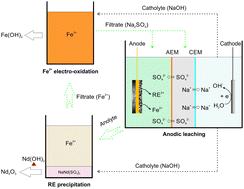
This communication presents a chemical-minimized strategy for recycling NdFeB swarf using a three-chamber electrolysis cell. The NdFeB swarf was effectively dissolved in the anolyte, followed by electro-oxidation of Fe2+. By leveraging the cathodically generated NaOH, 94.56% of rare earth elements and nearly all Fe were recovered as rare earth oxides and δ-FeOOH, respectively, resulting in a significant reduction of alkali consumption by over 90%. This recycling process eliminates acid consumption and wastewater discharge with an acceptable energy consumption of 11.82 kW h kg−1.
本文提出了一种利用三腔电解池回收钕铁硼金属渣的化学最小化策略。钕铁硼薄片有效溶解在阳极液中,然后电氧化Fe2+。利用阴极生成的NaOH, 94.56%的稀土元素和几乎所有的铁分别以稀土氧化物和δ-FeOOH的形式被回收,碱耗显著降低90%以上。该回收过程消除了酸消耗和废水排放,可接受的能耗为11.82 kW h kg−1。
期刊介绍:
Green Chemistry is a journal that provides a unique forum for the publication of innovative research on the development of alternative green and sustainable technologies. The scope of Green Chemistry is based on the definition proposed by Anastas and Warner (Green Chemistry: Theory and Practice, P T Anastas and J C Warner, Oxford University Press, Oxford, 1998), which defines green chemistry as the utilisation of a set of principles that reduces or eliminates the use or generation of hazardous substances in the design, manufacture and application of chemical products. Green Chemistry aims to reduce the environmental impact of the chemical enterprise by developing a technology base that is inherently non-toxic to living things and the environment. The journal welcomes submissions on all aspects of research relating to this endeavor and publishes original and significant cutting-edge research that is likely to be of wide general appeal. For a work to be published, it must present a significant advance in green chemistry, including a comparison with existing methods and a demonstration of advantages over those methods.



 京公网安备 11010802042870号
京ICP备2023020795号-1
京公网安备 11010802042870号
京ICP备2023020795号-1

 分享
分享
 求助内容:
求助内容: 应助结果提醒方式:
 扫码关注我们
